Pioneer, Apprentice, Perfectionist
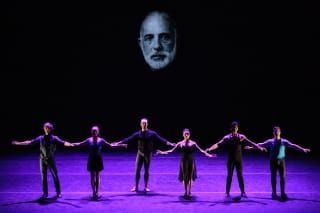
DEMO: Jerome Robbins – American Dance Genius
Terrace Theater
The John F. Kennedy Center for the Performing Arts
Washington, DC
October 20, 2017
The centennial of Jerome Robbins’ birth in 2018 will spur big celebrations. This first one, part of Damian Woetzel’s Demo series, was small in scale and simple in format. Oddly, it suited the ballet choreographer and director of musicals, movies and television productions who had started as an American character dancer and became a complex individual. Seven dancers, active or retired, took to the Terrace Theater’s modest stage to deliver bits and pieces of the Robbins opus. These “pas” were dissected and discussed. Most members of the cast were current or former New York City Ballet dancers – Tyler Angle, Tiler Peck, Unity Phelan, Amar Ramasar, Daniel Ulbricht and Heather Watts – with Woetzel doing more than just being the program’s moderator. Trim and suave, he danced a little as Robbins’ hesitantly eager “Faun” and in ballroom turns around the floor from the “Shall We Dance?” number of “The King and I” musical. Woetzel’s ballroom partner, who had come up to the stage from the audience, was Julie Kent - a ballerina emerita of American Ballet Theatre and current director of The Washington Ballet. Robbins had begun dancing and choreographing for (American) Ballet Theatre, and later performed with and co-directed New York City Ballet.
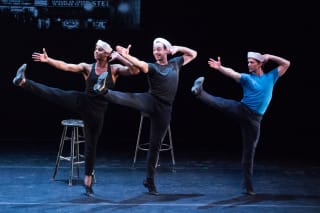
Robbins (1918 –1998) insisted that dancers give the movement he devised just the right emphases, and so did Woetzel, with Watts’s help, during the course of this demon- stration. In excerpts from the early (1944) “Fancy Free” we saw three sailors (Angle, Ramasar, Ulbricht) release and expand from contracted crouching to relaxed stretching, doing so with more and then less resistance. Exceptionally, however, the turning that turns up isn’t done colloquially but with classical control and bravura multiplicity. Again, in “Interplay” (1945), Ulbricht showed an expansive Robbins male. Are any other choreographer’s examples of Americana ballet as persuasive?
If the program’s start was dominated by men in motion and Robbins’ knack for making dance seem a street activity, there came to be more reliance on formality. As time went on, older music of the academic mold interested the maturing Robbins - particularly Chopin’s pianistic compositions. After a sample from Robbins’ experiment in “silence” (the 1959 “Moves”) was shown by Phelan and Ramamsar, Peck was proudly authoritative in fragments from “Three Chopin Dances”, “Other Dances” and “Dances at a Gathering”. She was partnered by Angle, Ulbricht and again Angle – who was at his most harmonious.
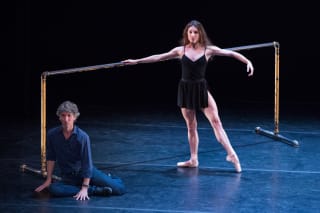
Seeing these Robbins splinters reaffirmed his varied use of motion, but also showed how important stopping and stillness were in his choreo- graphy. The commentary by Woetzel, Watts and the dancers was supplemented by historic photo slides and video clips of performances and rehearsals. Yes, at work Jerome Robbins could be relentlessly exacting and bossy, especially when his view of how Americans move was at stake. Yet he could also be the attentive student with his elders – choreographers he admired such as Antony Tudor and George Balanchine. Socially, when he wanted to be, Robbins could be utterly charming and entertaining. I’ll always remember him in that mood at a 1960s party in critic Edwin Denby’s Chelsea loft. If Robbins had not been harsh in rehearsal, would the choreography look so fresh today?
Pianist for the program was Kurt Crowley, and Kate Davis sang to a couple of the numbers.
copyright © 2017 by George Jackson