Petipa Laughs
"Alexei Ratmansky's Harlequinade"
Studio 5
New York City Center
New York, NY
January 22, 2018.
<br>
City Center's Studio 5 presentations, like the Guggenheim's Works & Process series, offer glimpses into the creative process, but the City Center's are held in a working studio, with the audience forming a U-shape around the speakers, which gives a casual, immediate air to the presentations. The most recent featured the Russian choreographer Alexei Ratmansky and ABT Director Kevin McKenzie discussing the upcoming production of Ratmansky's reconstruction of Marius Petipa's 1900 two act comedy "Harlequinade", which was based on the traditional commedia dell'arte characters. It tells the story of Columbine,a young girl who defies her father's choice of a rich suitor in favor of a poor but charming young man, Harlequin, who in this case, happens to end up with money too.
McKenzie began by asking Ratmansky why he wanted to revive the ballet. Ratmansky replied that though it is a lesser known work of the 50+ Petipa created, a fairly complete version exists in the Stepanov notations now at Harvard ("a treasure"). It was originally choreographed for the Hermitage Theatre, a family venue, though the family was the Russian Tsar's. The Tsar liked it so much, it was moved to the Mariinsky, where it was danced for a number of years with various casts. Like so many of Petipa's works, it had a rocky Soviet history, though photographs show that it was performed in a one-act version in the 1930s. This version was revived in the 1970s for the Maly Theatre by Pyotr Gusev who used memories of older dancers to produce his version; Ratmansky said that the notations show that little of Petipa's choreography was retained. Balanchine's version too, though he followed the libretto closely ("a model of comic ballet"), has only wisps of Petipa.
Ratmansky also gave a brief but fascinating history of the ballet notations at Harvard. Vladimir Stepanov was a corps dancer at the Mariinsky who developed a system of notating dance in the 1890s. Even though Petipa objects (he didn't like skeletons, he said, according to Ratmansky) the Mariinsky decided to notate his ballets and to teach the system in its school. Ratmansky showed a page of the notations he worked from to decipher Columbine's act one solo; these were made during rehearsals by several people, including students, and the quality varies -- there are clearly some cross outs as the notator went "oops". He also found a more complete version of the solo in a box for a different ballet (he explained that he went through the complete collection). The more detailed version was choreographed for Olga Preobrajenska, not the original Columbine, Matilde Kschessinskaya. Ratmansky explained that Petipa was perfectly happy to re-choreograph solos to feature a dancer's strengths, which does make it difficult to determine what is "original". Preobrajenska had extremely strong feet and her version had a number of hops on point with the working leg at 90° followed by a phrase on the same leg. ABT soloist Cassandra Ternary danced that variation to collective gasps. Ratmansky said the less complete notation showed the dancer changing legs and that is the one he will probably use.
Ratmansky also discussed other sources of information, including old photographs which sometimes provide clues. He showed a photograph of a lovely backhanded lift for Pierrot and Pierrette (two servants who play an active role in the story) which was not in the notation, but which he will use. And even now, there is a historical memory, as he was told by an older dancer that she remembers a French ballet master telling her that when he studied with Preobrajenska she showed him how Harlequin slapped the stage with his golden stick, a move that ABT principal Jeffrey Cirio demonstrated with gusto. Ratmansky also talked abut Petipa's choreography for the corps, saying he loves Petipa's mathematical imagination, and though ABT does not have as large a corps as Petipa's Mariinsky, he worked out a compromise and said he was thrilled at the first rehearsal to see the kaleidoscopic patterns emerge.
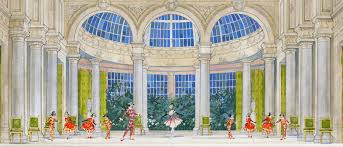
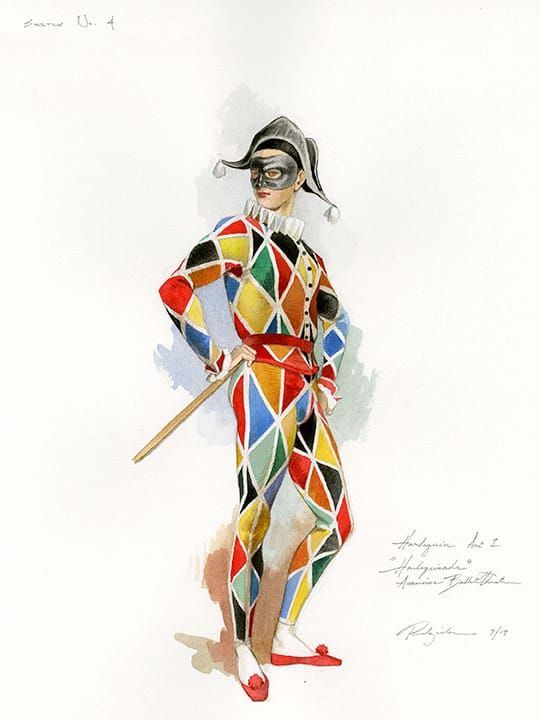
The choreography of course doesn't occur in a vacuum and he and designer Robert Perdziola decided (after much discussion) to use the original set and costume designs, which were well documented in the Mariinsky archives. The original costumes were designed by Ivan Vsevolozhsky, the director of the Imperial Theatre and a moving force behind the flowering of the Russian ballet in the late nineteenth century. In answer to a question, Ratmansky said that yes, the costumes would include the traditional wigs, though they will be slightly modernized (the question of corsets didn't come up, but they are surely not in the offing). The presentation was an eye-opening and tantalizing glimpse of the ballet and of the complicated and selfless process of recreating it.
Copyright © 2018 by Mary Cargill



