Pertinency to the Present
"Shoot the Moon", "The Statement", "Singulière Odyssée"
Nederlands Dans Theater
Opera House
The John F. Kennedy Center for the Performing Arts
Washington, DC
April 5, 2018
This past Thursday, the Nederlands Dans Theater offered a thrilling program, delivering a riveting intensity to the Kennedy Center stage. In three ballets, Paul Lightfoot and Sol Léon, as Artistic Director and Advisor respectively, presented lively, modern stories and showcased a performance full of current relevance and intrigue. Since 1959, NDT has been leading the way in Europe, establishing a reputation for stunning technicality and a distinct contemporary aesthetic. Now almost sixty years later, the Dutch company lived up to its international prestige with a breathtaking performance in the nation’s capitol.
An element of all three ballets that really set this performance apart was the installation and utilization of set design. In “Shoot the Moon”, a rotating set broken up into three separate rooms encapsulated love stories illustrated by the relationships of five dancers. Every time the set turned, new dancers and relationships were revealed, motivating the plot to progress, and symbolizing the passage of time. All the while, through innovative choreography, dancers employed the set as an additional partner, leaning against the scenery for support and pushing off the walls for auxiliary momentum in swift lifts and rapid inversions.
The ballet incorporated other mediums including lighting and live film in order to reveal additional performances hidden behind the walls of the set. Although the movement itself was abstract in quality, the intense focus that the dancers brought to their performance made the emotional connection concrete. They were exceptionally technical — practically inhuman in clarity — with a wealth of expression conveyed through the upper body. The piece included a manipulative duet in which Myrthe van Opstal’s contorted body served as a metaphor for her trapped emotional state, and a love triangle in which guilt and betrayal were portrayed: both through Sarah Reynolds and César Faria Fernandes’ shriveling, shaking gestures hinting at internal conflict, and Sebastian Haynes’ accusatory pointing, his vocalization of breath a startling form of punctuation. All the dancers, regardless of their role, seemed to hold a unique power over their environment in which they took complete control of surrounding forces and bent them to their will. Their isolations served as a crippling energy, causing a rippling effect throughout the atmosphere of the opera house. Their dancing was truly larger than life.
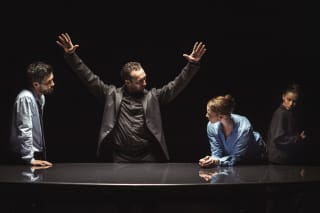
The setting of “The Statement” was a tense conference room where an ominous obsidian table dominated center stage. An equally mysterious fixture loomed above the dancers surrounding the table, casting a feeling of fated doom upon the performers. Unlike the other two ballets, choreographed by Lightfoot and Leòn, this piece was created by Crystal Pite, who made a risky yet intriguing choice by composing movement directly to dialogue. The dance was set to a soundscape by Owen Belton, which incorporated the voices of four vocal performers, heatedly arguing about their organization’s role in escalating and profiteering off violence in some unnamed foreign conflict. Each dancer epitomized a voice — matching an utterance’s stuttering, halting line with their own ticking, abrupt motion — syllable for syllable. Individually, the four performers emitted differing tones in order to conform to their assigned characters. Chloé Albert in particular brought an aura of feminine potency, exuding the supremacy and duplicity of the anonymous corporate forces referred to as the ‘Upstairs.’ As the ballet intensified, lighting played a significant role in carving the stage into separate spaces, showing the splintering effect that conflict creates. The ending of the piece was especially powerful, where the overhanging fixture descended downward, appearing to crush Spencer Dickhaus as his own guilt corrupted his psyche and the ‘Upstairs’ turned to him for blame.
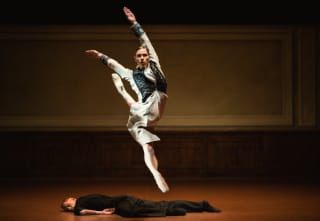
In “Singulère Odyssée”, the dancers of NDT seemed to defy time and gravity to present a ballet that emphasized the individualism that emerges from a world preoccupied by constant motion. Since the dancers had already proved themselves as masterful movers, what really stood out in Lightfoot and Leòn’s vision were the moments of picturesque stillness that permeated the composition as a welcome relief from the whirlwind of sustained mobility. Marne van Opstal notably spent vast portions of the piece immobile, watching as his fellow company members passed him by in stunning feats of technical agility. The ballet was set in Basel, Europe’s busiest railroad station for international travel. Multiple points of entry and exit within the set itself were handily used in order to allude to the busy come and go attitude of the Swiss terminal. Max Ritcher’s score — played by the Kennedy Center Opera House Orchestra, directed by Philippe Auguin — was light and airy, teetering along with the dancers as they came and went. Over time, the music slowly built up to a climax in conjunction with a fleeting instant of unison movement by the whole cast, weaving in and out of one another in a kaleidoscope of bodies. In the end, the ballet reverted back to how it started: a young woman sitting as still as a statue, looking out across the station, as if no time had passed at all.
Whether it be exploitation and infidelity in a relationship, a question of corporate morality, or the propensity for time to easily pass us by, the Nederlands Dance Theater is able to conquer a barrage of issues which influence the present and will most likely have a remarkable impact on the future. Their ingenuity both in content and set design inspires a fascinating program and begs the question: what pertinent topic do they plan to tackle next?
copyright © 2018 by Arielle Ostry



