Pearls, White and Pink
Pearls, White and Pink
"Apollo", "Ballo della Regina", "Tschaikovsky Pas de Deux", "Chaconne"
New York City Ballet
David H. Koch Theater
Lincoln Center
New York, New York
April 25, 2025
The trend of City Ballet’s marketing department naming programs with poetically descriptive titles seems to have slightly run out of steam, and this program was named somewhat prosaically All Balanchine I. There were, though, hints of a theme, as the pearl in the original “Ballo della Regina” could be seen echoed in the luminous white of “Apollo” and in the iridescent costumes of the other three works. And much of the dancing had a pearly glow, though one other recent innovation, the “see the music” lectures before a ballet, did dim the gleam somewhat. Verdi’s “Ballo della Regina” music is accessible, bouncy, and melodic, and did not need extended explication that ran longer than the actual ballet; the somewhat restive audience wanted to see the ballet and hear the music.
There was much to see and hear in the opening ballet. “Apollo” has had many changes in its nearly 100 year existence, though the current all-white, stripped down (no birth scene, no staircase) version has an established NYCB history. It is bracing in its purity, though the older, more Expressionistic version does have an interesting gritty vigor.
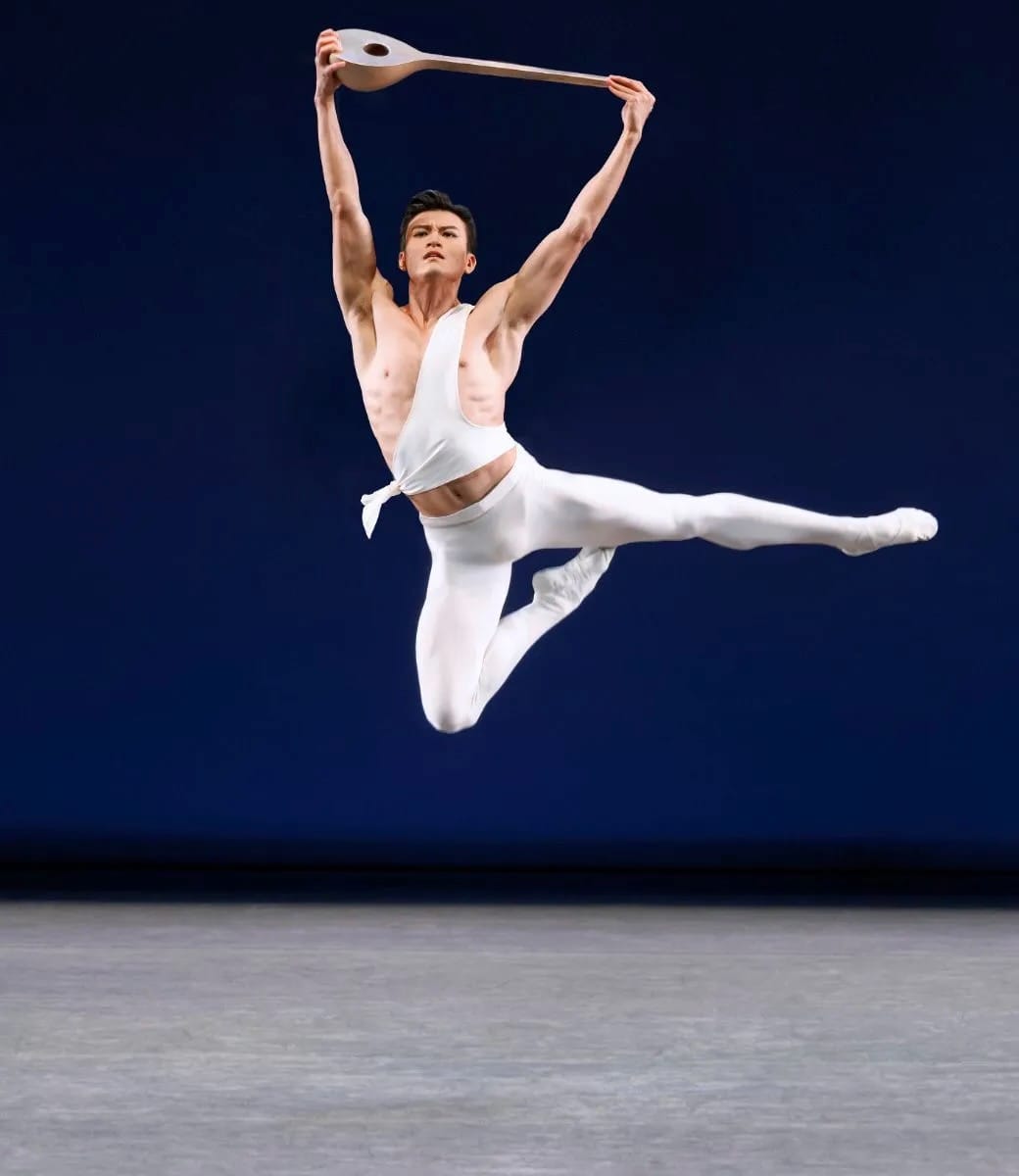
Chun Wai Chan did provide a great deal of vigor in his focused, determined approach. His opening arm swings were powerful and concentrated and he was an authoritative, if still slightly raw god. Chan had a thoughtful, deliberate reaction to the muses, handing out his gifts after carefully watching them. He had the tall muse cast (Mira Nadon as Terpsichore, Miriam Miller as Calliope, and Emily Kikta as Polyhymnia—reversed in the program, though the NYCB Instagram account has the correct names), and they were certainly worth watching. Miller and Kikta expanded their long, elegant legs with a jazzy nonchalance, and were especially bracing in their little dance together. Nadon, too, has an elegant set of legs, and her Terpsichore had an alabaster glow, with smooth, confident jumps; she seemed to be dancing only for Apollo, variously leading him, comforting him, and laughing with him.
Chan’s second solo had a powerful, sculptural approach, as he seemed embody both Atlas, supporting the glove and Charles Atlas, lifting the muses. His soccer kicks could have been a bit more fierce and free and he did struggle a bit with his pirouette descent, but the call to Olympus had a magnificent grounded majesty.
When it finally started “Ballo della Regina”, led by Megan Fairchild in her final performance of the unnamed dynamo of a heroine, and the young and phenomenal David Gabriel, had an effervescent if speedy majesty—it did seem at times that the conductor was making up for lost time. Fairchild seemed to float delicately through the innumerable hops on point, a butterfly with ankles of steel. Her upper body was relaxed and expansive and her expression warm and serene. It was an astounding performance from anyone, much less a dancer on the verge of retirement.
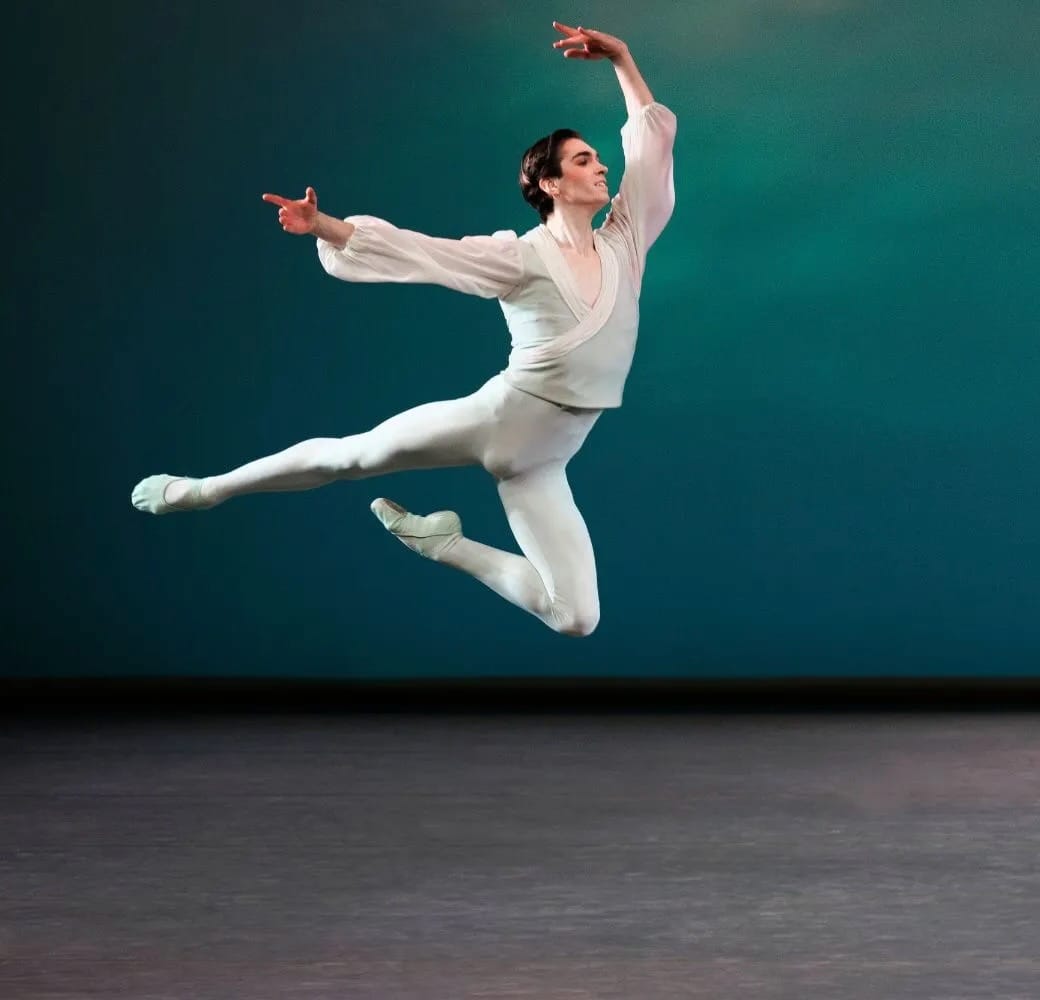
Gabriel joined NYCB in May 2022 and has, one hopes, a long way to go before retiring, but he danced like a seasoned pro. His jumps were effervescent, seeming to soar up in the air while he rearranged his feet, and then float down in a perfect landing to toss off some elegant petit batterie. His performance, though, was more than a technical tour de force, he brought a poetic lyricism to the quiet opening, as he walked on alone, one of Balanchine’s melancholy seekers. The four soloists, Sara Adams, Ashley Hod, Baily Jones, and Olivia MacKinnon, were pushed so elegantly by the elegant music, and Hod, in the third jumping solo, was especially eager.
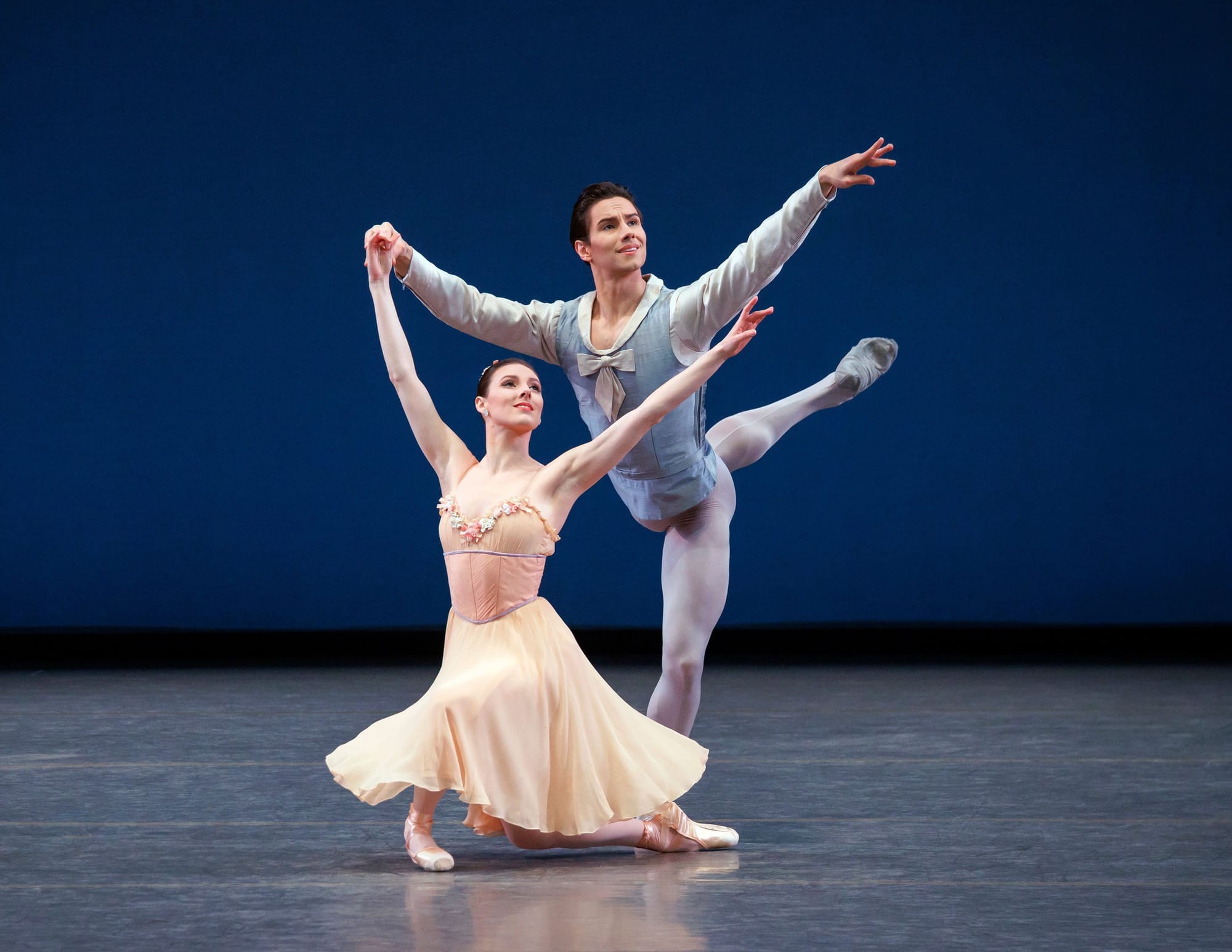
Tiler Peck and Roman Mejia were also a very elegant and eager couple in “Tschaikovsky Pas de Deux”, and deserved their extra curtain calls. Peck has polished her role to a burnished sheen and danced with a brilliant clarity and musical flair. I did miss the sense of spontaneity that can make the solo feel like an unexpected drink of champagne, and at times her musical accents felt a bit over planned, as she can so very pointedly hold up the music with a very obvious rubato, but the pure beauty of her dancing is exhilarating.
So too is Mejia’s powerful extravagance as he moved from serene balances to explosive cabrioles and innumerable and impeccably controlled turns a la seconde while bringing his hand to his hip with a flair that Basilio would relish. He appeared to revel in the joy he was giving the audience as it gasped in astonishment and roared with approval.
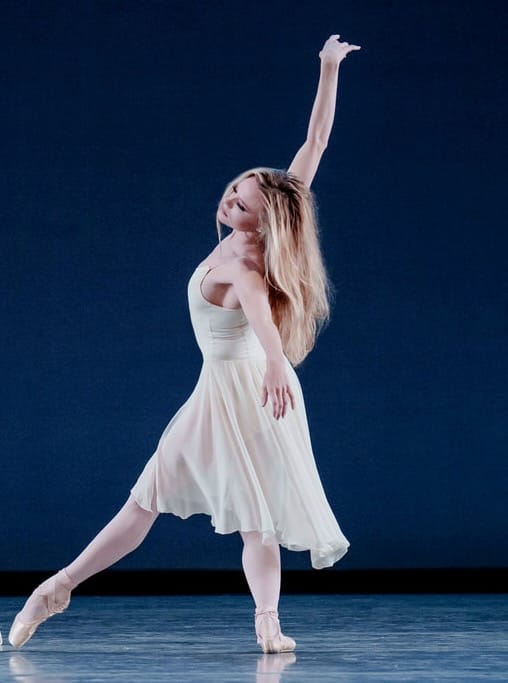
There is little roaring in Balanchine’s mysterious “Chaconne”, a formal excursion into the moods of music from Gluck’s 18th-century opera “Orphée an Euridice”. Sara Mearns and Tyler Angle in the roles originally danced by Suzanne Farrell and Peter Martins were the lead couple. Means walked slowly through the quiet, dimly lit opening which may echo the Underworld where Euridice dwelt. Most dancers give the opening a ghostly quality but Mearns, with her unique dramatic presence, gave the unnamed woman a palpable air of suffering, a feeling that remained even when partnered by the always stalwart Angle. It was a gripping opening.
The more radiant second part, however, was less successful, as she lacked much of the crisp, sharp wit and incisive footwork needed and some of her dancing was a bit shapeless. Rather like a conversation, the two dancers alternate solos while the non-dancing partner stands on the side, watching, listening, and reacting. Means tended to relax and, at times, seem to withdraw, an unfortunate and very unusual lapse for someone who usually has a powerful and imaginative dramatic presence. She missed some very fine dancing from Angle, whose quick batterie and generous demeanor were well worth watching.
© 2025 Mary Cargill



