Past Perfect
"Soiree Musicale", "Capriol Suite", "Three Virgins and a Devil", "Suite from Mazurkas"
New York Theatre Ballet
Florence Gould Hall
New York, NY
April 23, 2010
The New York Theatre Ballet is the small group affiliated with the school founded by the famous Cecchetti teacher Margaret Craske, and it gives regular performances of chamber ballets, works which would be lost on larger stages. Though the company performs new works, it is best known for its scrupulous and honorable revivals of earlier masterpieces, with live piano (played by Mariko Miyazadi and Ferdy Tumakaka), a rarity in this age of tape. The combination of the British greats, Tudor and Ashton, seasoned with a fine comedy by Agnes de Mille and a rare Limon made for a wonderful program. Antony Tudor's "Soiree Musicale", choreographed in 1938, was originally intended as a demonstration of Cecchetti technique. It is a bundle of charming dances, a group of nineteenth century lithographs brought to life. The nine dancers (six women and three men) perform lighthearted, but gloriously musical, stylized folk dances, so evocative of the Romantic period. There is even a slyph, the charming Young Wha Lim, full of little grace notes, a Spanish gypsy number, and an infectious tarantella, with Rie Ogura and Steven Melendez as the happy couple.
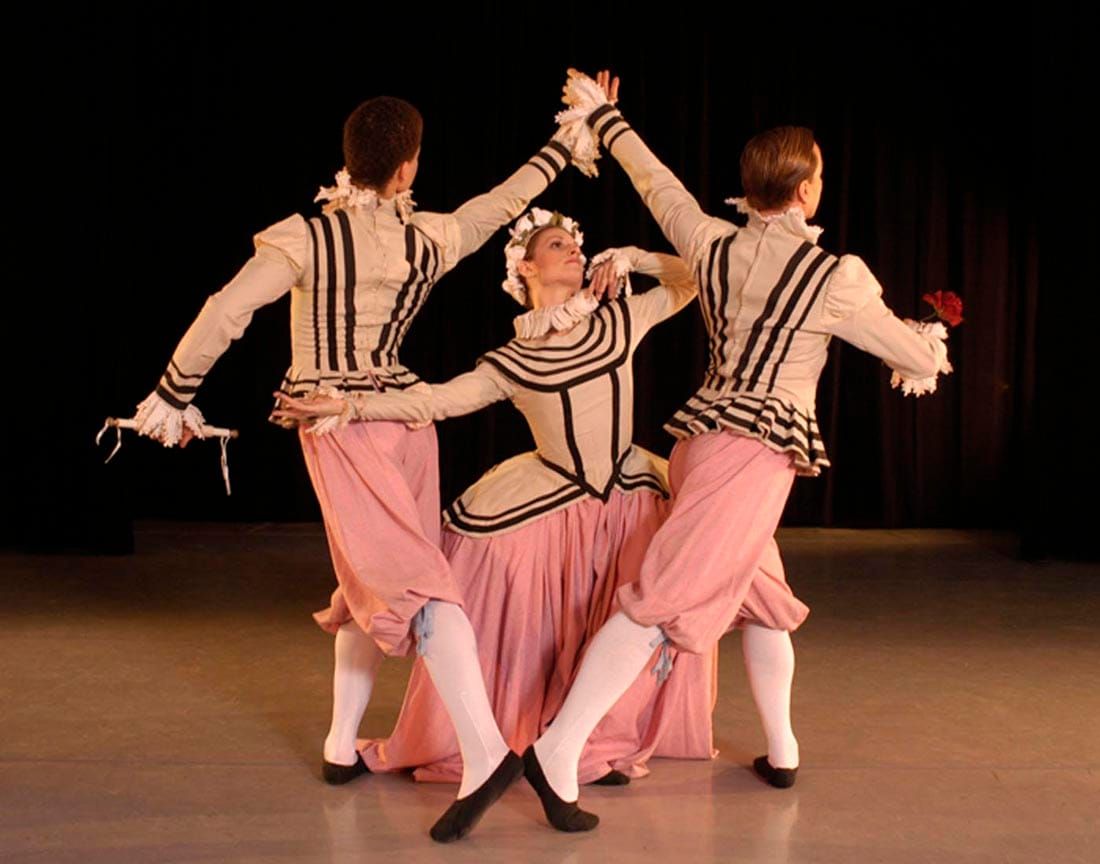
Frederick Ashton's "Capriol Suite", from 1930, is another evocative set of dances, a salute to the Elizabethan era. This was Ashton's first ballet (he had previously created some dances for musicals), and there are glorious portents of greatness to come. The stylized peasants, with their intertwined scarves, are surely cousins to the frolicking dancers of "La Fille Mal Gardee". There is a profound and delicate musicality; at one point two couples dance, sometimes merging their steps, and sometimes dancing separately to the same music, so that there is a glorious asymmetry. The mysterious heart of the ballet is a pas de trois with Amanda Garrett, Steven Melendez and Stephen Campanella, where one man presents the lady with a rose and the other a scroll. There is no explicit story, just a mood devised by a magician.
Agnes de Mille's "Three Virgins and a Devil" is another Renaissance excursion, a dance based on a comic story by Boccaccio of an energetic little devil tempting three women to follow him, playing on their various vanities (greed, lust, and piety). One follows him for jewelry, one to catch a passing man, and finally the pious one runs after him in the vain belief that she can convert him. It is a charming character study, and great fun; Mitchell Kilby as the clever little devil threw a delightful tantrum.
Jose Limon's 1958 "Suite from Mazurkas" is a set of dances to Chopin. His company had been on a somewhat unsuccessful European tour (as the informative after-the-show talk explained), which included Poland, where the company was much more popular. They had been given a piano concert in Chopin's house, and this work was an homage to that country. It features a group of dancers dancing stylized mazurkas in solos, twos, threes, and finally together, led by a single man (Steven Melendez) who has an introspective, haunting solo, where he reverently touches the ground. Any similarity to Robbins' 1969 "Dances at a Gathering" is presumably intentional. Robbins created a great ballet, but the Limon work is full of beauties. The Nile may be deeper and wider as it flows, but there is something majestic, I am sure, about standing at its source, and the New York Theatre Ballet has given us a number of sources.
copyright © 2010 by Mary Cargill



