Paging Miss de Mille
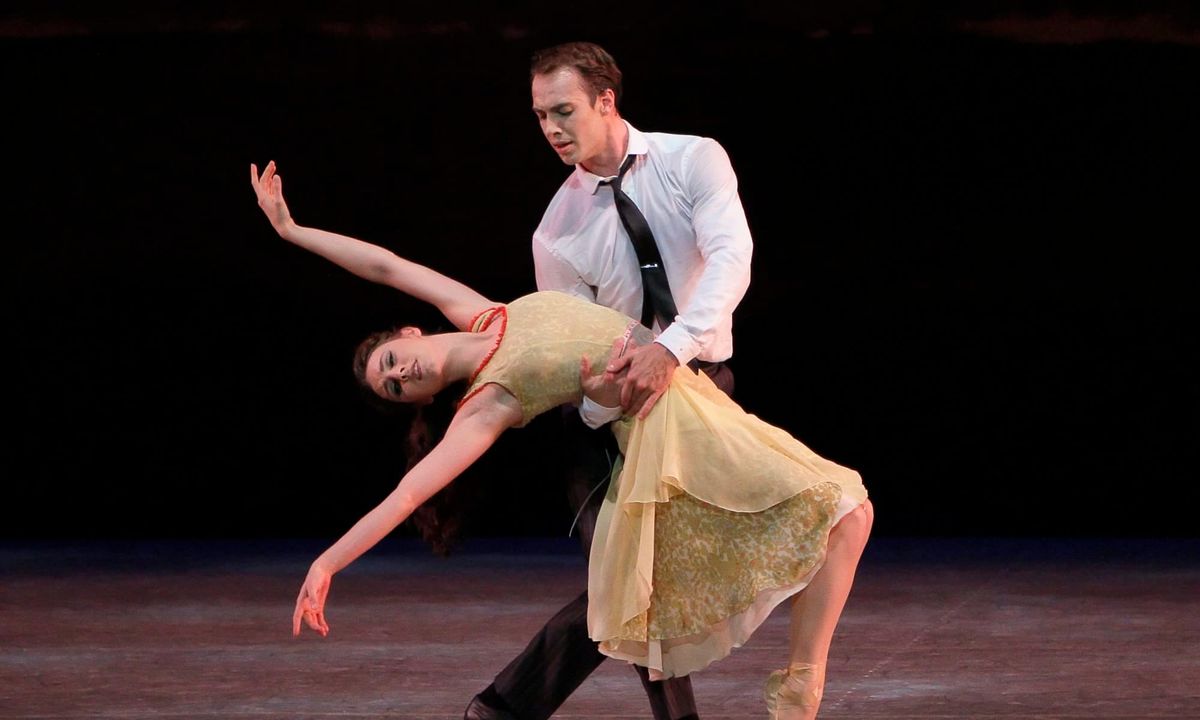
"Dances Concertantes", "Estancia", Brahms-Schoenberg Quartet"
New York City Ballet
David H. Koch Theater
New York, NY
May 29, 2010
Christopher Wheeldon's new ballet "Estancia" is based on an old score and its original story. The flavorful music, by Alberto Ginastera, was commissioned by Lincoln Kirstein for Balanchine in 1941 when America Ballet Caravan was visiting Argentina , but, since the company was disbanded, Balanchine passed up the opportunity. It is hard to imagine what he would have made of the story of a city boy visiting a ranch on the Pampas, falling for a local girl and finally getting her once he had tamed a wild horse. This is de Mille territory but Wheeldon saddled up to it. As part of the Architecture of Dance, it has scenery by Santiago Calatrava, quite lovely scenery, but the lush palms in the background don't square with the detailed synopsis' description of the Pampas as desolate grasslands.
Unfortunately, Wheeldon's choreography doesn't square up with much either. He tends to take situations literally, and doesn't, or can't, use choreography poetically. (This was the case in an earlier ballet based on Oscar Wilde's "The Rose and the Nightingale"; Wilde clearly meant his story to be symbolic, but Wheeldon spent a lot of effort getting his dancers to form a literal rose, where a more imaginative choreographer would have formed the perfume.) The story is simple (even simple-minded), but without the copious notes, would not have been clear. The city boy (Tyler Angle) dances some slightly awkward steps, but there is none of the restless yearning the libretto indicates, just a lot of acrobatic fidgeting. The girl (Tiler Peck) also gets a lot of fidgeting, and they manage to meet cute, when he trips over her rope.
There is a great deal made of the wild horses the locals spend time capturing, but Wheeldon can only imagine them as dancers dressed up in horsey suits, complete with tossing tails and funny hats. Since both the girl and the boy must capture and tame one of them before they can come to an understanding, it seems obvious that they symbolize something wild and free in each of their natures which must be controlled. But none of this comes through the excessively literal choreography. The horses, in fact, get to wrap their legs around the energetic gauchos, a somewhat queasy sight, given that the Pampas are described as something that "insinuates itself in people's entrails." The final pas de deux, under a lovely starlight effect, is ersatz MacMillan, complete with Peck's fishtail legs, so familiar from MacMillan's "Romeo and Juliet", and the finale, with colored scarves, is similar to Frederick Ashton's much more musically sensitive "Daphnis and Chole" finale.
There is nothing wrong with using other choreographer's ideas--Balanchine of course reworked Petipa's vision scenes many times. But Balanchine's vision scenes give the impression of being choreographed by a giant standing on the same mountain Petipa climbed and describing the view with the sun at a different angle. Much of the current derivative choreography gives the feeling of someone routing around in the valley, gnawing on an old bone under the impression it is steak.
There was real steak in Balanchine's "Dances Concertantes", with its colorful costumes and atmospheric set, both by Eugene Berman. It is set in an imaginary theater, and gives the impression of a number of Harlequins and Columbines relaxing at home. Sterling Hyltin and Gonzalo Garcia were the leads; she was sparkling and clear, though her upper body is a little flat, which makes her dancing a bit stringy. Garcia was fluid, and caught the right balance between playing to the audience and just dancing. The four pas de trois were wonderfully faceted.
Balanchine's' "Brahms-Schoenberg Quartet" gives the impression of four distinct short stories, somewhat related, but each with its own private drama. Jennie Somogyi stood out as the lead in the first movement, floating through like a memory of someone lost. She has an uncanny ability to dance as if the stage didn't exist, as if she is seeing her own private world. Sebantian Marcovici, unfortunately, didn't provide much support.
Jenifer Ringer and Jared Angle danced the smokey, mysterious Intermezzo in one long stream, though there was one of the three fate figures who thought is was appropriate to grin through the whole thing. Benjamin Millepied was attentive in the slightly martial Andante (it always seems to me to be a dance with The Girl He Must Leave Behind); Yvonne Borree was fragile and delicate. The gypsy-inflected Rondo featured Maria Kowroski and Charles Askegard. Kowroski is a somewhat insecure turner, and seemed to overcompensate with slightly mannered arms, but when she could just let go and hurl her legs around she looked gorgeous. Askegard has always been a very solid turner, and looked like he was having fun--the audience, under the spell of that luscious music, certainly was.
copyright © 2010 by Mary Cargill