One for the Ages
"Concerto Barocco", "La Valse", "The Four Temperaments"
New York City Ballet
David H. Koch Theater
New York, NY
May 9, 2009
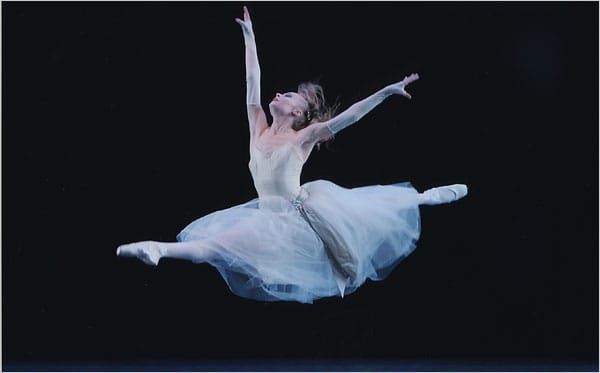
The program, and indeed, possibly this season and several to come, was dominated by Janie Taylor's haunted and haunting performance as the doomed heroine in Balanchine's surrealistic "La Valse". This was beyond dancing, almost beyond theater--the stage seemed to disappear as the audience itself was absorbed, with the other dancers on the stage, in watching, in awe and horror, this young girl's absolute willed self-destruction. There was nothing sympathetic or soft about her performance, it was almost triumphant in its destructive power, in its display of a will so in control that it could preside over its own demise. Though Taylor's unearthly pallor and her mass of golden hair help to create a creature not quite of this world, her performance was more than physical. Every nuance, from the odd, almost mime with her partner, to the first fear that she felt when she realized that Death was going to seduce her, to her final fervent determined greed to experience all that life and death could give her, resonated in her every gesture.
The rest of the cast helped cast the spell. The three opening solos seemed to be echoes of her earlier life, from the carefree Lauren King and Allen Peiffer, to the more romantic Kathryn Morgan and Daniel Applebaum, to Faye Arthurs' rejection of her partner, Adrian Danchig-Waring. This tied the two halves together, and gave a nightmarish quality to Sebastien Marcovici's dancing, as the three couples seemed to echo through his memory. He, as Taylor's partner, was no fresh-faced innocent either, but he, unlike Taylor, could pull back from the edge, and could only watch helplessly, with the rest of us, as she went, clear-eyed and determined, to her own oddly triumphant end.
The rest of the program, though made up of two of Balanchine's most enduring masterpieces and a delightful bon-bon, seemed more prosaic, if genius can ever be routine. "Concerto Barocco", after several years of seeming neglect, has got the corps it deserves, eight of the most experienced and elegant dancers in residence. The lead violin, though, was a very young corps dancer, Megan Johnson, who gave a flowing, but not very nuanced performance of the pas de deux, wonderfully supported by the elegant and warm Justin Peck. Abi Stafford was the second violin, but certainly not the second banana, as she gave one of the best performances I have seen from her, rounded, committed, elegant, and interesting.
Ana Sophia Scheller, replacing Sara Mearns, danced with Jared Angle in his debut in "Tschaikovsky Pas de Deux". She is a dancer who seems incapable of making an awkward move, technically fearless, but never flashy; harmony and elegance seem to be her middle name. Angle, as always, was a dedicated partner, and seemed to enjoy the chance to try flamboyance, though it doesn't really seem his natural language.
His brother Tyler, also got a debut as Sanguinic in "The Four Temperaments". Unfortunately, he partnered Savannah Lowery, whose bumptious performance overshadowed his elegant one. The themes were clear and unexaggerated, though Ashley Laracey in the third, while lovely, seemed to be trying to inject some emotion into what should be one of the few true abstract pas de deux. Sean Suozzi, too, as Melancholic, was not quite able to make his movements universal, and lacked the weight , both physical and emotional, needed to get the push and pull of that wonderful solo. Ask la Cour, as Phlegmatic, lacked some of the fluidity of most recent versions, but his wry persona gave his solo a true wit. Ellen Bar, too, could have used more weight as Choleric, but she sparkled in the quick little steps. The glorious finale cast its spell, though I was still reeling from the effect of Taylor's monumental "La Valse".
copyright © 2009 by Mary Cargill



