Old Favorites in a New Format

"Arden Court", "Sea Lark", "Esplanade"
Paul Taylor's American Modern Dance
David H. Koch Theater
New York, NY
March 11, 2015
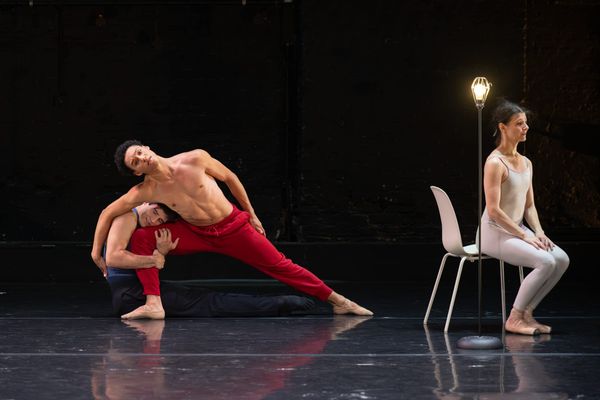
Last year, Paul Taylor announced a new approach to his company, adding other modern choreographers' works to his repertoire. The current New York season includes Doris Humphrey and Shen Wei, though most of the schedule is full of Taylor, with the traditional two new works by the indefatigable choreographer. It also includes, after a long, financially determined hiatus, live music, played by the Orchestra of St. Luke's. The second night was vintage Taylor, two familiar and welcome works ("Arden Court" and "Esplanade") and the new "Sea Lark", a bright, happy recapitulation of many familiar strands.
The dancers in "Arden Court" seemed to respond to the opening piquant urgency of the music with an openhearted precision, led by the incisive Michael Trusnovec. The witty and at times wry middle section shows various kinds of relationships, with Aileen Roehl as a modern day sylphide, energetically but haplessly enticing the introspective loner. Parisa Khobdeh, with her 1940's smoldering femininity, moved with serene hauteur as men swarmed around her. The central pas de deux, danced by Trusnovec and Laura Halzack, full of Taylor's complex, soaring lifts, showed a partnership, a meeting of equals, as they often echoed each other's moves as if they were sharing thoughts. It was a mature, generous, and profoundly moving performance.

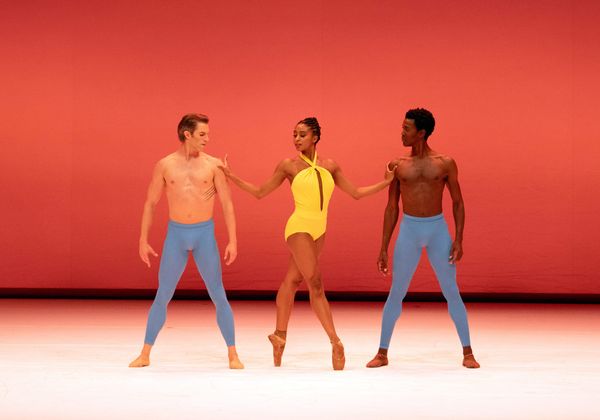
The new "Sea Lark", set to selections from Francis Poulenc's "Les Biches", is not about birds (though the dancers are lighter than air); the larks are lighthearted romps set on the seaside. The ten dancers, dressed in cropped playsuits for the women and white bell bottoms with colorful tea shirts for the men, inhabit a land of eternal youth without the shadows the younger Taylor often found. Nor is there any echo of the ambiguous, uneasy undercurrent of the Nijinska choreography; this is a sunny landscape where the sea is calm, the sky is blue, and the boat never rocks. It is a light piece, pure joy and a fine antidote for a miserable winter. The dancers seemed to enjoy the sweet-natured innocence of the choreography, which ended with the cast marching with a nautical swagger as individuals broke from the group to show off a series of gymnastic gyrations.

"Esplanade" is another, earlier, salute to youth, though it, like "Arden Court", has a darker, lonelier side. The opening has a friendly formality, as the dancers join hands to run through the luxurious Bach music as a united group. The mysterious center saw Michelle Fleet as the odd girl out, hunched over in a mysterious pain as the dancers ignore her. The dancers reach towards each other but can't touch, and the movement ends as they crawl into a tight circle, propelled by the Bach music.
The finale resolves their suffering, as Fleet skips through the group; she has the ability to communicate directly to the audience, opening her arms to invite them in. The famous finale, where Taylor used everyday running and falling moves to catch the soaring music, was breathtaking, as the dancers seemed to hurl themselves fearlessly on the ground; it was dancing without a net.
copyright © 2015 by Mary Cargill