Old Favorites and New Clothes

"Who Cares?", "Ivesiana", "Tarantella", "Stars and Stripes"
New York City Ballet
David H. Koch Theater
New York, New York
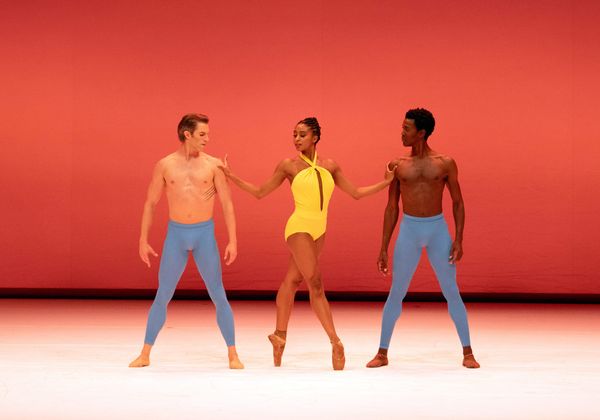
The 2013 New York city Ballet Spring Season opened on the anniversary of Balanchine's death with an all-Balanchine program, celebrating the froth, with the exception of the seldom-seen, dark, and unforgettable "Ivesiana". The present, I supposed, was new costumes for "Who Cares?" by Santo Loquasto. The older ones (by Ben Benson, replacing the Karinska ones, which I never saw) featured light-hearted, fizzy little pastel tutus. The new ones use more saturated colors, the corps boys in atomic blue shirts, pants and shoes, the female corps in strident turquoise and the demis in electric pink with distracting (and vulgar) cutouts under the bust. The three principal women are in the same outfit; a sleeveless do cut like a Western dance-hall girl's come-hither dress, with black net overlaying bright pink (Tyler Peck), purple (Abi Stafford) and turquoise (Ana Sophia Scheller). The older, somewhat garish male costume has been replaced by a sequined vest that might make Liberace avert his eyes. The colors seemed to fight each other, and were so dark that they tended to blend into the background, making the dancing hard to focus on.
Which was a shame, because the dancing was, by and large, superb. The corps looked very well-rehearsed, and played well with the music. Brittany Pollack, with Andrew Scordato, in "That Certain Feeling" was especially creamy. Tiler Peck's approach to the Patricia MacBride role is simply masterful. She has managed to inhabit the music, developing a complex emotional arc. The glorious pas de deux was a short story featuring a woman with a past, not really trusting in her happiness, shown by moving slightly behind the music, as if it were pulling her in. Then in a glorious burst of joy, she sailed on top of those beautiful melodies, hurling herself fearlessly at her partner, the solid and elegant Robert Fairchild.
Abi Stafford, on her stairway to paradise, looked lovely with her bouncy ponytail, but had a tendency to smooth over the complex rhythms, making her dancing unnecessarily placid. Ana Sophia Scheller tore into the Marnee Morris role, with some beautifully controlled turns that breathtaking. And Fairchild, over-sequined though he was, gave gave his dancing a Gene Kelly flair.
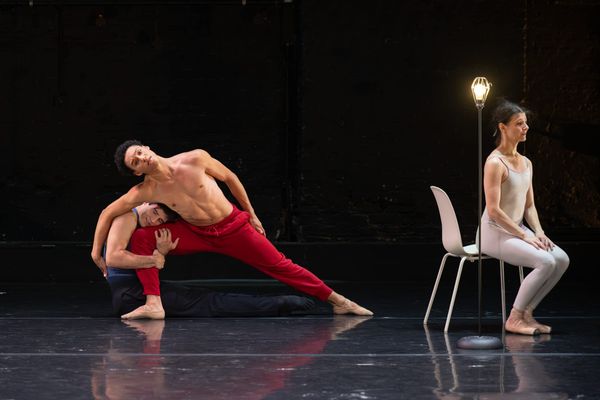
"Ivesiana" is more an Expressionistic exploration of the Charles Ives' music than a ballet; only the third movement "In the Inn" is on point, and it seems out of place. "Central Park in the Dark" is the title of the ominous first movement, with the corps shuffling in the dark like trees or disembodied observers. Ashley Laracey was the young innocent caught in their midst, as she walked through, blindly, until caught by Zachary Catazaro for an unpleasant encounter. The stylized violence was never explicit and the audience is not sure what exactly happens--at one time, she seems to pursue him. But the images of youth defiled or innocence betrayed are absolutely haunting and Laracey, by simply walking, hesitating, turning, reaching, was unforgettable.

The second movement "The Unanswered Question", is probably the most famous, as a woman (Janie Taylor) is carried on by four men, never touching the ground, while a fifth man (Anthony Huxley) reaches for her in vain. Taylor, with her pale skin that seems to reflect light and her lush golden hair that seems to move on its own is physically perfect for these ghostly icons. But it is not just her physical presence, she can give stillness a powerful and magnetic presence, an unreachable and unknowable goddess, whose leaving creates a dark void.
The final movement "In the Night", is a theatrical tour de force, as the corps does nothing except crawl on their knees in the dark, with the lighting suggesting creatures in a swamp. A disturbing ending to an unusual and powerful work.
This was followed by a jolt of sunshine, the "Tarantella" pas de deux with Megan Fairchild and Joaquin de Luz. De Luz is a powerhouse, but he puts the music first, and danced with an elegant and open-hearted swagger. Fairchild, who looks lovely in the costume's headdress, used her lightening-fast footwork to flirt with the music.
"Stars and Stripes" is another straightforward bust of energy, but the musicality and structure of the choreography make it more than a glorious romp. The echoes of all those Petipa girls with their sparkling emboités resonates through the meticulous construction. The first two movements (led by Erica Pereira and Savannah Lowery respectively) were a bit routine, but the work came to life when Daniel Ulbricht charged on in the third campaign, leading an energetic and powerful regiment. Ulbricht's jumps, landing securely in demi-plié, seemed to hover, and his every move was crips and clear. The audience roared with approval.
Ashley Bouder, with Andrew Veyette, stayed just this side of coy as Liberty Bell, though she veered dangerously close to caricature. Her dancing was a marvel of classical purity, powerful and clean, but she doesn't need to insist that the audience get the joke; her masterful performance was enough. Veyette's springy jumps were unbelievably juicy, but he tried a bit too hard to make his melange of turns look Soviet. But the audience loved the ballet, and so did I.
copyright © 2013 by Mary Cargill