Old and New
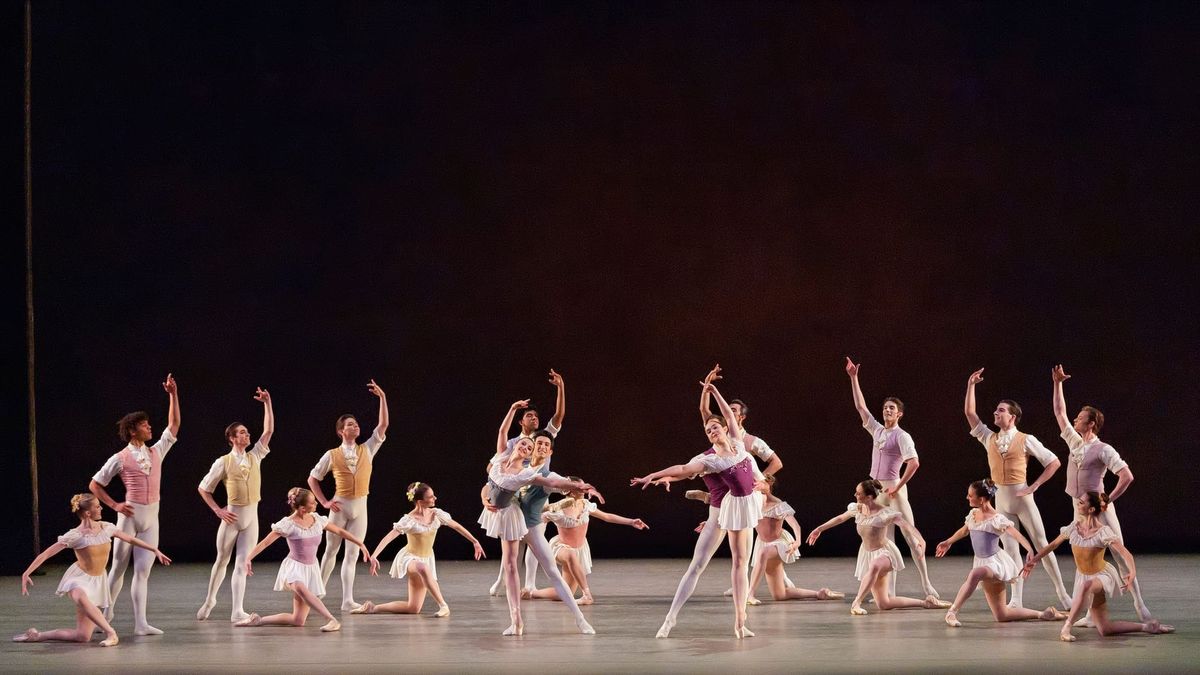
“Fancy Free”, Agon”, “Brandenburg”
New York City Ballet
David H. Koch Theater
Lincoln Center
New York, New York
May 10, 2023
This program opened with Jerome Robbins’ first work, “Fancy Free” (1944) and closed with his final ballet, “Brandenburg” (1997), with Balanchine’s “Agon” in the middle. When “Fancy Free’s” three sailors first jumped out on the Ballet Theatre (now ABT) stage, the US was fighting World War II, and many in the audience would have recognized those boys whooping it up in New York City and understood the horrors they would soon be shipping off to. By 1980, when they made it to NYCB, the world had changed, but the three sailors and the girls they meet remain firmly and gloriously in 1944. "Brandenburg's" happy generic peasant dancers exist in a timeless Robbins-land, yet for me "Fancy Free" makes a much more vivid impression.
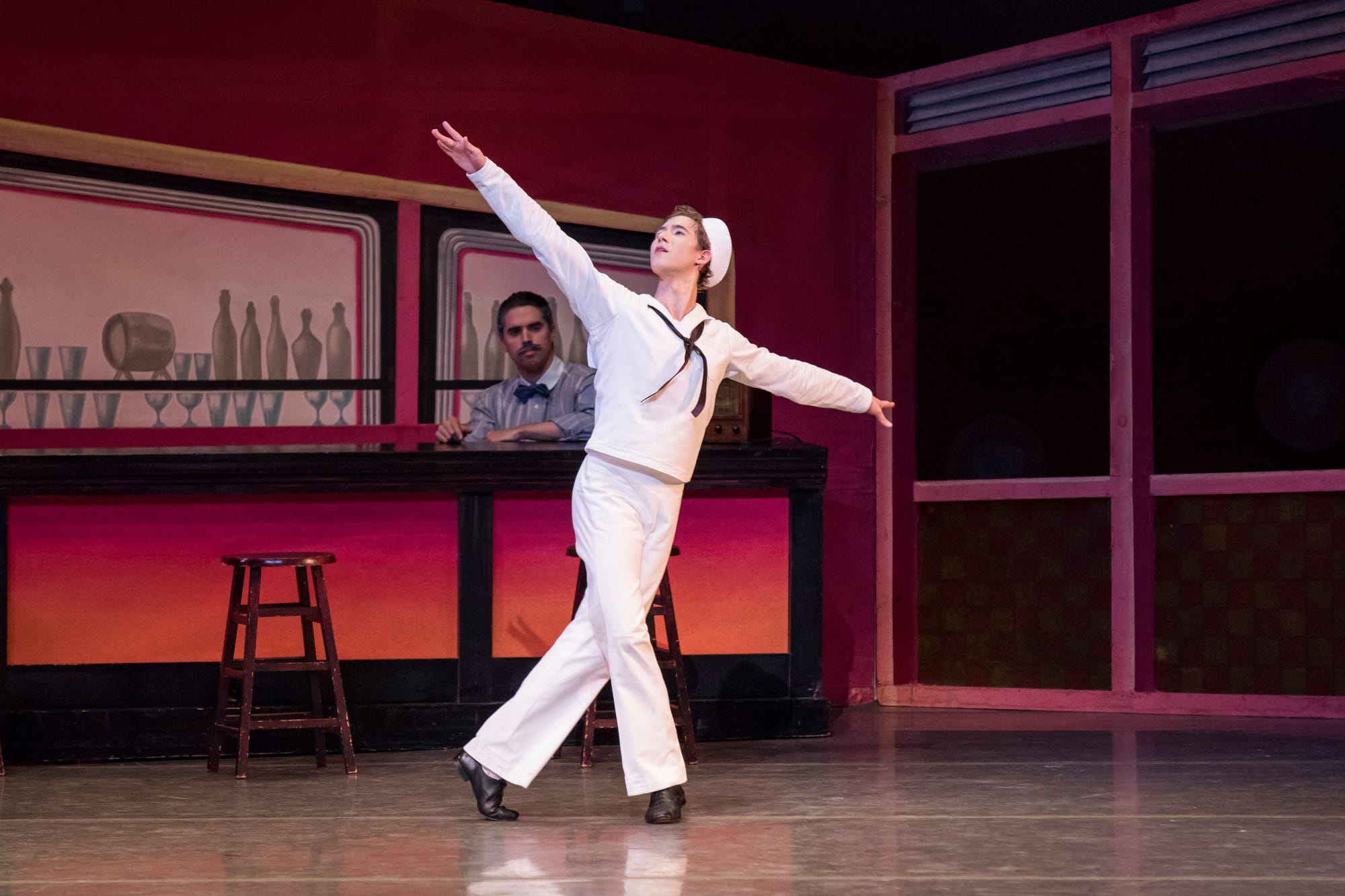
The sailors (Roman Mejia, Joseph Gordon, and Andrew Veyette) had a youthful and almost bashful intensity, which, with their distinctive personalities, made them irresistible. Mejia was the prancing little showoff, with flashing jumps into a split, combining swagger with an almost pathetic eagerness. Mejia was born, it seems, under his own spotlight, but his effortless, springy, elegant jumps and infectious grin were never self-centered--his sailor was a person, not a dancer. Gordon was the shy, cornfed guy, awed by his first visit to the big city and he made his solo a soliloquy of awkward yearning, while Veyette was the big lug whose brashness covered his affection. “Fancy Free” is a fine depiction of male friendship, with its hidden emotions (how moving sharing a pack of chewing gum can be), and the cast seemed to be living, not dancing, the story.
The girls (Mary Thomas MacKinnon with the pocketbook, and
Alexa Maxwell with the pas de deux), with help from their wigs, looked right at home in the 1940’s. MacKinnon sashayed on with a brassy confidence, happy to flirt with whoever looked available, but putting up with no nonsense. She knew she wasn’t in any danger, and so far, thankfully, the program has, and needs, no trigger warnings. Maxwell played a younger, more naive girl than some, and I missed the subtlety of the slightly condescending but sympathetic air of a self-confident New York working girl having a brief interlude with an awkward, lonely guy. The pas de deux had a bit of a Romeo and Juliet feel and the misty romance, lovely though it was, seemed a bit out of place considering the girls’ indignant exit when it became clear the boys would rather fight than flirt. But it was a fine performance, and a visit to New York in the 1940’s is always welcome.
“Agon” was choreographed in New York in the 1957 but its energy and attack are timeless, and it seems as modern as tomorrow. It looked very well rehearsed, and the opening was crisp, sharp, and vivid; it is astounding how many patterns Balanchine could develop using those four men and eight women. They were a black and white kaleidoscope with sparks shooting in every direction, balanced with an astringent courtliness.
Taylor Stanley debuted as the Sarabande dancer, which was originally choreographed for Todd Bolender, who had a strong modern dance background. Stanley, a dancer with a unique, malleable physicality, gave a grounded, twisty, and flowing performance, alternating classical forms with a shivering eccentricity. It was an unexaggerated, gripping performance.
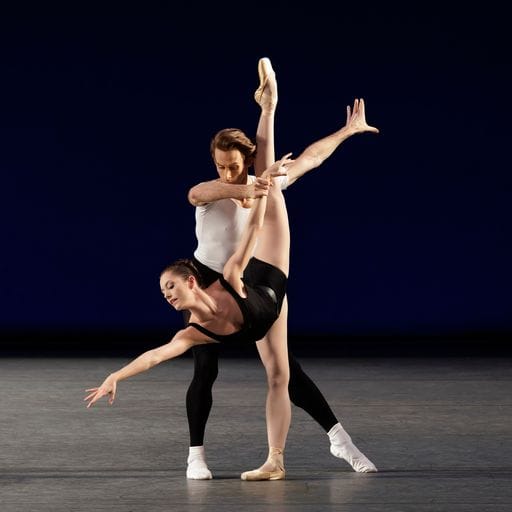
Emilie Gerrity, ably supported by Sebastian Villarini-Velez and Address Zuniga, danced the second pas de trois; her balances were secure and confident, almost too nonchalant. The pas de deux, with Unity Phelan and Adrian Danchig-Waring was also secure and confident, though certainly not nonchalant. Phelan, with her perfect proportions and effortless extensions seemed to sail through the technical aspects with a cool concentrated composure. This coolness seems much more in tune with the descriptions of Diana Adams, its originator, than the more steamy versions often seen now and the two dancers’ emphasis on shapes and movement was mesmerizing; the audience roared its approval.
“Fancy Free” is rooted in the 1940’s and “Agon” is welded to its Stravinsky score; Robbins’ “Brandenburg”, Bach’s “Brandenburg Concerto No. 3” and parts of three others, seems to float above the music, affably unmoored. It uses the music almost as a decorative background while the large cheerful corps, in youthful peasantish costumes, and two couples (Indiana Woodward with Antony Huxley and Mira Nadon with Aaron Sanz, all debuts) shuffle through various Robbins motifs, including, of course, somersaults, cartwheels and complicated lifts.
As they skipped through the music, the cast looked well-rehearsed and vibrantly alive. Woodward and Huxley had a pleasant, adagio encounter, ending in an upside down lift; though Huxley is a bit too short for Woodward, he was an exemplary partner. Woodward’s graceful upper body and deceptive power were, as always, a lovely combination.
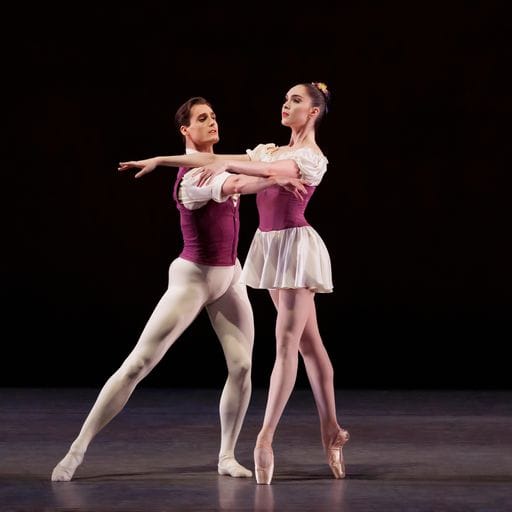
Nadon and Sanz danced a rather clichéd “I can’t see you, you can’t touch me” pas de deux, perhaps an inversion of Balanchine’s “La Sonnambula”, as Sanz ducked under Nadon’s outstretched arm. There seemed to be no motivation behind the rather overwrought emotion, though Nadon is a hypnotically riveting dancer and Sanz complimented her luxurious line beautifully. The final movement saw them cheerfully joining the shuffling crowd, happily swapping partners with Woodward and Huxley. The ballet is certainly pleasant, if too long, but looked out of place with the other two magnificent works.
copyright © 2023 by Mary Cargill



