Old and New

First program: "Airs", "Piazzola Caldera", "No Longer Silent"
Second program: "30 Incoming", "3 Epitaphs", "Tensile Involvement", "Piazzola Caldera"
Paul Taylor Dance Company
David H. Koch Theater
Lincoln Center
New York, NY
November 3, 2026 (first program) and November 5, 2026 (second program)
The two programs combined the old and the new, and a variety of styles with three of Taylor’s works—“3 Epitaphs”, “Airs”, and “Piazzolla Caldera”; one premiere, Lauren Lovette’s “30 Incoming”; and two new-to-the Taylor company, Alwin Nikolais’s “Tensile Involvement”and Robert Battle’s “No Longer Silent”.
“Airs” is basically a compendium of happy Taylor steps, with exuberant stag leaps, sideways skips, little skittering steps, impossibly strong jumps from deep plies, daring lifts, and generous open arms. The seven dancers (four women—Madelyn Ho, Jada Pearman, Jessica Ferretti, and Emmy Wildermuth and three men—Alex Clayton, Devon Louis, and Austin Kelly) were dressed in shimmering aqua and cavorted in front of a blue dappled background surrounded by Handel’s music. Taylor’s dancers have always been athletes as well as individuals, and all the dancers were both strong, with low, grounded runs, and eloquent, exuding Taylor’s special joy.
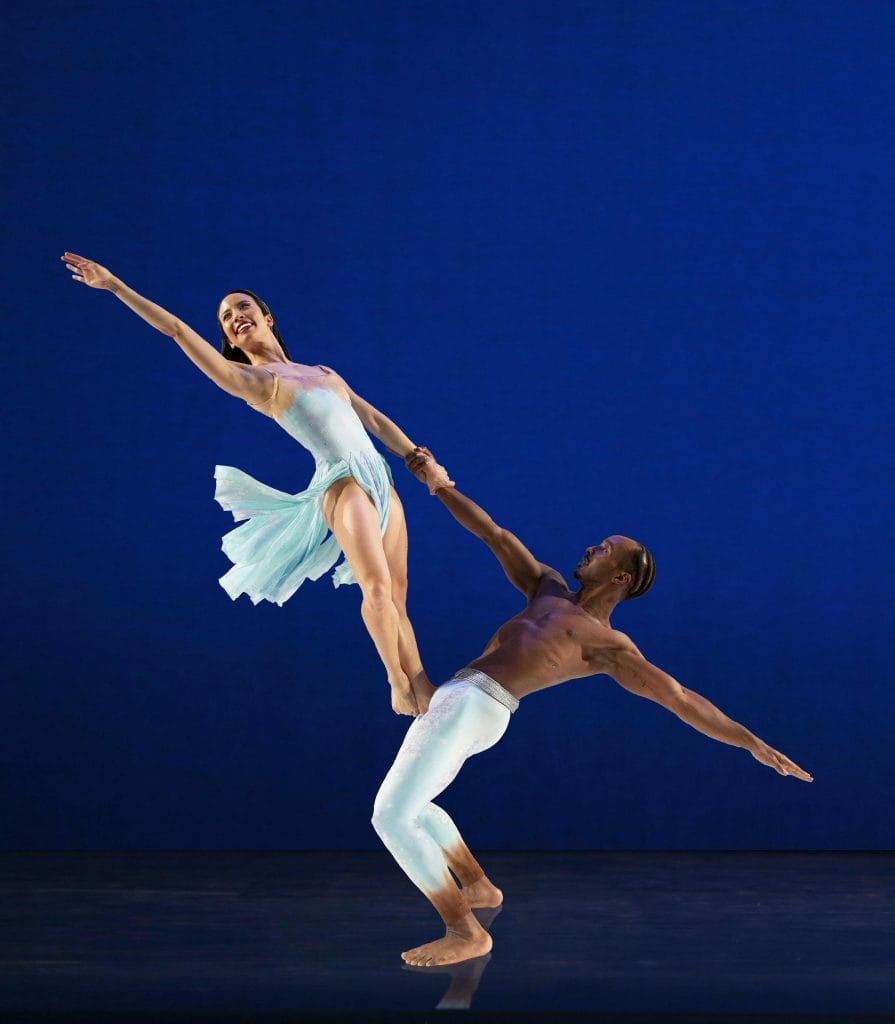
Kelly’s dynamic, juicy plies and quick, bounding jumps gave his solo an openhearted beauty, and his dance with Pearman, a powerful dynamo, was full of light, skittering steps that seemed to float. Ho, another powerful dynamo, floated through her lifts too, impeccably supported by Clayton while balancing on his thighs and reaching heavenward—they were clearly halfway there.
Taylor observed this youthful paradise, though, without sentimentality; no one can be happy all the time, and Ferretti was eloquently expressive as the outsider. Her plaintive solo, with the revolving arabesques, was both solid and luminous, and her quiet, lonely observation of the three couples dancing happily was a lyrical sigh. Fortunately she did get to rejoin the group, as the cast exploded in dynamic circling runs and jumps—Clayton sharp turns to a freeze frame were especially impressive. Ferretti’s final open-armed embrace seemed to include the entire audience.
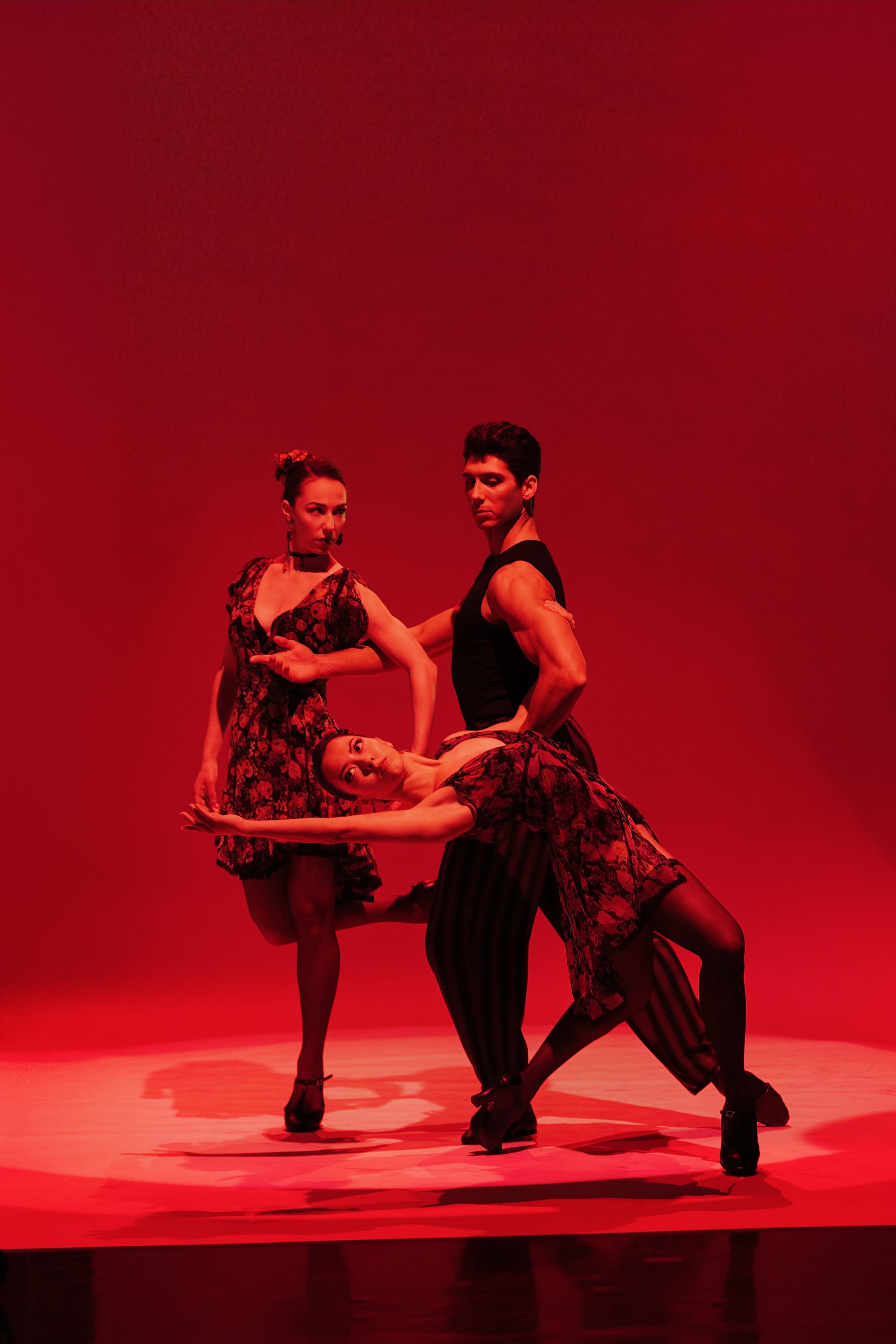
“Piazzolla Caldera”, choreographed in 1997, was set to recorded music by Astor Piazzolla and is Taylor’s exploration of the tango. At that time, live music was becoming prohibitively expensive, and Taylor chose specific recordings to add atmosphere. The urgent rhythms and plaintive wails of the music, along with Santo Loquasto’s dark red sets and louche costumes gave the work an atmosphere of smokey desperation; it seemed to be set in some grim night club full of lost souls.
Many of the dancers emphasized the swaggering hints of violence and lust, the men strutting with arrogant shoulders and the women eyeing them greedily. Lee Duveneck dancing with Jada Pearman (November 3rd) was especially swaggering and brutal. There was certainly violence and lust in the choreography, but there was an underlying hollowness, and Devon Louis, also with Pearman (November 5th), gave the dance a hint of wistfulness, as if he too were lost; Louis is a dancer with an innate modesty and decency. The two drunken men (Alex Clayton and John Harnage) danced with impressive strength (the revolving cartwheels were flawless) but also caught the hints of sadness, as two lonely people tried to connect.
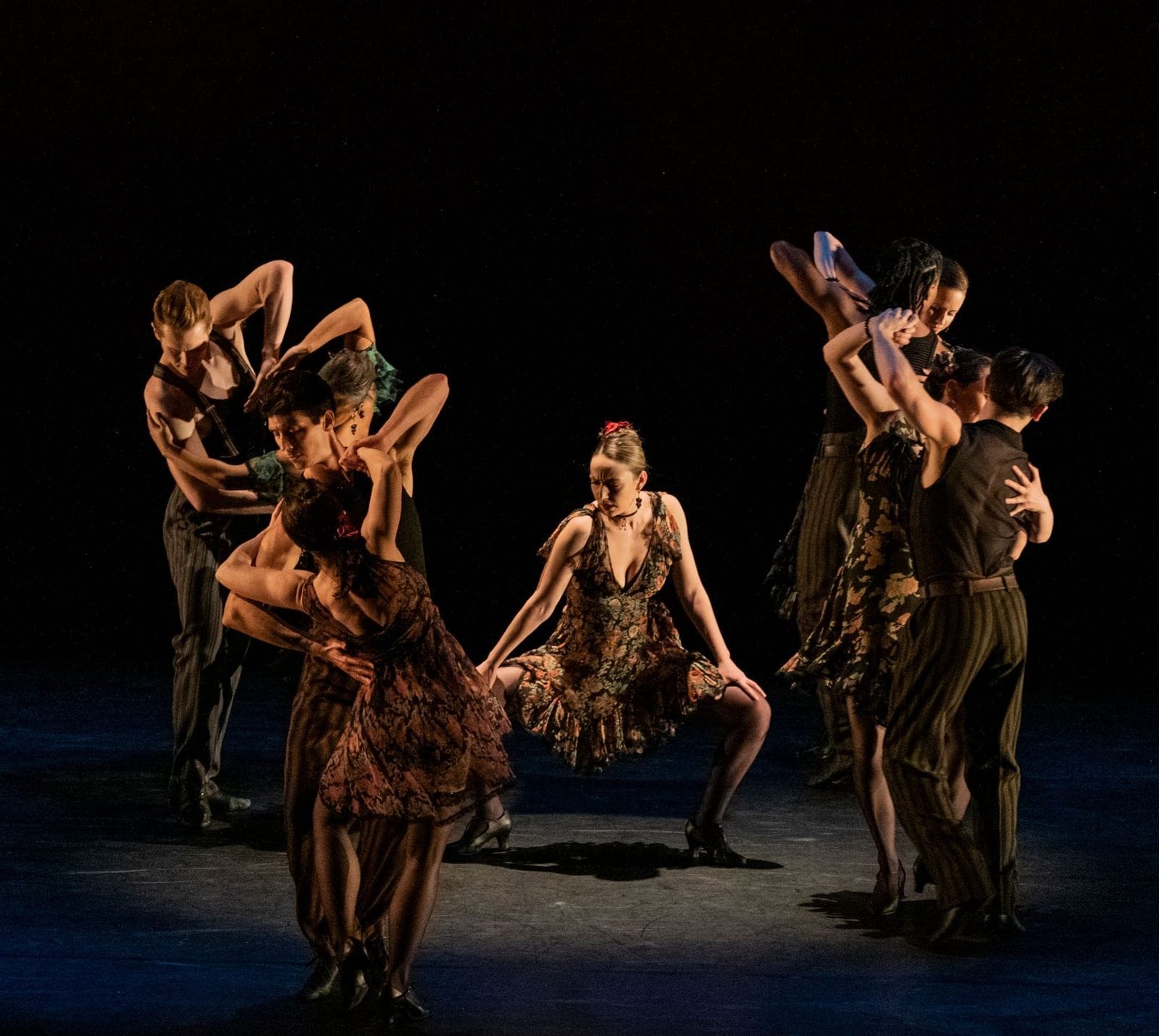
Jessica Ferretti, too, gave her solo a haunting sadness as she danced with her invisible partner while looking in vain for love. She was not a betrayed innocent, she had a gritty maturity, an air of having seen too much, and her brief bursts of anger were smothered in the end by hopeless resignation.
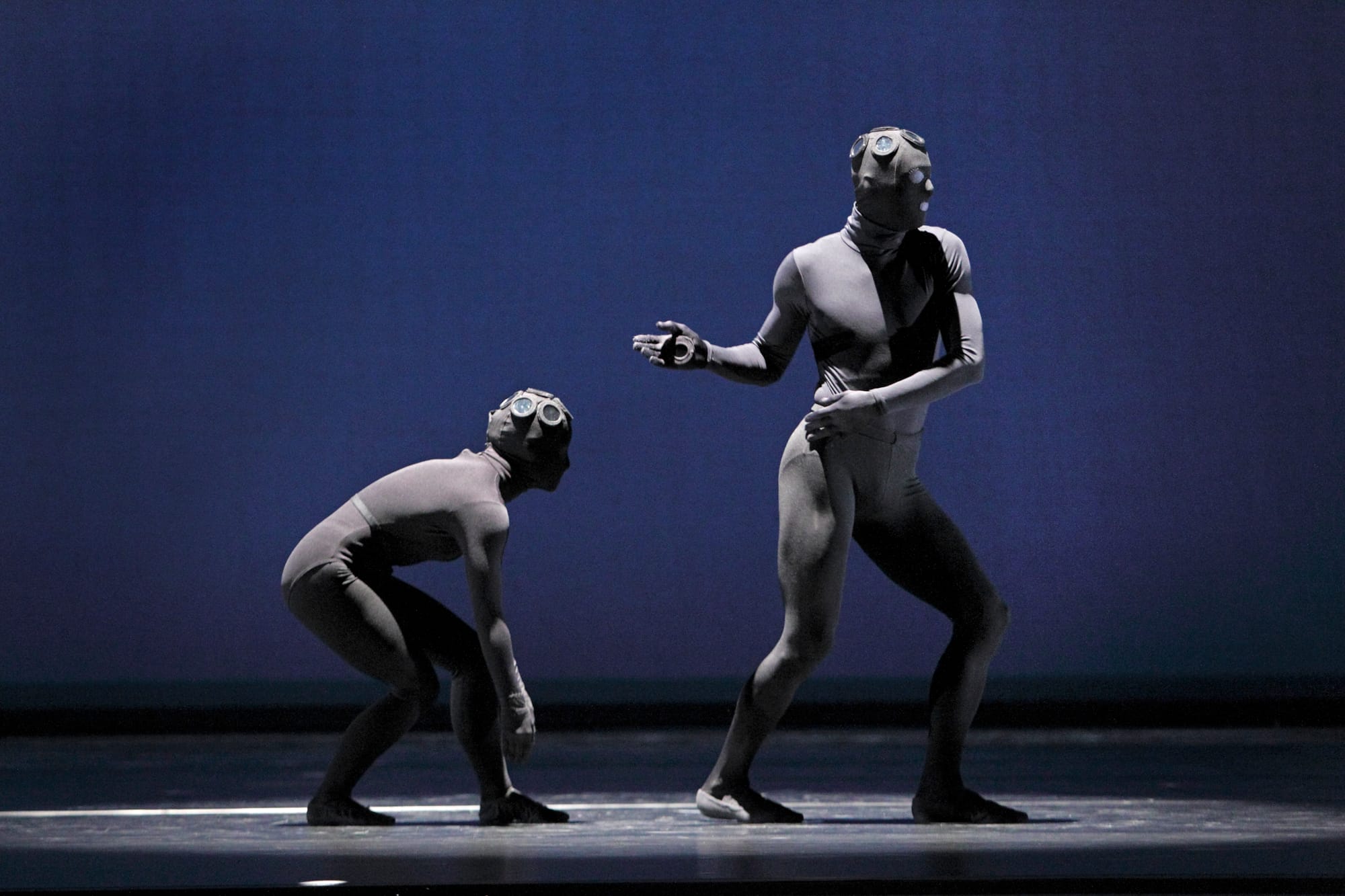
There are hints of resignation in “3 Epitaphs”. Taylor used early New Orleans jazz recorded by the Laneville-Johnson Union Brass and the music, with a prominent “thump, thump, thump” rhythm, was used for funeral marches, though this odd, witty piece is certainly not funereal. The five dancers (Kenny Corrigan, Lisa Borres Casey, Jada Pearman, Austin Kelly, and Emmy Wildermuth, were covered in muddy grey, with small mirrors which reflected the light as they moved. Their simian lopes and sudden pauses, perfectly timed to the music’s rhythms, looked like Taylor was experimenting with expression without faces. The very tall Corrigan looked like a vain, puffed up statue as he flexed his muscles to impress the very small Casey. The work, with its odd moves and sharp timing, is very funny, but there is a wry tinge to it, as if these anonymous half apes were trying to become human.
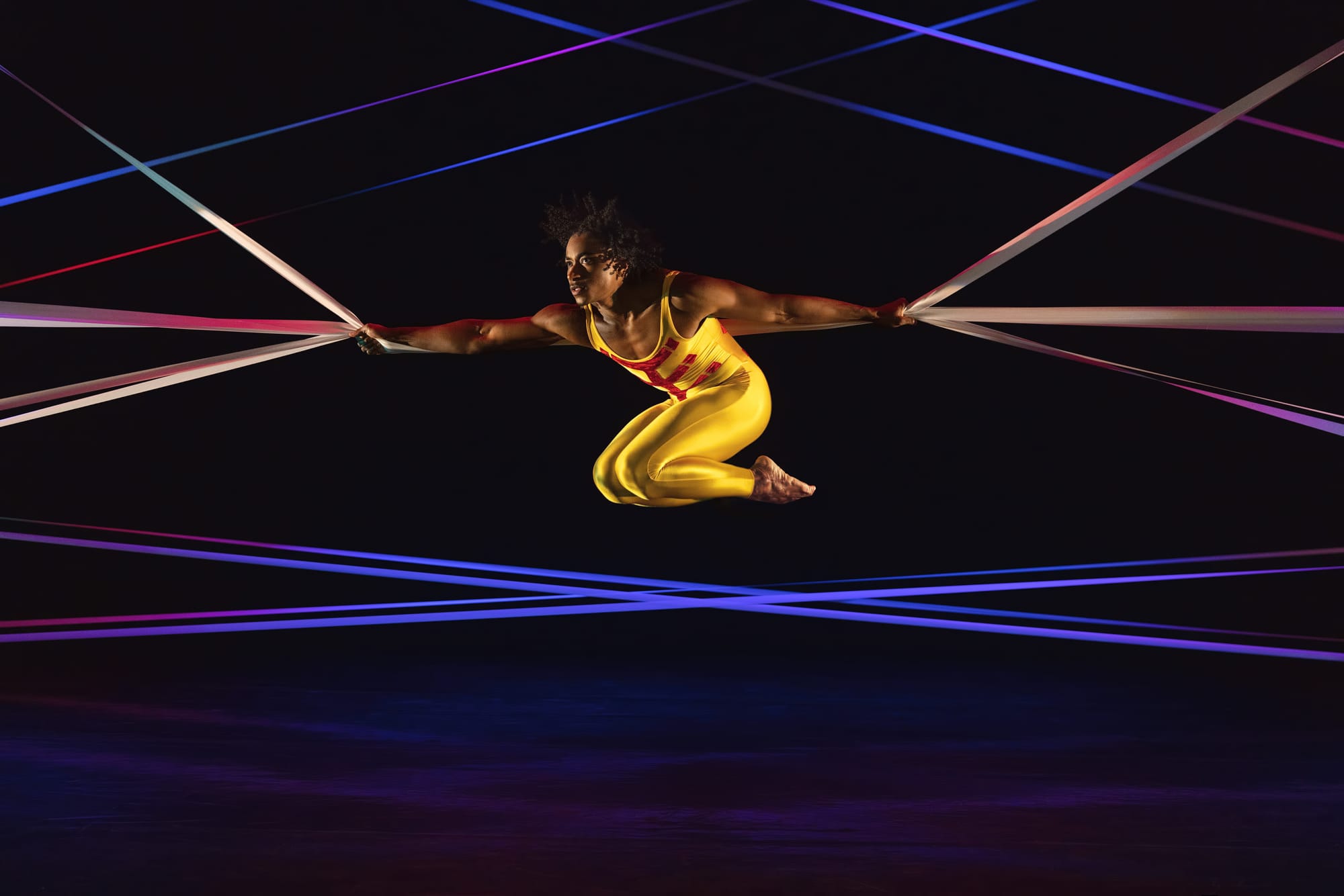
Alwin Nikolais’s “Tensile Involvement”also has a quirky humor. Nikolais, a multitalented man of the theater (he choreographed the work, wrote the music and designed the set, costumes, and lighting) premiered it in 1953. Its six minutes were packed with movement, color, and fun, as the ten dancers, wearing yellow leotards with a few thick red ribs painted on, manipulated streams of elastic bands hanging from the ceiling which were lit in a shifting rainbow of colors; it was like a waterfall in a light show. Louis had a brief solo, as he climbed over and through the spider web of ribbons, and the dancers formed different shapes with their bands; rectangles, squares and stripes seemed to magically appear. The precision and accuracy of the dancers was in an odd way inspiring—perfection always is, especially when combined with joy.
Lauren Lovette’s “30 Incoming” may have been trying for quirky humor as well. She used the music (or rather the sounds) of work by The Books, a duo who experimented with sound collages in the early 2000’s. The opening had a surreal fascination, as Elizabeth Chapa, in an elegant white dress with an impressive train, moved to a chopped up recording of an answering machine, her arms billowing, until she stepped out of her dress, wearing beige underwear. The costumes were by Mark Eric, whose gowns for the new ABT ballet “Trio Élégiaque” were also beautifully cut. Chapa then took down her hair (it looked like a golden waterfall) and seemed to be both celebrating her freedom and summoning her memories.
But if so, the memories did not congeal, and the rest of the work was a series of seemingly unconnected and bizarrely uninteresting vignettes. The nine other members of the cast also wore flesh colored underwear, except for moments when they changed to white pajama bottoms, though Emily Wildermuth did appear in a chunky paper suit which the cast tore off, revealing her underwear, after which she joined Ferretti and Chapa to be rude to the always charming Payton Primer. Caleb Mansor and Patrick Gamble, in front of a shimmering curtain, knelt and seemed upset as the score screamed “God, God, God! Then Gamble got a smooth solo with a lot of running. The finale had the cast walk on in sunglasses to ’60’s techno beat sounds, and then take off running and jumping, rather like “Esplanade” on acid, as the score boomed “I am what I am”, and “nuttiness” until Chapa reappeared wearing the lovely white skirt. The dancing was impressively strong but the point was elusive; the work seemed to take itself too seriously to be satire and was too disjointed to be meaningful.
Robert Battle’s “No Longer Silent” was originally choreographed for students at the Juilliard School in 2007 for a program of dances to music which was banned by the Nazis, and then danced by the Alvin Ailey company in 2016, is rich in meaning. Garland used a composition entitled “Ogelala” by Erwin Schulhoff written in 1925 for a German dance company. The music, made up of thirteen separate scenes (the original dance was based on a legend of a pre-Columbian warrior), is quite Stravinsky-like, the Stravinsky of “Firebird” and “The Rite of Spring”, opening with quiet, ominous drums, and changing into sharp, insistent rhythms.
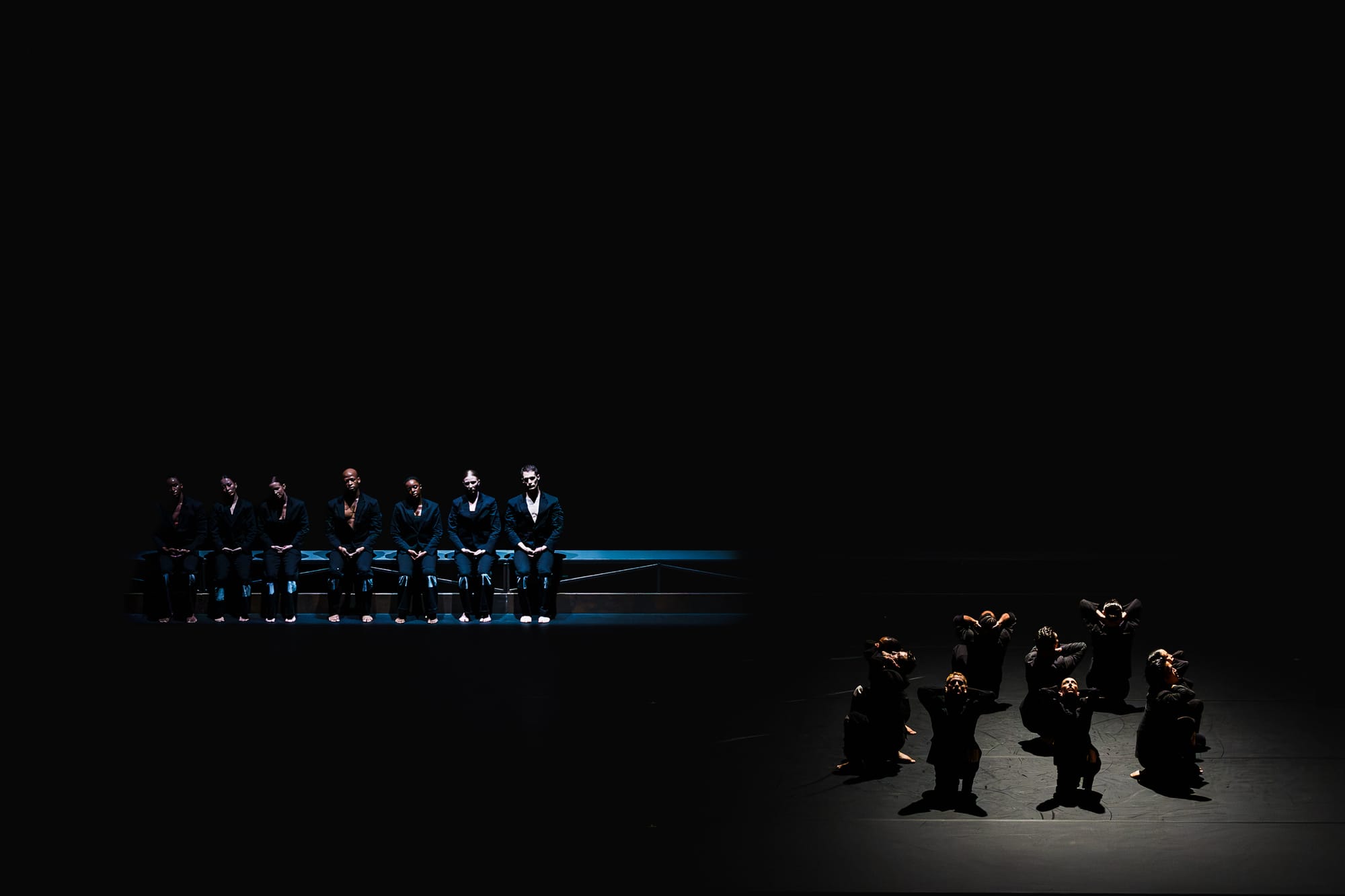
Battle’s choreography, too, often looked back to massed groups of so many Expressionistic dances, bringing in three cohorts of dancers (the eighteen cast members filled the stage), all dressed in black with ill-fitting suits, moving with mechanistic regularity. It had an oppressive atmosphere, as groups formed and reformed, huddled, lifted their hands high, fell down, accompanied by an almost obsessive stomping. Occasionally someone tried to break free, but was felled by some power or tossed high by the group, very evocative of some “Rite of Spring”. The episodic music, each section coming to an end, only for another one to start, did tend to dilute the effect of these deaths, though the harsh lighting and insistent rhythms were gripping. The long bench at the back was an especially effective prop, as, late in the work, the cast huddled on it, with their necks bent sideways.
There were no program notes, though in reading about the work later I found some interviews Battle had given when he first choreographed it for the Juilliard School; he was honoring the composer (Schulhoff died in a concentration camp in 1942) whose music was “no longer silent”. He base some of the images from photographs from the camps, especially pictures of people with their hands up, and one of a group sitting on a bench, the origin of that haunting moment. The work is not perfect—to some extent it seems to try to universalize a period of unique horror—and it is a bit diffuse, with a too many climactic scenes. But the contrast between the quiet moments and the bursts of energy, and the power of the stage pictures with their anonymous, sculptured groupings, and the energy of the music, caught so strongly in the percussive pounding dances, is haunting. It is an unforgettably impressive work, and the dancers gave a fierce, committed performance.
© 2026 Mary Cargill