Oh, You Beautiful Doll
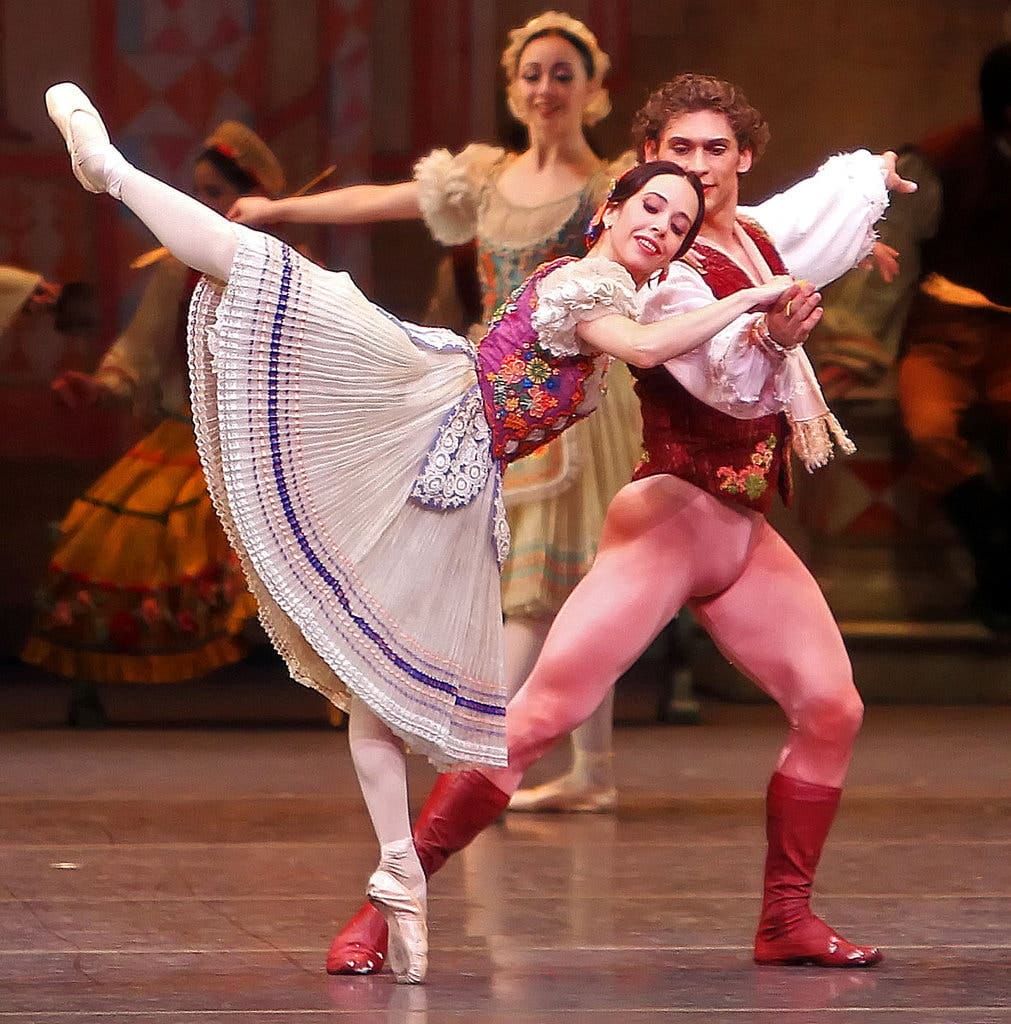
"Coppélia"
American Ballet Theater
Metropolitan Opera House
New York, New York
June 16, 2011
ABT's current version of the 1870 French comedy is based on the version Frederic Franklin danced in the 1930's, which was set by Nicholas Sergeyev from his notation of the Russian version of Marius Petipa; a distinguished lineage, indeed. There are similarities between this and the New York City Ballet's version (set by Alexandra Danilova, Franklin's frequent partner, who also danced the Sergeyev version), especially in the second act, though the ABT version has more mime for the mysterious Dr. Coppélius. ABT's version is pure delight, with beautiful, colorful sets (by Tony Straiges) and costumes (by Patrica Zipprodt) which gently evoke the 1880's, especially in the charming, old fashioned headdresses of the first act Coppélia and her friends.
Xiomara Reyes was an effervescent Swanilda, using her warmth and acting to create a warm-hearted girl, loving but spunky. She was particularly affecting in her dealings with Dr. Coppélius, happy to trick him when she though Franz was in danger, but quick to apologize once Franz was safe. She is not the most accomplished balancer in the company, but her turns were sharp and clear, and her footwork (other than an accidental slip in the second act, which she used for fine comedic affect) was elegant.
Her Franz was the young Bolshoi phenom Ivan Vasiliev. He is a stocky dancer with charm to burn, and, when he can, uses the stage like a trampoline. This version doesn't let him cut loose until his solo in the third act, so it was a true highlight (unlike some versions of classical ballets, where the hero spends all night jumping, which makes the final variation seem like just an afterthought.) Franz is truly one of the most unpleasant of ballet heros, clearly not very bright, and not very faithful, but ultimately his true heart should show through. Vasiliev is helped by this production, which has him kill the butterfly by accident instead of gleefully stabbing it with a pin, and tones down the attack on the poor Doctor; the group of boys just asks him for beer money and he chases them off, accidentally dropping his key. (The Bolshoi version, also based on Petipa's production, shown live a few weeks ago, didn't have Franz involved at all, an even better solution.)
Vasiliev fit seamlessly into the production, seemingly dancing only for his partner, and his dancing, while spectacular, is also generous, even if at times, he isn't the most classical of stylists. The final pas de deux (in between some of the most amazing turns I have ever seen, where he seemed to hover in the air, wrapping his legs around each other in like an eggbeater), was a true dialog between Franz and Swanilda and their little village, as the couple acknowledged both the Burgomaster and Dr. Coppélius.
Victor Barbee was a slightly flighty doctor, with several well-timed slips, and a slapstick moment with the extra-large book of enchantments. He didn't have menacing undertones, which suited the light-hearted approach of this production, but his miming with Coppélia as he thought he brought her to life was gently moving. He seemed almost afraid of what he was trying to do, and, as she started to move, got on his knees in gratitude and relief. "I made you, you are so beautiful, look in the mirror" read so clearly, as did his ultimate disillusionment.
The first act mazurka was sprightly, and included Franz, flirting with the lead dancer (Gemma Bond). In this production the czardas has been moved to the final act, which does balance the folk dancing, though it did make it look a bit as if the village was made up of Poles one day and Hungarians the next. There were only two solos in the final act--work (spinning in the NYCB production) was left out, as were war and peace, so the extended (and somewhat complicated) metaphor of life over twenty-four hours was lost. There were only twelve hours anyway, danced elegantly by students from the Onassis School. Both Dawn (Stella Abrera) and Prayer (Maria Riccetto) were musical and elegant. Jeffrey Golladay had especially funny timing as the Chinese doll who couldn't sit up straight. This is a sturdy and respectful version of the comic classic; thank you, Freddie Franklin.
copyright © 2010 by Mary Cargill



