Of Style and Fractures
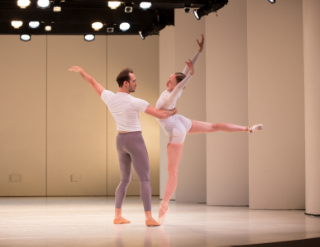
“Ritornare,” “Partita No. 2 in C Minor,” “Lasciatemi Qui Solo,” “The Innermost Part of Something”
Emery LeCrone Dance
Joyce Ballet Festival
The Joyce Theater
New York, NY
August 13, 2015
With over fifty original works in her artistic portfolio in less than a decade as an active choreographer, an evening of Emery LeCrone’s new and recent creations was promising to be at the very least intriguing, if not exciting. The presented ballets indeed were interesting, but more than anything they showed a fractured style of an artist who remains in search of a stylistic identity and voice.
The New York premiere of LeCrone’s 2015 work “Ritornare,” a duet of interlaced movements that opened the evening, was the least daring of the night’s ballets, and perhaps that made it the most cohesive. Throughout the work, Shane Ohmer and Izabela Szylinska’s conserved movements to Ludovico Einaudi’s piece for the piano by the same title, whimsically performed by Melinda Faylor, folded carefully into the loops of the recurring body bends of the choreography, and possessed preserved, encapsulated energy and sensitivity in their connection. LeCrone’s choreography and the dancers’ execution forged a tender intimacy between the couple, as though taking care to approach something extremely precious between them. It was simple, but full of beauty in its simplicity and reserve.
Another New York premiere, “Lasciatemi Qui Solo” to live soprano and harp performance of Francesca Caccini’s music, was a hazy, wary number that Kimi Nikaidoh danced with heaviness, adding earthbound energy to the spinal spirals and gravity succumbing steps of LeCrone’s design. The ballet had its captivating moments, but amid the few emotion-filled bends that elegantly syncopated the vocals, the work as a whole quickly began to feel repetitive in a way that wasn’t portraying a tortured soul, but instead just felt torturously long.
The world premiere, “The Innermost Part of Something,” a ballet for three male and three female dancers set to a compilation of modern music by Darrell Fitton, Nils Frahm, Geir Jenssen and Paul McMahon, at first seemed determined to have it all and tried to live up to its profound sounding title. The dancers’ color-blocked costumes by VPL by Victoria Bartlett in all their unapologetic hues and form-fitting asymmetric structure, and the hip-hop beats of the music and resounding influence in the steps, gave the work a daring feel, and suggested a portrayal of a nexus of creativity, pulsating in its quest to expand and become something bigger.
Unfortunately the work never rose beyond its promising start, and after two-thirds of the ballet, with no named moves in sight (unless you count one rogue developpé to stage back), the highlight of the ballet was a duet for two men moving in sync on the dark stage side-to-side, their fluid transitions making them appear suspended in the air, like strobe-lit dancers in a night club. The evocation may have been visually impressive, but while the Joyce Theater neighbors the trendy New Yok nightlife scene, the two dancing forums are worlds apart, making the duet’s status as the ballet’s highpoint troubling. As though recognizing that dangerous direction, at that point LeCrone’s choreography hit the brakes and changed direction, with the dancers now appearing in leotards and tights and choreography to match. Instead of looking creatively ambitious it started to appear cautiously emulative of neoclassical works, and the work struggled to find direction, lost in its wandering last section to repeating music.
The only familiar work to the New York audiences, “Partita No. 2 in C Minor” set to Bach’s music by the same title, didn’t fare much better. As though trying to find their rhythm and their way into Bach’s score, the steps of this work at times felt simulative of better known Bach ballets, borrowing hand positioning and accenting from the likes of Balanchine and Robbins. At other times, they were simply overly repetitive. In one of the duets, by ABT dancers Stella Abrera and Alexandre Hammoudi, the slew of developpés was overwhelming to the point of being tedious. The other couple, NYCB’s Russell Janzen and ABT’s Stephanie Williams, replacing the originally scheduled Sara Mearns who withdrew on account of illness, had similar repetitions of the arabesque variety. Either by design or though lack of preparation, these two dancers performed with constricted upper bodies that refused to engage. The steps were there, but the dancing wasn’t, and it was easy to be left wondering if Mearns and her signature drama could’ve given the ballet the flair it was missing. Creating another Bach ballet was certainly a brave move on LeCrone’s part, but not all bravery should be applauded.
copyright © 2015 by Marianne Adams



