ODC Travels -- Locally
Dance Around Town
"Path of Miracles"
Grace Cathedral
Feb. 10, 2018
"What We Carry What We Keep
"News of the World"
March 15, 2018
Buena Vista Center for the Arts Theater
San Francisco, CA
For the last four decades, Brenda Way and KT Nelson have shared the stage during ODC Dance’s annual spring season; Nelson, at first as a superb dancer, today as a choreographer with her own distinct voice. This year the company changed its format. In a program called Dance Around Town, Nelson created world a premiere, “Path of Miracles,” for San Francisco’s Grace Cathedral (February 9/10). Way showed her new “News of the World” and the reprise of “What We Carry What We Keep” at the Yerba Buena Center for the Arts (March 15-18).
Both of these so very different programs showed ODC Dance performing superbly. Its individual members may be shortish (Daniel Santos, Mia J. Chong) or on the tall side (Jeremy Smith, Josie G. Sadan) but every dancers brings a finely honed technique, an individual personality and a generous ability to support and challenge. It helps that they work year-round with each other.
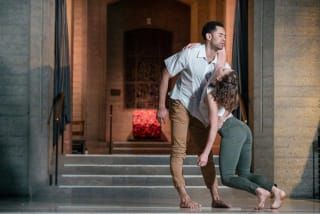
Joby Talbot’s 2005 choral work “Path of Miracles”, superbly performed live by the 17 member Volti Ensemble, provided Nelson with the backbone for choreography that spread through the cathedral’s cavernous space. The audience was restricted to 150 per performance. The Camino de Santiago, an ancient and now revived pilgrimage way, which ends in Northern Spain’s Santiago de Compostela, is credited as inspiration by both. Talbot had made the pilgrimage in preparation for writing the score in the early in the aughts; Nelson did it two years ago.
Since this was an evening performance the penumbral cathedral extended its majesty primarily in architectural terms; its magisterial stain glass and historical frescos paintings being largely invisible. Yet “Path” started on a rather pedestrian note. Tour guides, like those pouring out of the perennial tourist busses waving flag-adorned markers, took care of us. “Path” quickly became a journey, neither frivolous nor religious, but at the very least communal. Dancers, singers and audience members connected in a way that many so-called “installation” pieces attempt but do not achieve. Nelson is as much a musician as she is a choreographer. Here she worked brilliantly, weaving architecture, history, dancers and singers into a resonant whole that might be difficult to recreate anywhere despite distance. Dancers took to the air like flocks of birds. Voices swelled as dancers popped up between the singers. But individual choir members also stepped out to be partnered—Santos approached meandering bass Joel Chapman from behind. The majestic alto Celeste Winant found herself guided by a group of dancers. Strong arms raised singer Sidney Chen aloft to make him a momentary standard bearer.
As we crowded in an apse, and the dancers looked stuck, Tegan Schwab emerged, carried aloft by a male quartet. She became a trail marker for the ongoing journey while Private Freeman tapped out the steps with his pilgrim’s staff.
But perhaps the third (out of four sections) left the strongest impression. Here the dancers gave themselves over to various altars or chapels. The audience could choose its focus. I opted for partial perspectives. Even though details were difficult to catch, each looked intriguing enough so that I would hope to see them individually. a male walked tentatively toward the altar where a woman had disappeared into the dark. On the opposite side two women slowly found their way together. And on the steps of the main altar, Santos lay quietly for the longest time. Was he a sacrificial lamb, or a pilgrim at end of his journey?
A month later, on the other side of town, Way’s recent “News of the World” took the more personal give-and-take from last year’s “What We Carry What We Keep” into a larger social context. Both pieces highlighted Way’s propensity for a fast-paced, kinetically precise vocabulary that looks at once elegant and deceptively casual. And often she manages to include touches of humor into even serious subject matter.
The serio-comic “What we Carry” seems primarily concerned with the burden we impose on ourselves with material goods and the relationships that wear out. “What’s” pace is fast with many duets, often in unions, contorted partnering, heads resting on shoulders and arms slashing out. A male quartet crawls on all fours, partners drooping from their bellies. The hanging body over Jeremy Smith’s shoulder looks like a corpse. A quartet becomes two trios as if to share the burden. People bump into each other, and you wonder whether it is aggressive or accidental.
At one point the women exhaustedly collapse into a pile, with Santos circling around them around like a beast of pray. But then Tegan rises up as if awakened. Her fierce, space-eating and detailed solo told us one more time about how glorious a performer she is. Also that being alone with yourself is OK. A tall, multi-faceted artist, Sadan is retiring at the end of the season. She will be missed.
Anybody who has changed lodgings will appreciate Natasha Adorlee Johnson’s reading of a packing list on a stage full of furniture about to go. Her anger, her confusion, her boredom is palpable. But then Lani Yamanaka, a frantically arm-waving “conductor” tries to hold her uncooperative “band” together, only to find herself pick-pocketed by a slyly grinning Freeman. Timing is the essence of comedy; it also applies to choreographed humor.
Adorlee Johnson, ODC’s most dramatic dancer, also plays a prominent part in Way’s “News”. In a piece that looks at fraught female/male relationships, she just about beats to “death” a cowering female along a diagonal into an upstage corner. Meanwhile her colleagues blissfully cavort for us at the apron. Make-believe or not, this was horrendous watching. (It also recalled Doris Humphrey’s dictum that the diagonal is the most powerful line on stage.)
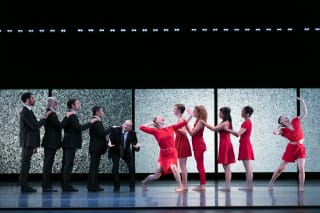
“News” made its point quickly. In the opening image, the men, wearing identical black business suits, the they men confidently headed for the more individualized women in differently styled red dresses. (I hate to say it; for just a moment they looked like Fred Astaires) But soon the men touched, caressed, or tried to get ahold of the women’s body. Even though they were uncomfortable by these manicured hands, they didn't quite know how to react. In another part, the men literally reshaped the women’s limbs as if they were puppets. They also were allowed to rest between male legs.
In an upstage duet for two of the younger dancers, Rachel Furst and James Gilmer, Gilmer’s every move was shadowed by voyeuristic males. Tegan screaming a the top of her voice – I still don’t know whether she actually made a sound – was dragged, lifted and manipulated until she finally collapsed into a friend’s arms.
In these sections –- “News” consisted of ten — the insidious nature of male behavior was quite readable, but other parts pointed to more subtle issues. Was a sitting line of the women’s angled and spread legs an in-your-face challenge to the guys or a desperate advertisement for their “goods”? In a group huddle the women seemed to be plagued by discord? fear? Lack of self-awareness?
At those moments I thought of Picasso’s “Les Demoiselles d’Avignon,” an image of which Doug Argues’ line images had slightly modified to be used a major backdrop. Alexander Nichols design then had it evolve into contemporary film-noir images of urban life.
copyright © 2018 by Rita Felciano



