Nuts and Bolts
"The Art of Partnering"
Studio 5
New York City Center
New York, New York
November 25, 2019
The intimate and imaginative Studio 5 presentations give the audience, who sit in a semi-circle around the artists, fascinating glimpses into the creative process. This evening Alastair Macaulay, the former Chief Dance Critic of the "New York Times", put together a discussion on ballet partnering in three works by Balanchine with Jonathan Stafford, the Artistic Director of the New York City Ballet demonstrating some of the issues with dancers Sara Adams, Sterling Hyltin, Andrew Veyette, and Peter Walker, accompanied by the elegant playing of NYCB pianist Cameron Grant.
Macaulay introduced the evening with brief comments on the history of partnering, comparing the approaches of Bournonville (men and women are equal and frequently dance side by side) and Petipa, who saw the woman as preeminent, with the man supporting her. In Balanchine's early Russian works, Macaulay explained, he experimented with more modern approaches, but when he moved to the West in the late 1920s, he renewed the Petipa idea (with some modern twists) of the ballerina as the focus and the man as her cavalier.
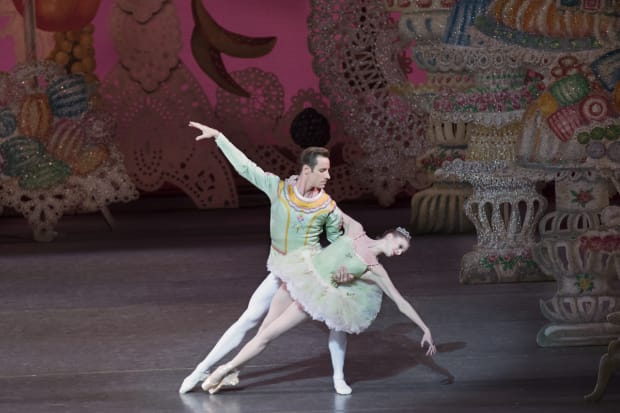
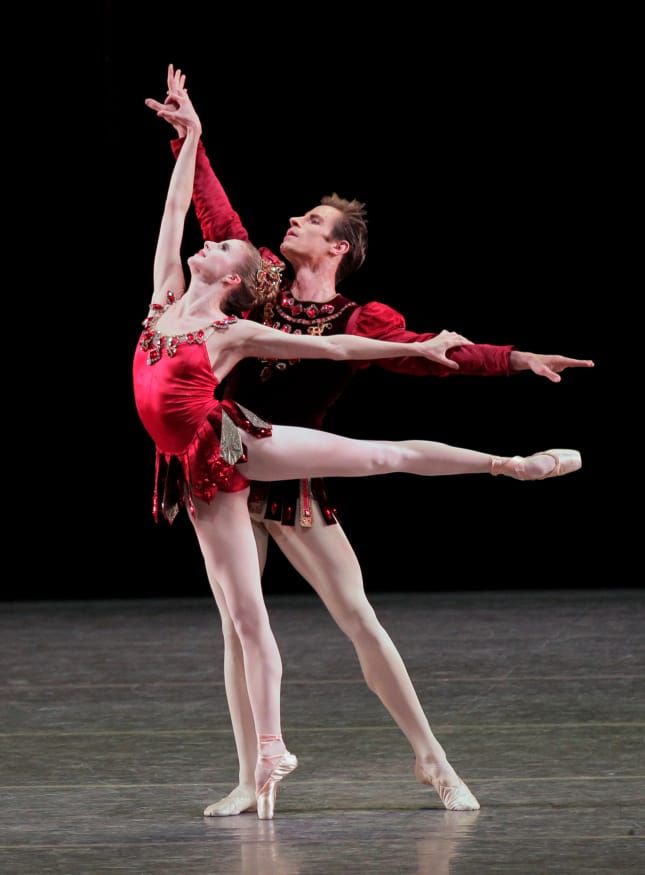
Stafford and the four dancers showed three pas de deux from the classical "Nutcracker", the brash "Rubies", and the modernist "Concerto Barocco", and talked about the technical and stylistic partnering challenges. Soloists Adams and Walker opened the evening with the "Nutcracker"; both have danced it but never together, so this was, Stafford said, an opportunity for the audience to see how partnering problems are worked out. Thus the audience was prepared when, in an opening phrase, Adams fell off balance. The partners' heights and proportions are crucial, Stafford explained, showing where the very tall Walker cut Adam's arm movement short, knocking her off balance; the second go round was flawless.
So too were the jumps into the shoulder sits; Stafford said with mock disappointment that timing is everything. The supported pirouettes into the backbend, though, were a bit messy and according to Stafford, this moment is always fraught, even though NYCB dancers have been doing flawless supported pirouettes since their student days. Matching the music to the woman's turns so she stops and bends back right at the crescendo, staying long enough to fill the music while making it all look perfectly smooth is the partner's job. The Cavalier, Stafford said, needs to guide the ballerina and know when to step in; it is his job to save her.
Adams and Walker also danced the pas de deux from "Concerto Barocco"; Adams has danced it before but Walker learned it for the presentation. Stafford talked about the three soaring lifts, pointing out that the woman uses the man's writs to push away has hard as she can -- a very unusual approach, since most lifts have the woman's arms soaring free. The push and pull actually makes the lift easier, Stafford explained, as the woman supports her own weight. Walker added that the men are taught to use their palms to lift, not their fingers, and the pressure of the woman's weight on his wrists helped keep his hands on her waist. (He wooed what would happen if his hands slipped up, to much laughter.)
"Concerto Barocco" has another unusual lift, where the man supports the woman on his hip, and Stafford went into some detail about the geometry of the movement. There was more geometry in "Concerto Barocco's" sliding move, where the man pushes the woman on the edges of her shoes just far enough so that she can use the point of her toe as a fulcrum to stretch out, the man balancing the woman's weight perfectly; listening to Stafford's meticulous explanation was revelatory. Discussing this partnering with Macaulay, Walker said that the man in "Concerto Barocco" must be invisible, that if the audience notices, he is not doing his job, and added that Jock Soto in SAB taught him everything he knows about partnering.
Sterling Hyltin and Andrew Veyette have been dancing together for years and whipped through the last part of the "Rubies" pas de deux, though at the end they were doing slightly different versions -- a wonderfully extem- poraneous problem solving demon- stration. They have both recently worked (individually) with Patricia McBride and Edward Villella, an opportunity for which they were extremely grateful, and talked with Macaulay about the subtle differences among the versions they have danced -- where to slow down or speed up, which way to turn, where to put the arms -- and the audience got a fascinating glimpse into some of the nuances of a partnership.
Veyette talked about one moment that Villella stressed, as the man briefly swings in front of the woman; Veyette always had to dance it to her side, since his training and instinct was never to step in front of his ballerina. For this brief moment, Veyette said, he does, before getting back to partnering. Veyette and Stafford also talked about partnering in general, stressing the importance of anticipating the woman to make sure she stays secure. They both agreed that watching the back of the neck is a key to partnering, since it shows where the dancer is moving. Hyltin said that a good partner knows where she is going before she does, and that, apparently comes from her neck.
The evening ended with another "Nutcracker", this time by the experienced Hyltin and Veyette. Macaulay asked about their interpretation, since some Sugar Plums give a serious, almost solemn tinge to that soaring and falling music. Hyltin said she could only be happy since that pas de deux is her favorite work to dance, that she loves every moment and actually is afraid of being too giddy. It was magical to watch it after the detailed, precise, and technical analysis of the opening performance, as, despite the practice costumes and the bare setting, the nuts and bolts of the partnering disappeared into a glorious, musical flow.
copyright © 2019 by Mary Cargill



