"Nutcracker"--One More Time
"Nutcracker"
San Francisco Ballet
War Memorial Opera House
San Francisco, CA
December 13, 2017
Maybe a break from writing clears the mind and opens it to fresh perspectives even on familiar material. At least, it seems so after more than a dozen yearly viewings of Helgi Tomasson’s 2004 “Nutcracker" set at the time of the 1915 Panama-Pacific International Exposition. He set it to a grand event that somewhat ironically celebrated the country’s hegemony while Europe was already engaged in what was supposed to be the “War to End All Wars.” In 2017 the world seems even less safe than it did in 1915, so a work like “Nutcracker” may really look anachronistic. Yet superbly performed by an excellent ensemble to what maybe the best ballet score written, this standard has all the redeeming qualities that make it worth looking at again and again: Beauty, Dreams, Love.
Over time, paintings acquire a softening patina. On opening night Tomasson’s first act almost looks like it has gone through this gentle aging process: the soft light on the Victorian houses, the women's gleaming pastel gowns and, above all, the family celebration's easy grace within Edwardian formality. What in the early years looked to me stiff and painted on now has become natural. The children's dances incorporated the boys' barely suppressed rambunctiousness contrasting with the girls' budding ballerina charms. The flirtation between the loose-limbed Max Cauthorn and the stiff-legged doll ballerina Lauren Parrot infused a spark of humor into these otherwise conventional solos. Olivia Callander's prepubescent and initially shy Clara and Shane Wexelman's Fritz stepped into their roles convincingly.
Tomasson gave some of the best choreography to the snowflakes. He divided the ensemble into overlapping asymmetrical formations giving the impression of the blizzard -- and it was a blizzard -- being whipped up by the dancers. Frances Chung and Vitor Luiz, accompanied by a retinue of three, again zipped through their leaps and jumps with immaculate control. Chung's radiant smile just about melted the "snow."
Former Principal, now Character Dancer, Rubén Martín Cíntas gave his Drosselmeyer a splendidly complex interpretation by weaving his function as a protector and guide of Clara into an active observer of the world of the divertissements in which he found as many delights as she did. He courteously bowed to the Spanish performers; closely examined the Russian dancers' Fabergé-style eggs and just about joined the Chinese. Yet he did so without ever interfering with the spotlight demanding performances of these character dances.
The second act's opening remains problematic. Tomasson placed it in the Exposition's Glass Pavilion, now the City's Conservatory of Flowers. Exquisitely lit by James F. Ingalls, children from the ballet school awaken at dawn as dragonflies, ladybugs and a variety of butterflies. They may cute to watch but the choreography is heavy-handed. Not even Sasha de Sola's pristine and lovingly solicitous Sugar Plum Fairy -- her velvety point barely touching the ground -- could infuse these bugs with some vitality. I don't remember having seen a cyclorama of blooming flowers attempting to give warmth to this scene. It didn't help.
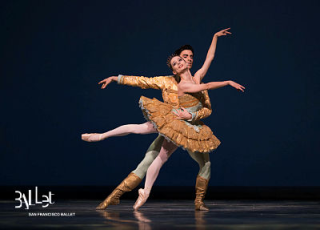
With Clara stepping into a music box, whose miniature version she received in the first act, Tomasson switched gears to set the scene for the bejewelled Grand Pas de Deux for Maria Kotchekova and James Walsh. Time stood still in their masterful rendition. It may not be true that "beauty will save the world" as Dostoyevsky's Idiot has said, but for just a moment it seemed possible.
copyright © Rita Felciano 2017