Noh Now
"Left-Right-Left"
Luca Veggetti, Director/Choreographer
Japan Society, New York
October 13, 2017
"Left-Right-Left" describes the basic act of walking, or dancing. It also might describe a historical or dramatic dialectic: a movement from hope to despair, to new hope. Taken together, this is the material for an experimental drama combining western contemporary dance with the 600-year-old Japanese Noh Theater. It's a tall order, a joint project of Japan Society in New York and the Yokohama Noh Theater. Italian choreographer Luca Veggetti, whose career has taken him from La Scala to Tokyo and New York, is bold enough to take it on.
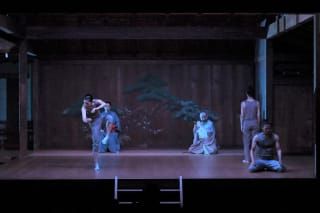
On the four corners of a bare, square stage, thrust on a diagonal toward the audience, Veggetti places four dancers, representing three generations: an old man, a younger man and woman, and an adolescent boy. Behind the stage sit two musicians. The piece begins in deep silence, broken by a sudden, violent wind through a flute – evoking the origins of Noh in religious ritual.
The old man begins to dance, as if coming to life. He starts with his eyes, then his mouth, then the whole face. The movement flows into his limbs. Without moving from his spot on the stage, he runs a gamut of emotion – elation, curiosity, surprise, wonder. Then he begins to cover space, as the flute is joined by spare beats from a hand drum, then a voice from the drummer, sustained notes that morph into two pitches, one high and clear, the other deep and guttural. The music is starting a long crescendo – a buildup of dramatic stress.
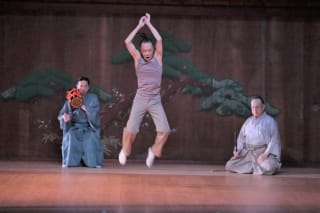
Suddenly, the old man leaps into the air and comes crashing down on his shins. This is the motif of this bare-bones drama, which looks like a prototype of Shakespearean tragedy, played without words. The young man, then the young woman take their turns in movement that melds east and western aesthetics, from the slow deliberateness of Noh to the off-kilter flow of hip-hop. And they too come crashing down, felled by escalating pressure.
The boy steps out, singing in an open-throated soprano. His chant sounds like a challenge to his elders, but he alone is able to stand. He stands and sings as the others huddle like refugees, whimpering and moaning. Then the old man steps out and proclaims something like a blessing on the new order.
In other words, the beat goes on. Veggetti has taken on a heroic task – to find the common elements in dramatic traditions from two ends of the earth, which grew out of completely separate cultures. His assignment was to bring back the Holy Grail of drama and act it out on the stage.
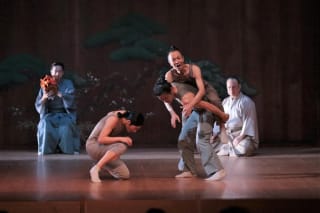
In this he may have succeeded, but at a price. In order to show the essence, he had to strip away most of the magical elements that seduce audiences, east and west, into the world of theater. Gone are the elaborate fixed settings, the hypnotic entrances and exits of the Noh play. And gone is the intricacy of plot and the depth of character that draw us into western drama. In the end, what's missing is the catharsis, the payoff for our journey into a created world
That said, "Left-Right-Left" is a production of the highest quality. The dancers are masterful, especially 74-year-old Butoh legend Akira Kasai, and Megumi Nakamura, a regal ballerina turned sinuous modern dancer. Ultimately the value of this project may be less in the production than the process – of artists immersing themselves in far different worlds, finding the depths of expression hidden in unknown tongues.
copyright © 2017 by Tom Phillips