New Mark Morris Works
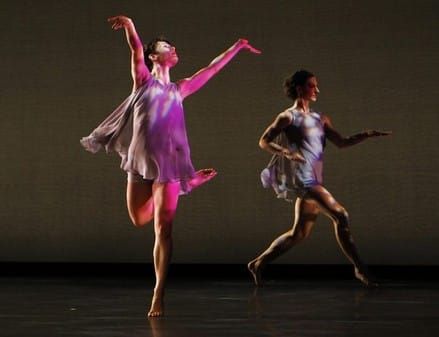
"The Muir", "Petrichor", "Festival Dance"
Mark Morris Dance Group"Mark Morris Dance Center
Brooklyn, New York
March 19, 2011
The Mark Morris Dance Group is celebrating its thirtieth anniversary, and brought three recent works to Brooklyn to celebrate. As always, music, live music, was front and center, and each work responded to the different composers in unique ways. The evening opened with "The Muir", set to Scottish and Irish folk songs arranged by Beethoven for violin, cello, and piano. There were three singers, and at times, the words did overwhelm the choreography--for vocal music, Morris does sometimes set the words and not the music. It worked best in the more exuberant parts, when the company performed folk-like movements. The more powerful the music, though, the less the dances seemed to add. Robert Burns' words and Beethoven's music were more than enough to portray the grief for the slaughter at Culloden, and watching a woman in a sylphide-inspired costume roll of the floor was unnecessary.
"Petrichor", which means, according to that invaluable source Wikipedia, the scent of rain on dry earth, a word coined in 1964 by two Australian researchers (does Morris spend his life finding obscure, perfect terms?), is set to the String Quartet No. 2 by Heitor Villa-Lobos for eight women. The chiffon costumes, by Elizabeth Kurtzman, resemble baby-doll shifts in various shades of pink and neutral, but there is nothing babyish about them, or the choreography. This is an abstract work, where shape and form merge seamlessly into the music. The dancers, though strong and vivid, have no distinct personalities, and it seems as if the viewer is watching a magical land where champagne bubbles go, bubbles which reflect their owners' emotions, both happy and sad, never still, and never flat. I could have watched it forever.
The unambiguously titled "Festival Dance" is set to the Piano Trio No. 5 by Johann Hummel, a contemporary of Beethoven. It opens with dappled lighting and a green background, and begins with a spring-like pas de deux. The costumes, by Martin Pakledinaz, are poodle-type skirts for the girls, and simple shirts and chinos for the boys, reinforcing the apparent simplicity and youth of the dancers. But this isn't just a romp, there is an underlying structure and symmetry to the choreography which gives it a haunting depth, especially in the slower second movement, where there seems to be some underlying current of danger or sadness But this disappears in the final rondo, a dance of magnificent generosity. This is Morris at his most gloriously outgoing, and the cast seemed to love every minute of it, as did the audience.
copyright © 2011 by Mary Cargill



