New Jamar Roberts at NYCB

“Forseeable Future”
New York City Ballet
David H. Koch Theater
New York, NY
October 9, 2025
Jamar Roberts is an American modern dance choreographer, associated most often with Alvin Ailey and his new work for City Ballet, entitled “Forseeable Future” is entirely true to that tradition. It’s a theater piece by a ballet company and in no way dependent on classical dance. Neither too bad nor too good, not unpleasant to watch, physically broad in its visual tableaux but thin as to its dance content, the piece was relatively meaningful as to its dystopian theme and registered as artistically sincere.
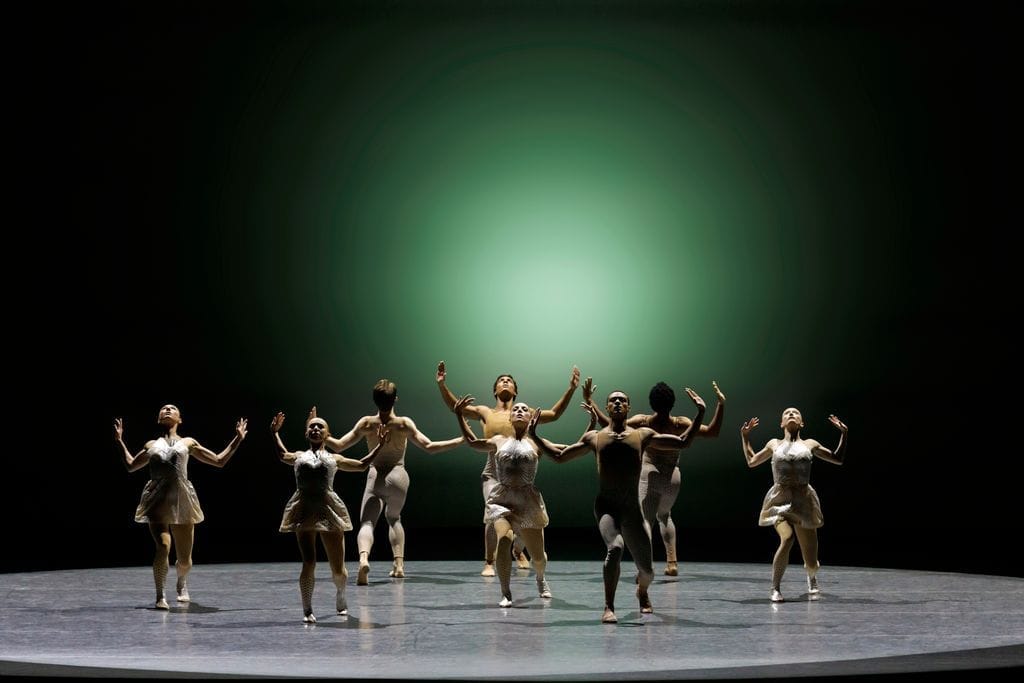
Four figures costumed as Angels (but crippled ones) with colorful wings react to a dystopia peopled by six more anonymous proletarian figures dressed in monochromatic gray. A relentlessly brutal soundscape (by what the program calls “the multidisciplinary performance artist Arca”) yields to a background of bell like major chords as the angels seem to struggle against and then succumb to the brutalist environment. Emotion is dissociative throughout except for a rather good concluding duet between Sara Mearns and Taylor Stanley, where the couple looks like it tries to mate, but fails and ends up seemingly dead on the floor.
The dramatic treatment of this action is fully comic book. The costumes by Dutch designer Iris van Herpen - produced for the company’s Fashion Gala this week - dress the proles in stiff gray skirts and bodices for the women and leotards for the men, while the two angelic women are costumed in blazing sunset pairs of wings, with their partners trailing wings of flowing clear gauze. The proletariat corps twitches about to musical pulses: frustrated, constrained and seemingly prodded by repetitive electronic impulses. The angels display emotion – especially Mearns – but they alike are constrained. It crosses one’s mind that this is the future after A.I. takes over the world.
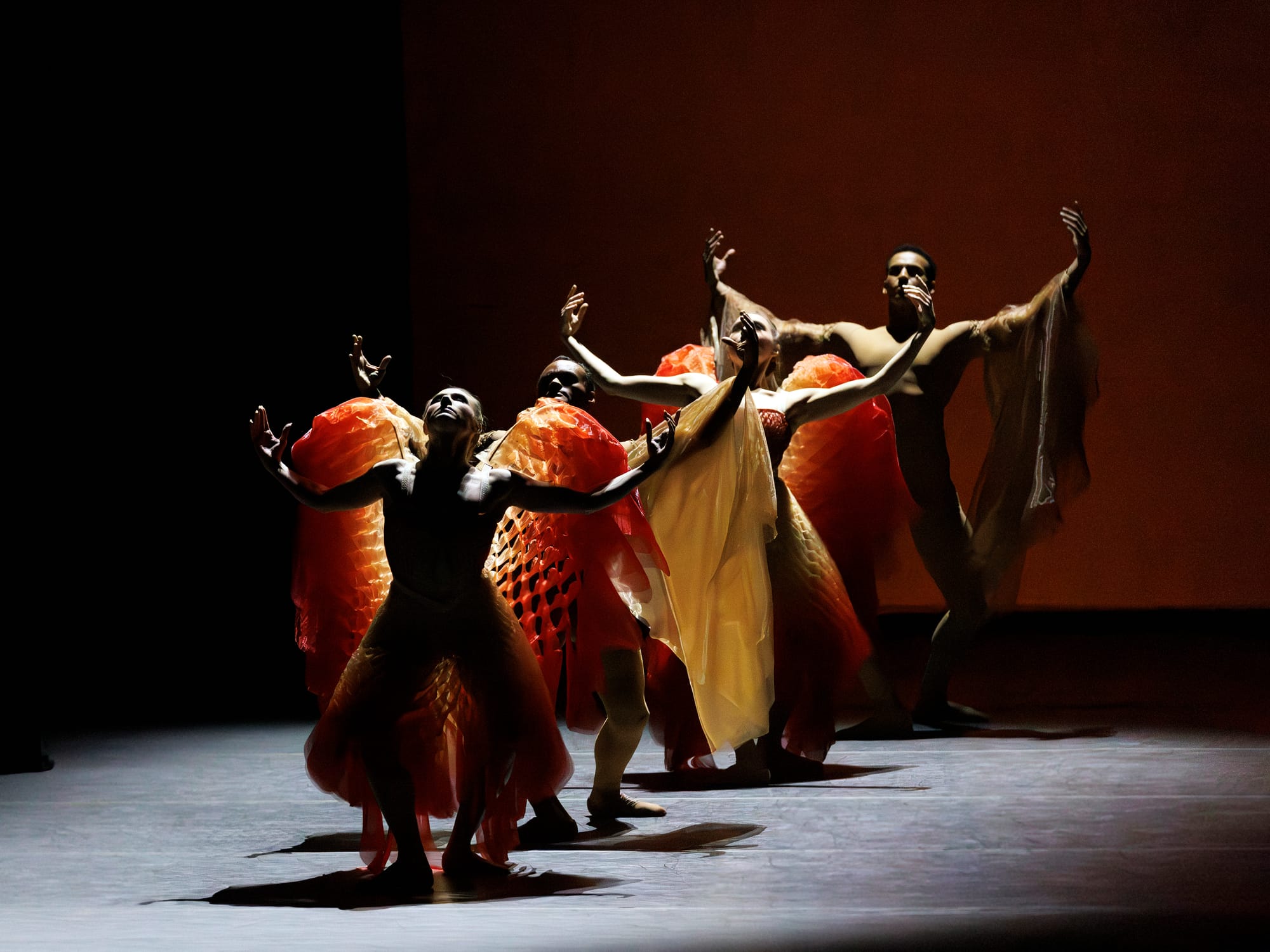
The costumes for the feathery Angels strongly resemble the pictures of angels that this writer used to see as a child in editions of Milton and Dante (by artists like Gustave Doré) in the late 1950s and 60s. The Proles are straight out of “Star Wars” or “2001: Space Odyssey.” The lighting by Brandon Stirling Baker is dim throughout to the point of rendering the action often unintelligible, before becoming blindingly backlit for the penultimate mating and death duet, where the back lighting silhouettes the figures to the point of suppressing their features. The couples at all times are stationary and their gestures merely suppressed impulses, animated by strong facial emotions.
As a dance drama in the tradition of Martha Graham and successors like Paul Taylor and Alvin Ailey, the work called to mind a knockoff of Taylor’s late style. But from a period when, instead of peopling his dystopias with vital characters and dense action (as Taylor does for instance in “Banquet of Vultures,” to be revived by the Taylor company at Lincoln Center in November) Taylor’s dances in his older age (for instance, his 2012 “House of Joy” with décor by Santo Loquasto) were increasingly void of dance content and consisted of rudimentary images and action. The best thing about the piece was its ending and the intense emotional performance Roberts pulled out of Mearns, who came alive in this ballet as she seldom has recently. Her powerful dramatic imagination has always been her strongest quality. Her partner Taylor Stanley’s fée persona seconded this well. Isabella LaFreniere and Ryan Tomash provided good dramatic weight as the second couple.
The use of mild qualifications above in my opening description is meant to indicate that this work has welcome thematic content in comparison with the moral, ethical and human emptiness of Justin Peck’s recent works for this stage and also in comparison with Peter Martins’ end-of-career commissions such as “Oceans Kingdom,” his collaboration with Paul McCartney that also featured Mearns. The drama here is relevant if crude. Also in contrast with most of the fashion gala pieces over the last decade, the costumes are put to thematic use within the dance. It wasn’t just an excuse for a fashion show.
Copyright © 2025 by Michael Popkin



