New Combinations
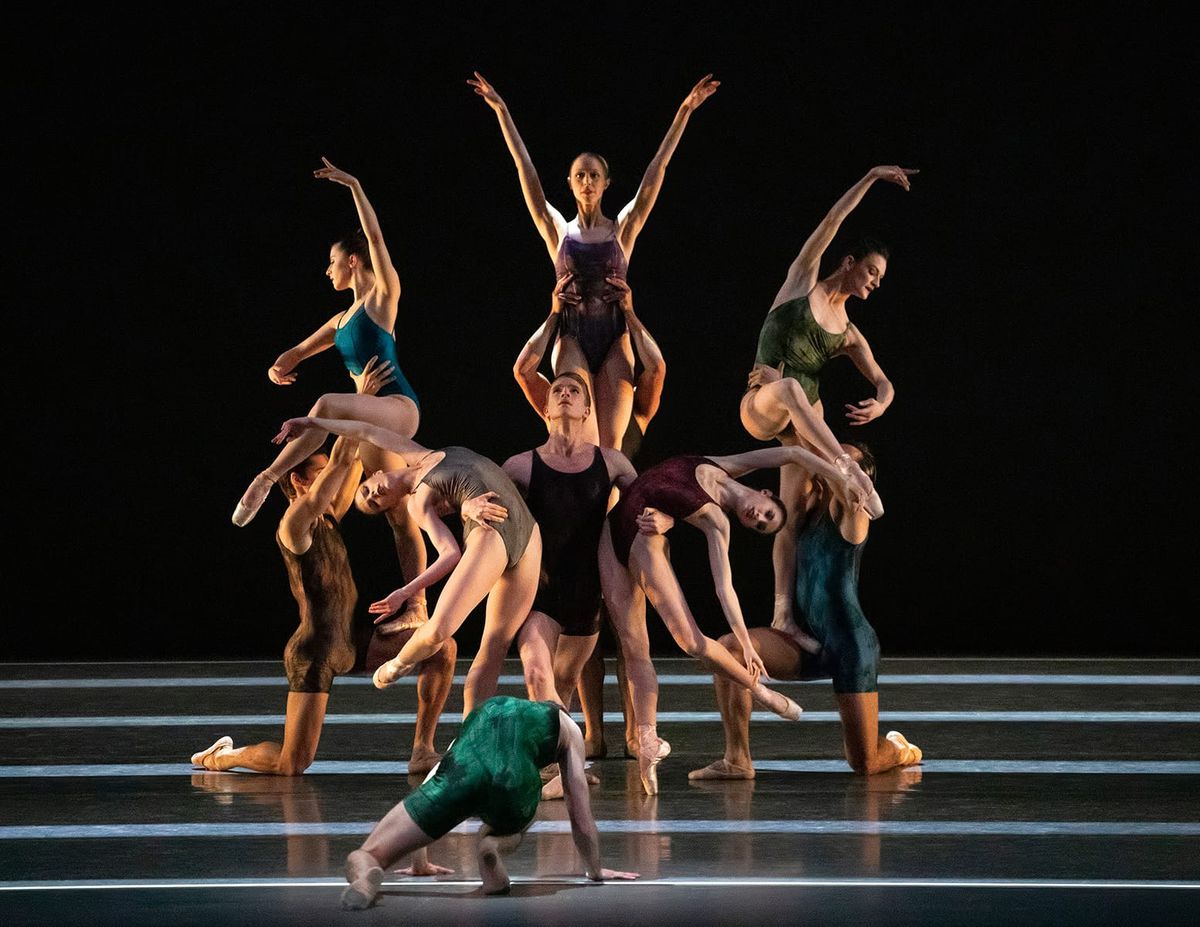
"Polyphonia,” “Bright,” “Opus 19/The Dreamer,” “Voices”
New York City Ballet
David H. Koch Theater
New York, New York
February 12, 2020
"There are no new steps, only new combinations". So said George Balanchine. At New York City Ballet, the company he founded, that statement has given rise to the rubric New Combinations, most often incorporating a new work, and other modern or modern-looking works; tutus and tiaras need not apply. Such was the case here, with wholesale debuts in "Voices," Alexei Ratmansky's newest ballet, just under two weeks old, and Christopher Wheeldon's "Polyphonia" which turns twenty next year. They were programmed with Justin Peck's "Bright,"new last year and Jerome Robbins' "Opus 19/The Dreamer" new over forty years ago. Novelty, chronologically at least, is relative.
Much has been made of Ratmansky's choice of music for "Voices", six selections from the contemporary Austrian composer Peter Ablinger's ongoing song cycle (his term) "Voices for Piano" comprised of taped speech – no one sings – and solo piano. True, there is no melody, and often no constant pulse, certainly not in the spoken sections, while rhythm is often subsumed in tangles of sound. By their own admission, the score is a stretch for choreographer and dancers alike. However, New York City Ballet has long included challenging scores in its repertory. Webern's "Symphony" Opus 21," even with Balanchine's guidance, has still not yielded all its secrets sixty years on, and if there's a melody in Pierre Henry's "Variations pour une Porte et un Soupir," it remains elusive.
That "Voices" is, at its core, a string of five solos for five women, also seems surprising. Yet as Balanchine famously announced, "Ballet is woman", and Ratmansky made a similar suite of solos for men in "Serenade After Plato's Symposium" though to a more traditional score than Ablinger's. The voices of Bonnie Barnett, Fjendine Ståtien, Farough Farrokhzad, Nina Simone and Setsuko Hara accompany and animate solos danced Teresa Reichlen, Indiana Woodward, Mary Thomas MacKinnon, Megan LeCrone and Alexa Maxwell respectively, while Agnes Martin's voice, discussing work and art, weaves through the finale.
Reichlen was, as always, beautiful to watch, clean, clear, her line drawn with an etcher's needle. But here that smooth alabaster perfection needed a little grit, weight, resistance, something akin to the push-me-pull-you of the dialogue in the score here and, with variations in emphasis, throughout the ballet. Heard on its own, the next duet with the voice of folk singer Fjendine Ståtien seems full of allusions to folk rhythms. Yet they vanished in the performance of Woodward's solo, which emphasized every sharply bent joint, knees, elbows, hips, like a modern Coppélia, or an articulated wooden toy on a string. MacKinnon was never quite still, tracing arcs around the stage, facing the audience or facing away, consumed by her thoughts. It's the kind of solo that could easily disintegrate into individual steps. It's to MacKinnon's credit that its integrity never wavered; its world remained whole and intact. Nina Simone's voice and sentiments provided the impetus for Megan LeCrone's solo, full of rage, to the point of walking off stage in mid-dance. While Simone's rage wells up from within fueled by centuries of injustice, LeCrone's was in response to exterior stimuli, like a specimen being prodded under a microscope, its limbs trying to escape in all directions. It was rewarding to see LeCrone, loose, with her whole body invested in the solo; more often, her legs have been stellar, her upper body trapped and tight. Like LeCrone, Alexa Maxwell has rarely looked better than she did here, her limbs baroque and macabre like a Yoshitoshi print, her concentration, and therefore ours, never breaking, and looking in her element.
Compared to the women, the men in "Voices," here Preston Chamblee, Davide Riccardo, Harrison Ball, Jovani Furlan and Peter Walker, seem to have almost nothing to do. But as the curtain opened partially, they skittered off stage as though driven by the force of Reichlen's presence, before she has even moved. They later acted as a phalanx, arms interlocked, escorting each woman off stage according to her situation. Reichlen joined the guys, interlocking her arms with them, while MacKinnon used them as a shield to hide behind. Chamblee, Riccardo, Ball and Furlan also danced quick solos of bread and butter virtuoso steps, brisés moving backwards, a circle of jetés, tours à la seconde (Walker's solo shot blended into the long and diffuse finale). The solos gave the audience a deeply desired chance to applaud something familiar. They also served as a reminder that no matter how unfamiliar the music, or a partially opened curtain might be, "Voices" is thoroughly rooted in the classical vocabulary, that seeing Ratmansky and the dancers stretch themselves is not something to be frightened of or put off by, but to embrace.
"Polyphonia," too, was danced by an entirely new cast, one that got the steps, which have rarely looked so pure and clean, but not the tone, the mystery which makes the ballet engrossing. During the leading ballerina's first duet, her legs reach into space like a sea anemone riding the tide, undulating from hip to knee to foot, an undersea waltz rhythm. Unity Phelan struck outward from the hip in a martial two beats. In the second pas de deux, the ballet's big coup de théâtre in which the woman – initially in a upended split – slithers under her partner's leg to kneel demurely before him, a moment which usually elicits gasps, went for naught, not a peep. Only the comparatively forthright men's duet by Harrison Ball and Sebastian Villarini-Velez delivered as expected.
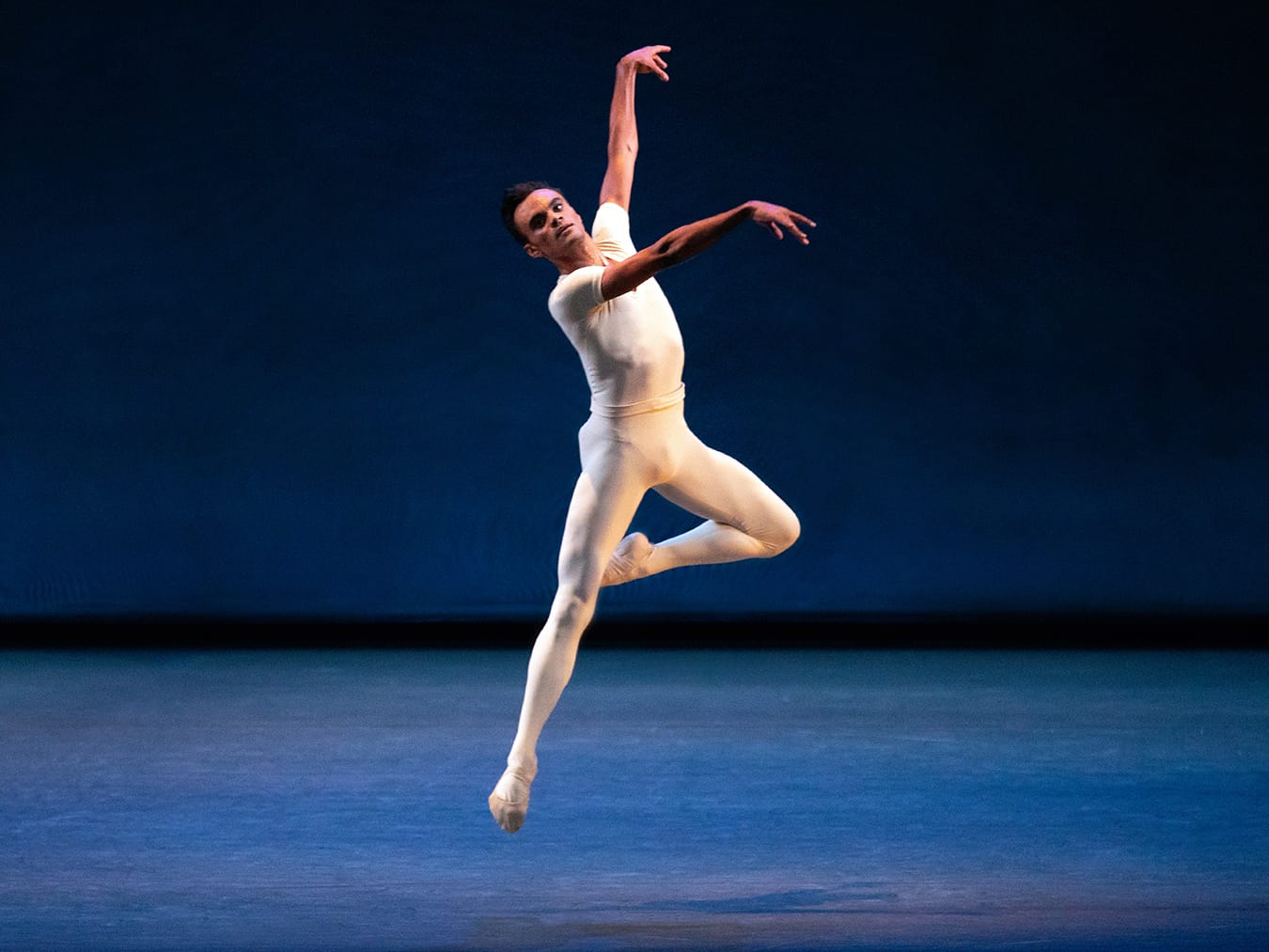
In "Opus 19/The Dreamer" Jerome Robbins took on the theme, frequently investigated by Balanchine, of the yearning, seeking male (here originally Mikhail Baryshinkov) on a quest to capture an elusive woman. Lauren Lovette was suitably delicate, ghostly and chimeric as the woman. Taylor Stanley was transcendent as the dreamer. This wasn't just a question of the dancer's fluidity, timing, or use of his eyes to direct the audience to what he saw and felt. Nor was it a result solely of intelligence or forethought. Although Stanley has worked out a narrative for himself (he recounts it in a video on the company's website), what we saw on stage was not words illustrated but a dancer living out his dream in this moment, and taking us along for the ride.
"Bright" was saved by being eight minutes of unnecessary only because it was the one ballet of the evening in which one didn't have to fight the darkness to see the dancing.
copyright © 2020 by Carol Pardo



