New Combinations, Old Hats
“Monumentum Por Gesualdo/Movements for Piano and Orchestra”, “Klavier”, “Symphony in C”
New York City Ballet
New York State Theater
New York, NY
January 24, 2006
New York City Ballet has for the past few years called January 24, Balanchine’s birthday, “New Combinations”, based on Balanchine’s quotation “There are no new steps, only new combinations”, and has used the occasion for one of the season’s premiers. This birthday present was a new work by Christopher Wheeldon, and unfortunately, it was something of an empty package. Wheeldon used the adagio from Beethoven’s Piano Sonata in B-flat Major, another in the long list, it seems, of music not to be choreographed. There was little variety in the introspective, haunting music, and the steps seemed to float on the top—they could have been set to any old piece.
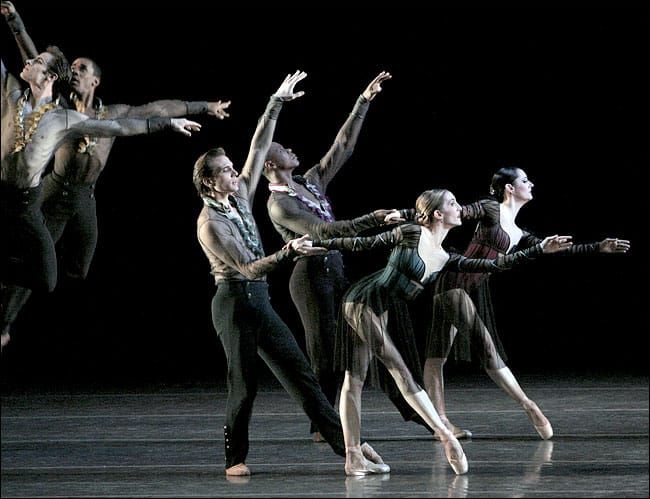
The set was a fancy chandelier lying at the back of the dark stage, possibly symbolizing the end of a grand civilization, the degradation of an opulent decadence, or the remnants of a road show “Phantom”. The costumes, by Jean-Marc Puissant and supervised by Holly Hynes, were dark net skirts for the women, who for some reason changed into shorter ones in the middle, and sheer shirts, with natty ties, for the men. The men, too, got a costume change; they switched to sheer u-shaped tops with color coded leis--costumes that could send mothers everywhere hurrying to yank their sons out of ballet schools.
The opening was striking, with the cast of ten walking around, lifting their arms in odd, ominous movements, but the mood of elegant decadence was not amplified or enlarged, it just ambled along with a lot of hauling and sliding. It was as if Jerome Robbins had been asked to choreograph “Some Variations on the Theme of Dracula” for the Ice Capades.
The dancers, Wendy Whelan with Sébastien Marcovici and Miranda Weese with Albert Evans, emoted strongly, but remained surprisingly blank. Wheeldon has usually been able to make his dancers look individual and interesting, but, by the time the dancers repeated their opening walking towards the back of the stage movements, the audience knew nothing more about them or about the music; the piece seemed to move from point A to point A with no detours along the way.
The evening opened with “Monumentum/Movements”, one of Balanchine’s uncompromising, elusive black and white combinations. Darci Kistler and Charles Askegard danced the lead couple in both pieces. Kistler, though some of the dancing was tentative, had an air of elegiac radiance, a sense of opening up, of reaching for the light that was truly beautiful. She looked less comfortable in the spiky “Movements”, and her sunny and gracious demeanor does not fit with the quirky, slightly ominous atmosphere. Askegard, on the other hand, was much better in the second piece, dancing with an odd, trapped feeling that caught the tension of the music.
“Symphony in C”, with its celestial architecture, is always a model of ballet construction, no matter who is dancing, but it was especially welcome with the very fine cast. Jennie Somogyi, though she does not yet have the fearless attack she showed before her injury, remains one of City Ballet’s most complete ballerinas, with an almost magical coordination that seems to carve the most beautiful majestic shapes out of the air. Sofiane Sylve danced the second movement. She is strong, centered, and equally majestic, but she doesn’t have the hint of vulnerability, of being pulled by fate to a doom that the role traditionally calls for. But she substituted a strength that seemed to portray a woman choosing her own destiny, almost willing her own sacrifice, that was striking and memorable.
The second movement is haunted by the ghost of Odette, and the third movement seems to be an homage to Princess Florine and her bluebird. Megan Fairchild and Joaquin de Luz certainly made the connection clear, with sparkling, beautifully classical performances (though Fairchild’s hands seemed at times to be turning into spatulas before our eyes). The somewhat thankless fourth movement was danced by Abi Stafford, who seems much more in control and at ease since she returned from her injury. New or old, “Symphony in C” is always a wonderful combination.
copyright ©2006 by Mary Cargill



