New Combinations
“Herman Schmerman,” “Principia,” “The Runaway”
New York City Ballet
David H. Koch Theater,
New York, New York
February 3, 2019
Under the rubric, “New Combinations,” New York City Ballet brought together a premiere by Justin Peck, a new ballet from the fall season by Kyle Abraham, and a ballet by William Forsythe that hasn’t been seen in full since 1994. It proved to be the kind of imaginative programming that makes elements and associations visible that might not otherwise be apparent.
The concert opened with Forsythe’s “Herman Schmerman” from 1992, a slangy title that anticipates a work that doesn’t take itself too seriously. This was perhaps aimed at the New York critics who treated Forsythe as an outrageous upstart during the first several decades of his career. Considering Forsythe’s early reception, Peter Martins, NYCB director at the time, was taking a chance inviting him to create a ballet for the company. The fact that the piece hasn’t been seen in its entirety since 1994 speaks for itself (only the central duet has been performed). Seeing it now, you wonder what all the fuss was about.
The work, which has an electronic score by Thom Willems, is set for four women and three men. On Sunday the first part featured Sara Mearns, Unity Phelan, Naomi Corti, Harrison Ball, and Joseph Gordon, followed by a duet for Tiler Peck and Tyler Angle. After these two sections there is a short finale, which ends with all the dancers diving to the floor and, blackout. The ending encapsulates the good humor of the work as a whole.
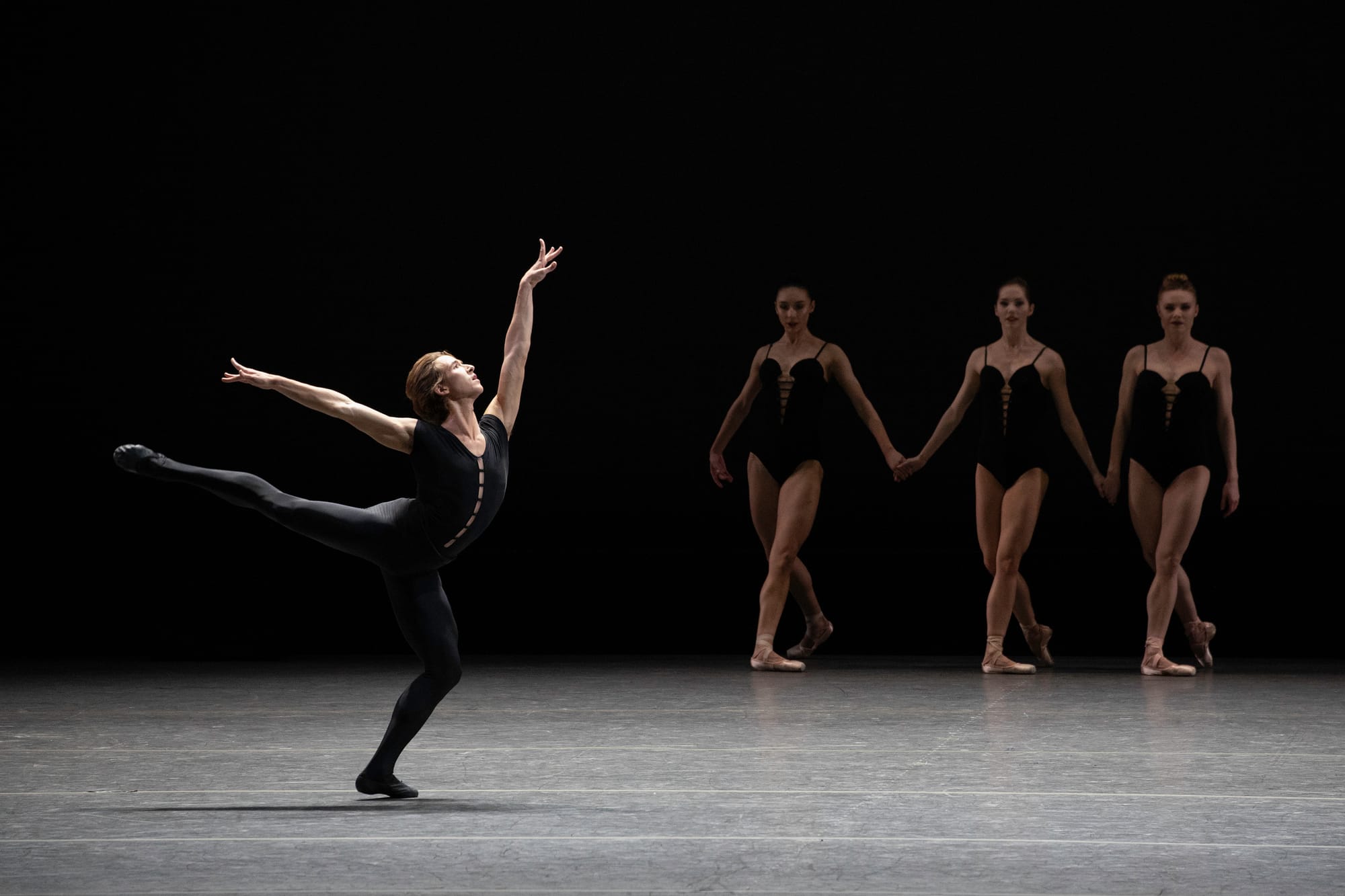
Forsythe is often referred to as a deconstructionist, but it is clear from “Herman Schmerman” that his purpose was not to deconstruct (or destruct as some would have it), but to analyze the classical vocabulary to see how it could be extended. His approach might be called analytic classicism. This is not so different from what Balanchine was doing earlier in the 20th century with the jazz inflections he gave to the danse d’ecole. Now, of course, we are used to seeing the off-balances, legs turned in and out, jutting hips, tapping toes for emphasis, and high extensions that break the classical line, which Balanchine introduced. Forsythe, in the 1980s and ‘90s, pushed extensions and off-balances to more extremes, which led to new kinds of tensions. He demanded fast footwork, and gave arms and hands new emphasis. Today, many of these elements have been absorbed into the ballet mainstream and, like Balanchine’s innovations earlier, no longer look particularly revolutionary.
What is less talked about than Forsythe’s self critical approach to the danse d’ecole, and what I found especially interesting in “Herman Schmerman,” is his use of stage space and his arrangements of the dancers. It is rather different than what we usually see at New York City Ballet, and it looked fresh, although certainly not radical. For example, in the first section there is a moment when the men dance in from the wings and through a line of women, who are executing quite different material. The men settle in back of the women and carry on with their own dance, and then we see that the two combinations of movement, although different, fit together like pieces of a jigsaw puzzle. It should be added, that in this section Forsythe pays homage to Balanchine, using some of the jazz inspired steps Balanchine incorporated. Forsythe also gives us one iconic pose from “Agon” where the ballerina wraps her leg around her partner’s back in a high attitude. The pose only lasts a moment and is not repeated, but it makes an impact.
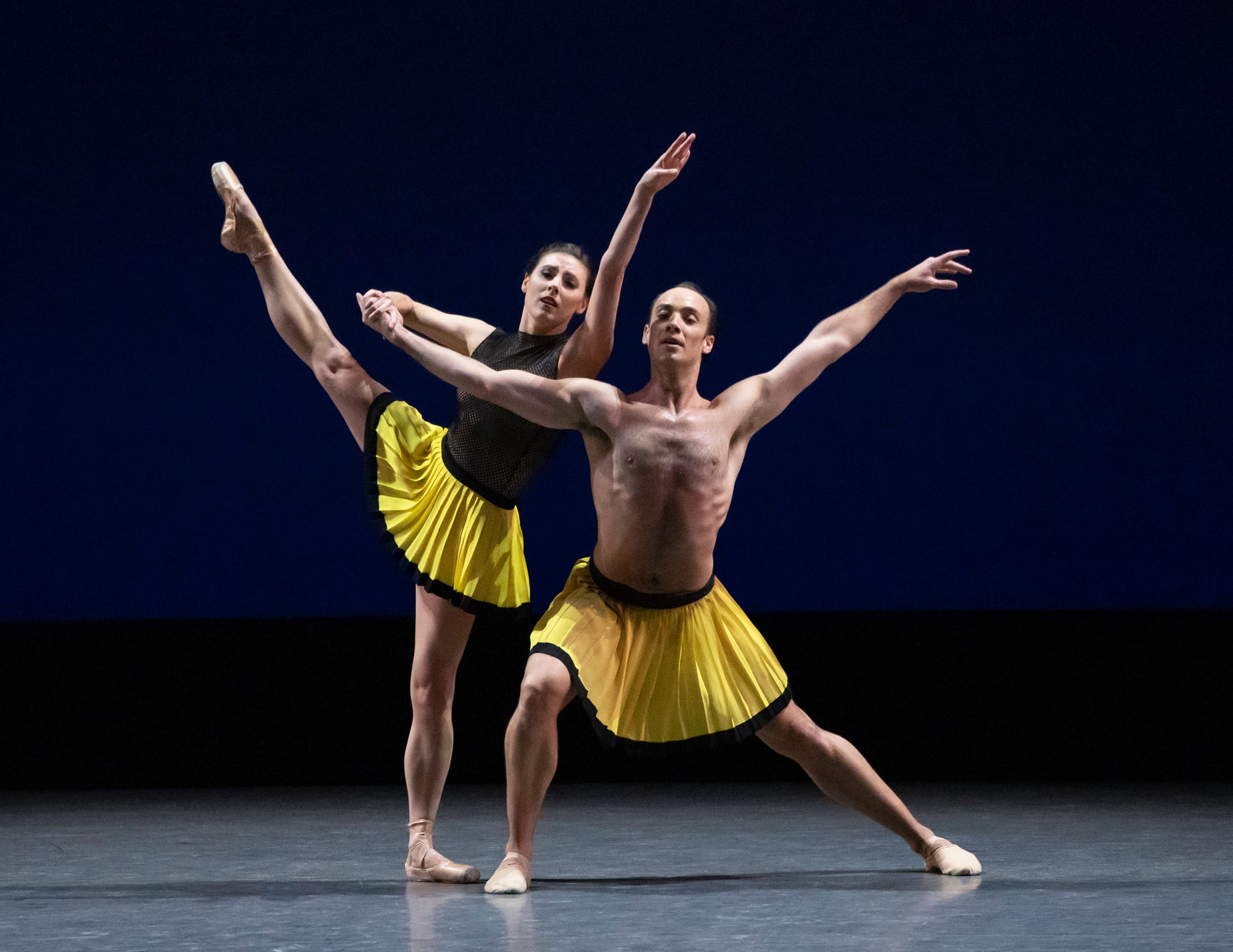
The duet, danced by Tiler Peck and Tyler Angle is notable in that the woman appears to be in charge without being mean about it. She crooks her finger and he comes, but it’s all good humored, and they shake hands at the end. The only odd part of the work, in my view, is when, halfway through the duet, the couple, who like the rest of the cast wear black costumes by Versace, disappear into the wings and reappear wearing short yellow skirts, the man now bare-chested. The new costumes add nothing to the dance and mostly look silly. Who knows where the idea came from, maybe Versace wanted to make more of a statement, maybe Forsythe thought the bright yellow added to the insouciance he wanted to achieve.
“Principia” is the title of the musical work by Sufjan Stevens that Justin Peck used for his new ballet, and which he retained for its title. Although “Principia” can be associated with several philosophical works, it is tempting to think of the ballet in terms of Newton’s three volumes on the laws of motion and gravitation. What could be more appropriate to dance?
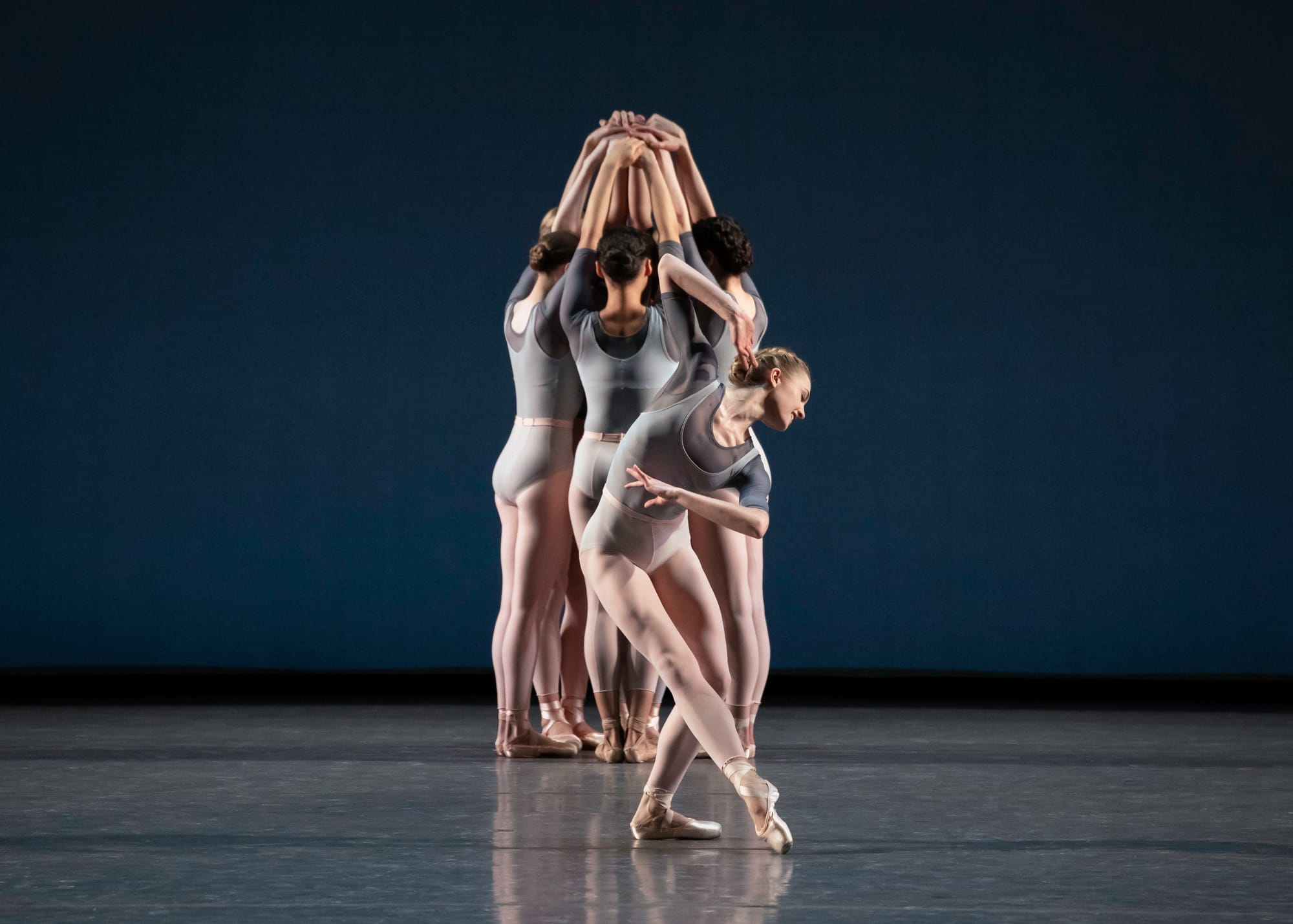
Peck’s ballet is a big work for twenty-four dancers dressed in light colored leotards and tights. Although plotless, we seem to be viewing a communal Eden. The ballet begins with a large group in a tight circle, as if proclaiming its unity. As this configuration dissolves, individuals meld effortlessly into and out of shifting patterns, sometimes dancing alone, sometimes with others. In the second section small groups emerge, with arms raised, as individual dancers lightly touch the upraised arms and the groups dissolve. This is set to music that features the chimes of bells, which coincide with the groups’ dissolution and regrouping into new formations. A turning point in the ballet comes in a riveting moment, during which Harrison Coll sees Daniel Applebaum across the stage and merely stops to look. After that moment, a number of individuals gradually find partners. There is a duet for Tiler Peck and Taylor Stanley, where they rarely separate from each other, and at the end walk off hand in hand. This and other dances for couples, including Coll and Applebaum, happen without disruption or a sense that they threaten the community. By the end, as the cast lines up across the stage, Coll and Applebaum are together, as are others, while still remaining part of a unified whole. All of this is achieved in a smoothly choreographed series of dances that includes a number of Forsythe’s innovations, perhaps tamed a little, but there nevertheless and now fully absorbed into the classical vocabulary.
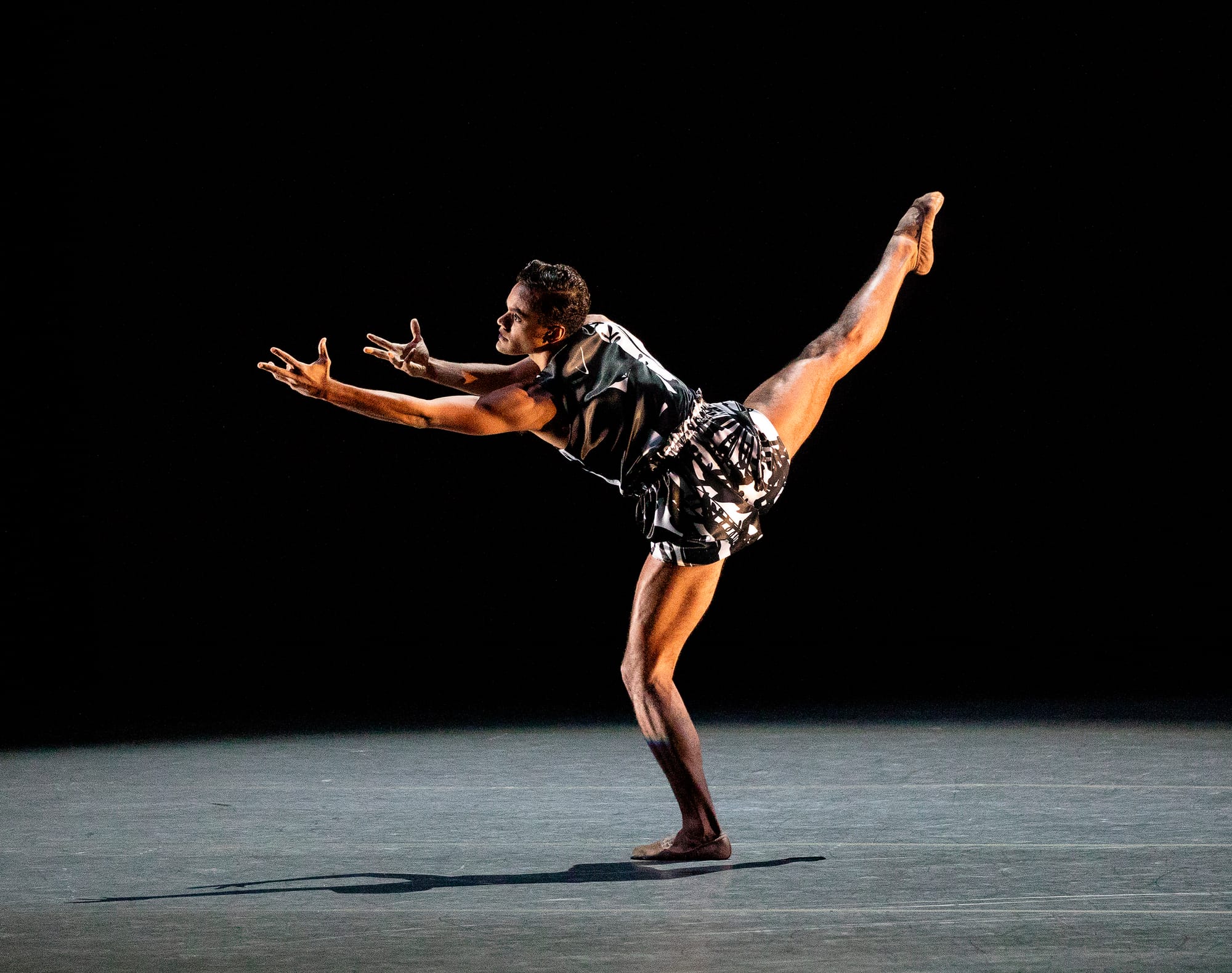
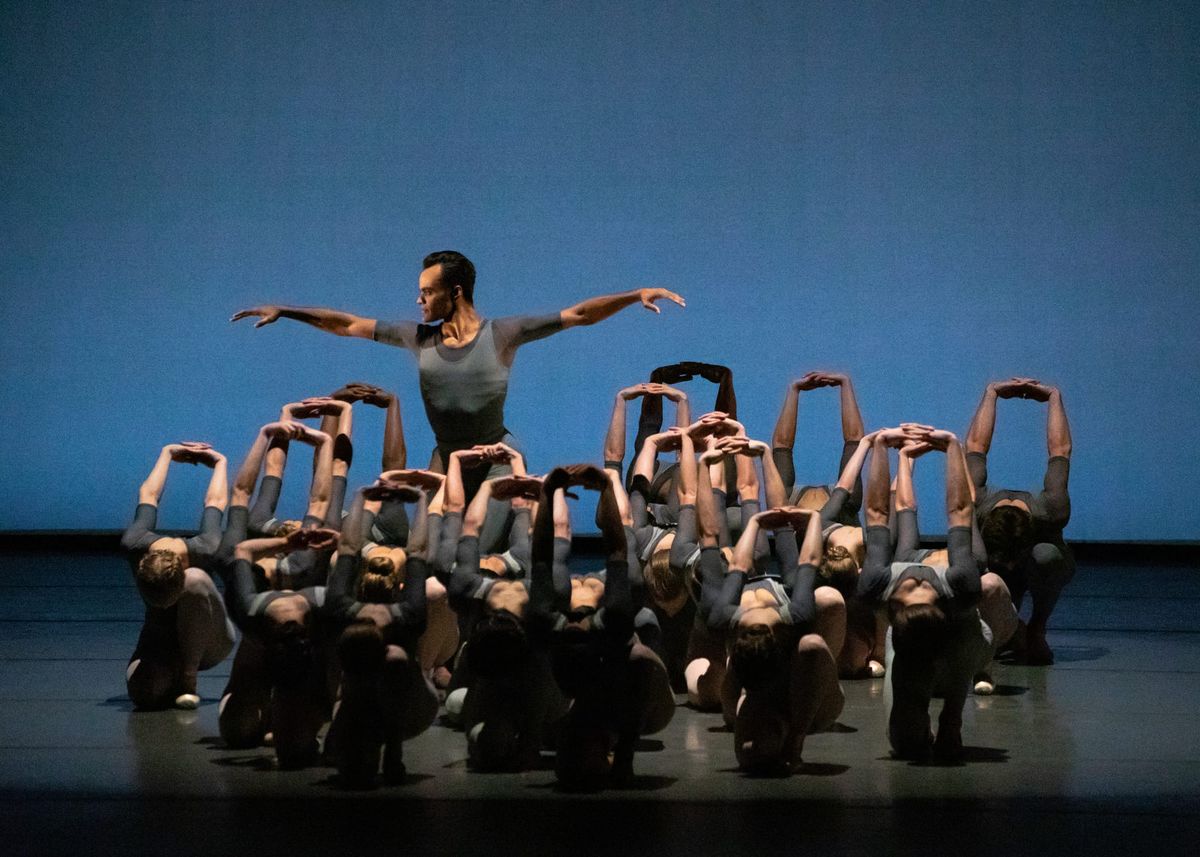
The last work on the program, Kyle Abraham’s “The Runaway, pretty much defies categorization. It received its premiere during the fall season and is making a return appearance. The costumes by Giles Deacon are fantastic concoctions in black and white that range from shorts and top splattered with black for Taylor Stanley, the central dancer, to a headdress that totally covers Peter Walker from the neck up and looks like a gigantic spray of feathers. The central women—Ashley Bouder, Sara Mearns and Georgina Pazcoguin — wear elaborate hats and ruffs that obscure their faces. Then there is the music, which starts with Nico Muhly’s appropriately titled “Quiet Music,” that segues into hip hop by Kanye West, Jay-Z and others. Throughout, Stanley is the star, dancing solos that start and end the work, plus several in between. His opening dance is like a 21st century Apollo moving from spasmodic beginnings to mature power. And his last dance has him alone on the stage in a deep back-bend as the curtain falls. It is a tour de force role, which he dances with compressed intensity.
Much has been made of Abraham being the first black choreographer to be engaged at New York City Ballet in decades, and of Stanley being a dancer of color. These are important landmarks, and much of the credit for bringing Abraham to NYCB goes to Justin Peck, who is part of the current team directing the company. “The Runaway” is also a huge hit with audiences. However, all of this tends to obscure another important element, which is that “The Runaway” is an excellent piece of choreography. Abraham does not come from the ballet world, his dances are in a contemporary idiom, but that doesn’t make them any less disciplined. Here he combines his own vocabulary of shimmying arms and torso, and hip hop moves, with classical steps that make the danse d’ecole look refreshed, rather than diminished. Unlike Forsythe, he is not attempting to critically examine the ballet vocabulary, but rather to demonstrate that it is flexible enough to work in league with other genres to capture elements of contemporary existence.
One last point: in the printed program Abraham is listed as choreographer in collaboration with NYCB. This would seem to indicate that the dancers had input into the dance making process. That has to be a first for the company, not that dance making is a collaborative effort, but that the collaboration is acknowledged.
copyright © 2019 by Gay Morris



