New and Old
"Antique Epigraphs", "She Holds Out Her Hand", "Short Memory", "Song Before Spring"
New York Theatre Ballet
Danspace Project
St. Mark's Church
New York, New York
October 6, 2016
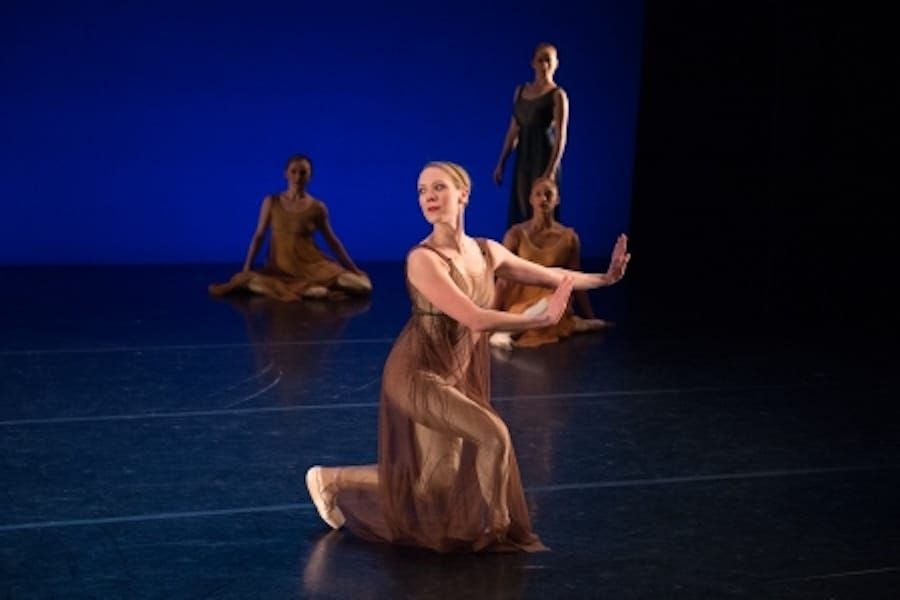
The New York Theatre Ballet is a chamber group renowned for its recon- structions of older, smaller, infrequently seen works which has in recent years broadened its approach with a series of programs called "Legends & Visionaries" which combine older works with new ones, often created for the company. The legend of the evening was Jerome Robbins' 1984 meditation on ancient Greek sisterhood, "Antique Epigraphs" which was set on the company by Kyra Nichols, a member of the original cast. The company performed at the Danspace Project, a repurposed church which has intimate seating (the ushers spent a lot of time asking the audience not to walk on the Marley stage), minimal lighting, and no wings or proscenium, a very different ambiance from the ballet's original setting at the New York State Theatre (as it then was).
To its great credit, the company used live music for all the pieces, and the musicians for "Antique Epigraphs" (two pianists and a flautist) performed behind the audience, surrounding them with the delicate sound of the Debussy, and flowing towards the eight dancers, who seemed to move in response. The potential disadvantages of the minimal stage, for me, made the work more varied and animated that the original "Dances at the Parthenon" haze, which was beautiful, but somewhat monotonous. The New York Theatre Ballet dancers were scrupulous and detailed, emphasizing the subtle variations on their upper bodies, shifting from traditional ballet poses to Grecian-inspired flatter, more angular shapes with effortless precision.
The well-behaved audience didn't break the spell by applauding the individual daces, which helped maintain the effortless, elegiac mood. Not that the dancing wasn't work applauding; Elena Zahlmann danced her first solo with a wary power and Amanda Treiber gave her a powerful energy and hint of rebellion, as if there were undercurrents of unease in that band of sisters.
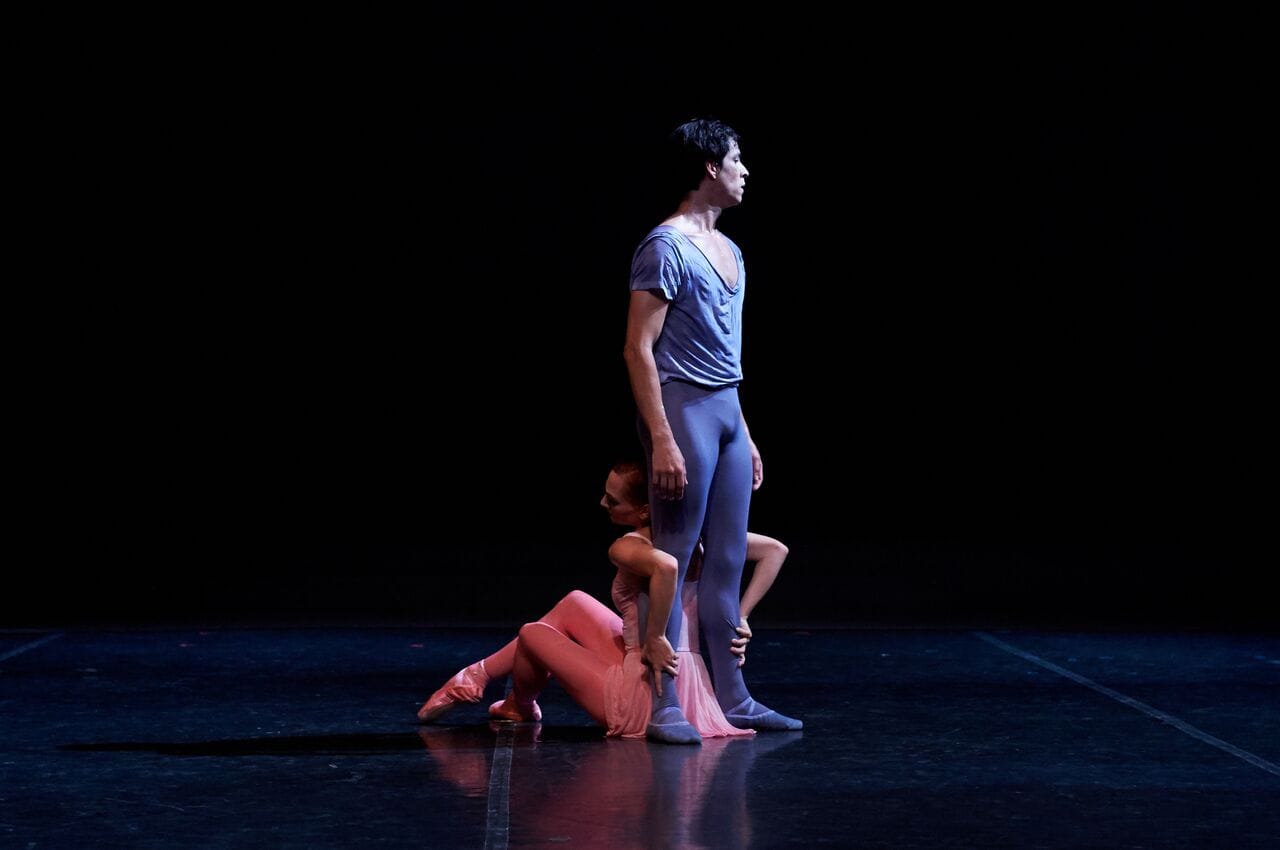
Treiber was also featured in "She Holds Out Her Hand", a premier by the former NYCB dancer Antonia Franceschi to music commissioned from Claire van Kampen ("Piano Sonata No. 1" played by Michael Scales). The choreographer dedicated her work "To the many families and parents who lost someone way too soon and their courage to go on" and adds that she was inspired "by an exhibition in the church which was of tee shirts used as grave sites." This tragic subtext, though, was not explicit and the work seemed more about the relations between the sweet and lyrical Amanda Smith and the tall, elegant Amanda Treiber. Smith opened the work in a pool of light, standing in the Degas "Little Dancer" pose, a motif that was repeated periodically amid the strident, rather monotonous music. Treiber, wearing bright pink tights which made her stand out amidst the group of women surrounding Smith, had a rather fierce pas de deux with some athletic coupling with the hardworking Joshua Andino-Nieto. All the dancers were vivid and committed, though they did spend a lot of time leaping to and fro across the stage, but for all its hard work, the piece was jerky and emotionally vague.
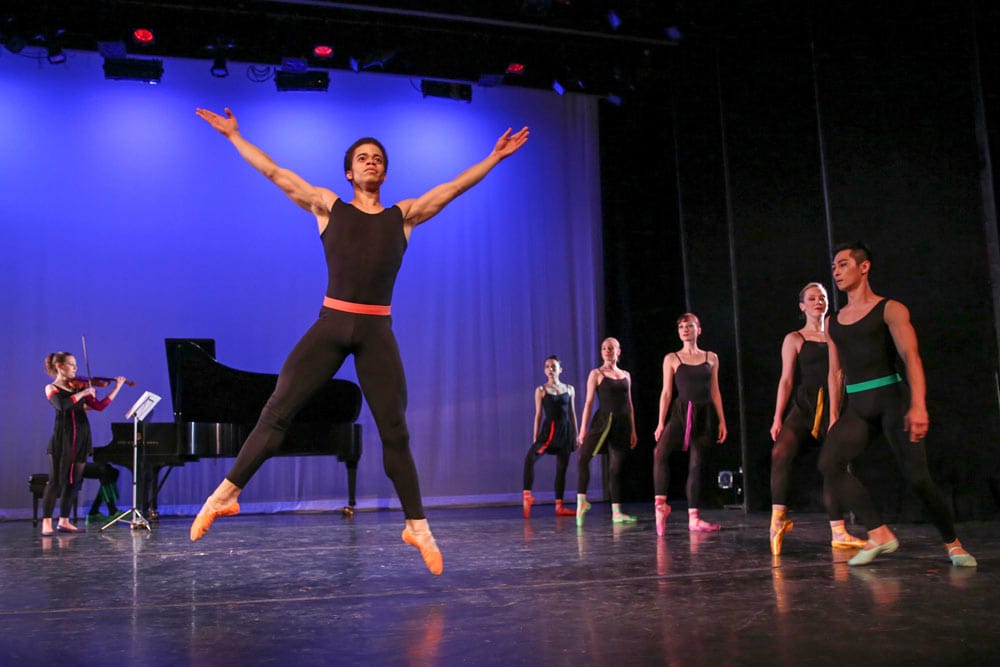
Pam Tanowitz's "Short Memory", choreographed for the company in 2013, had no emotional underpinnings. It was an impersonal excursion into movement for its own sake, gently upending various ballet motifs with wit and originality. It was enhanced by the simple black costumes accented by right primary colors (designed by Sylvia Taalsohn Nolan). The dancers' black tights helped emphasize the brightly colored shoes, making the dancers look as if they were dancing on Christmas tree light.
The choreography did seem like a present to the dancers, and they seemed to be having a great time with witty little shifts of weight and unexpected little shimmers. Steven Melendez stood out in a somewhat Bournonvillian solo, showing a smooth, quiet torso propelled by fast, generous jumps, in a dance of casual beauty, perfectly suited to his unassuming elegance.
Melendez, with the ABT dancer Zhong-Jing Fang, choreographed the final work "Song Before Spring", set to etudes by Philip Glass. The 45-minute piece for eight dancers was their first choreography, a daring commission. It was a confident work, full of ideas that weren't always clear. The dancers, dressed in modern clothing (the men in dress suits and the women in beautifully cut black and white dresses, which they eventually exchanged for more colorful ones – spring flowers, perhaps), formed a somewhat uneasy community, with various dancers breaking out in small, emotional vignettes. Some of these were striking; Melendez danced an Everyman solo, with a raw and naturalistic despair, and Zahlmann, in a red dress, was a conflicted scarlet woman, abandoned, angry, and alone, watched coldly by two men. But others, while energetically danced, seemed more a combination of movements than a statement. The dancers though, responded valiantly and the dancing, as it had been all evening, was compelling.
copyright © 2016 by Mary Cargill



