Name Game
“Giselle”
Mikhailovsky Ballet
David H. Koch Theater
New York, New York,
November 12, 2014, matinee
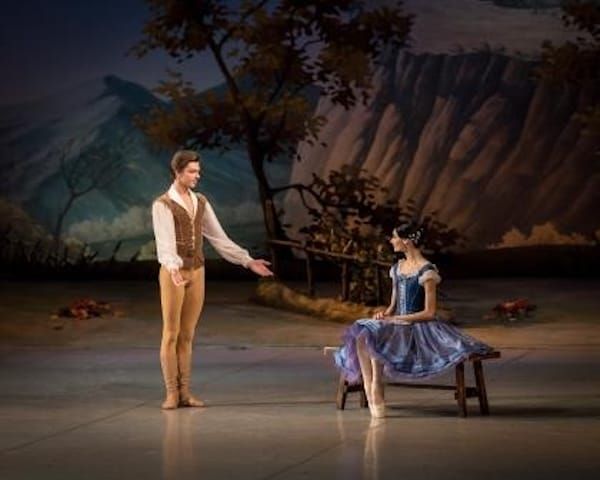
The Mikhailovsky Ballet, known in Soviet times as the Maly, is based in St. Petersburg, formerly known as Leningrad, and is a smaller cousin of the Maryinksy, formerly known as the Kirov. With all these name changes, it is probaby no surprise that their "Giselle" eschews named characters, and the active village is inhabited by Gamekeeper, Count, Duke, Mother, etc. Giselle does keep her name, basically I expect because it would be difficult to market the old ballet as "Girl". Despite these modern archetypes, the production, produced by former dancer and well-known Albrecht (back when he had a name) Nikita Dolgushin, is traditional without seeming hidebound, detailed and often very moving.
The Mikhailovsky Ballet includes some well-known dancers who have joined from larger Russian companies, including Natalia Osipova and Ivan Vasilev. The Wednesday matinee, however, had no starry names. Anastasia Soboleva, a first soloist who trained at the Bolshoi, was Giselle and Victor Lebedev, who graduated from the Vaganova School in 2010 was the Count formerly known as Albrecht. Soboleva is a willowy dark-eyed beauty, with long arms which had a tendency to fly, making her Giselle an impetuous, slightly coltish young girl. She is a deceptively strong dancer (the hops on point were fearless) but she didn't toss her technique in the audience's face and had a sightly inward, private quality, dancing with a quiet rapture that focused on Albrecht. The production was an interesting juxtaposition of stylization and realism which helped focus on the drama. The mad scene began with the peasants and aristocrats arrayed at the side of the stage, facing the wings in frozen poses while Giselle stood front and center, which encapsulated Giselle's devastating solitude with brilliant subtlety. Soboleva wasn't just alone, she was in physical pain and I have rarely seen that so explicit as she showed the waves of pain rippling through her body; it was almost possible to feel her heart breaking.
Lebedev was a young, somewhat callow hero. He is a slight dancer with an elegant jump and fluid back and an eager but still slightly rote stage presence. His Albrecht was a nice, slightly dim fellow who seemed to be in love with being in love. He was not helped by by second act costume, dark purple with spangly accents. (The most logical explanation seems to be that he snuck out of a costume party where he was dressed as a rhinestone cowboy.) Despite the shiny distractions, his second act had some fine touches. I was especially struck by a moment when he was dancing with Giselle and he paused slightly with his hand on her arm as if to prove to himself that she was actually real. His entrechants were amazing, as he bounded crisply and cleanly through what seemed to be about 50 of them before collapsing in a realistic heap. But he didn't just make it stunning physical exhibition, there was something forced about them, as if they were being pulled out of him by Myrtha and they made a dramatic impact.
The other featured dancers were generally fine, though the peasant pas de deux (Anna Kuligina and Ivan Zaytsev) teetered a bit in the supported pirouettes. The dancers, who come from various schools, danced with un-mannered clearness and the wilis seemed to barely step on the stage, a welcome contrast to the usual tap tap tap of Russian point shoes. Mikhail Messerer, a member of the famous ballet family (Maya Plisetskaya is a cousin), has been the Ballet Master in Chief since 2009, and has clearly done a fine job.
This production, despite the purple mistake, is beautifully designed (sets and costumes by Vyacheslav Okunev), though Bathilde does tromp through the forest in quite inappropriate attire; apparently "Too much bling" said no Countess ever. The bright autumnal colors of the first act contrast beautifully with the silvery forest of the second. Dolgushin has put the villagers in character shoes, so they hop happily through their dances. A travelling gypsy band seems to have left behind some used tambourines and their rattle added to the enthusiasm. For some reason Dolgushin has eliminated the queen of the harvest scene so Giselle doesn't get that short-lived moment of triumph but was still a fine and emotionally vivid performance.
copyright © 2014 by Mary Cargill



