Muddy Waters
Tradition and Innovation
"Concerto Barocco", "Oltremare", "Tschaikovsky Suite No. 3"
New York City Ballet
David H. Koch Theater, New York
February 6, 2009
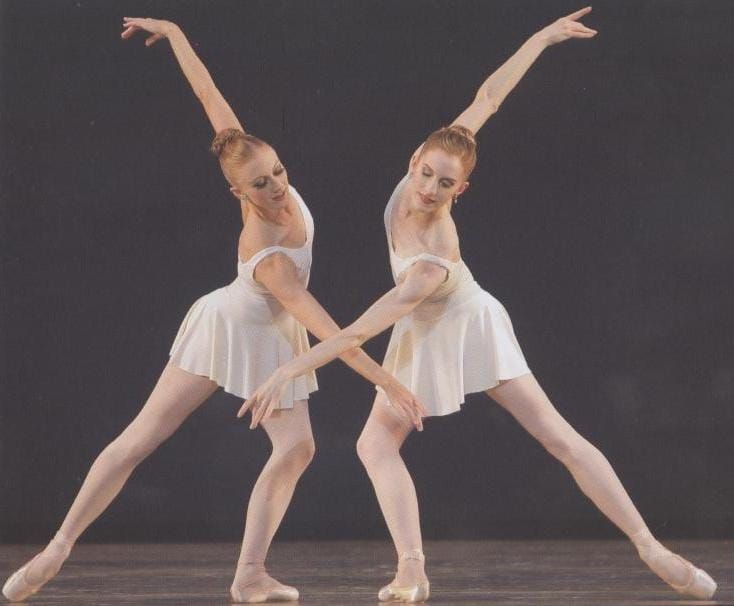
In the effort to come up with titles for their programs, the marketing department has reused the "Tradition and Innovation" idea several times for various collections, presumably to mean Tradition=Balanchine and Innovation=A Newish Ballet. However, genius will always equal innovation, and unfortunately, newish ballets tend not to be choreographed by geniuses nowadays. But Balanchine's "Concerto Barocco" will always be innovative, because it's architecture is so rich and so pure there is always more to discover. The performance, with Wendy Whelan, Rachel Rutherford, and Albert Evans, was a bit sluggish, and Whelan and Rutherford, both individually fine, are such different dancers that there seemed little connection in the opening section; they did not look like two strings on the same instrument. But once she got to the pas de deux, Whelan, with the elegant and unobtrusive Evans, used her luminous line and unique musicality to elegant effect. It was disappointing, though, that this imaginative dancer didn't vary the sets of repeated steps that Balanchine set to the gradually intensifying music; there was no real sense of movement reaching a climax.
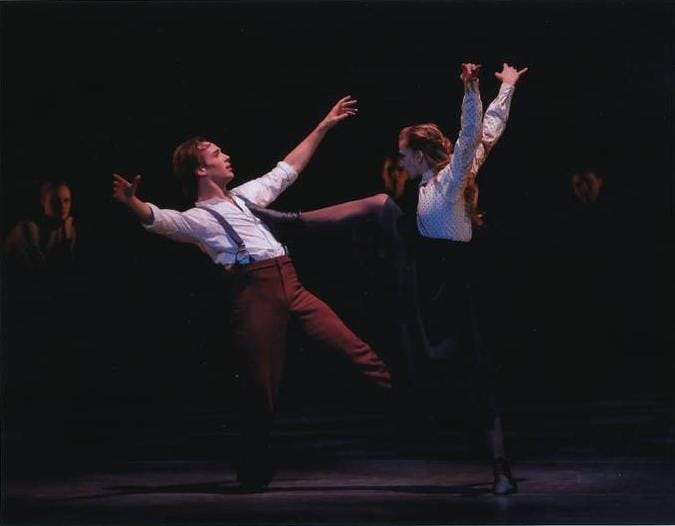
There was no climax to be reached in Mauro Bigonzetti's 2008 "Oltremare", a dreary and self-indulgent exercise. The unfortunate dancers trudged on stage carrying suitcases, and then had to sit through the work perched on them, presumably waiting for their ship to come in. They were dressed in vaguely turn-of-the-century clothes (though no respectable turn-of-the-century female would allow herself to be turned upside down and used as a mop so many times). The music veered into "Godfather" territory, so these were probably Italian peasants off to the new world, but the ensemble, once they could get up off their suitcases, broke into some vaguely Russian folk-dancing (complete with barrel turns). They could have been a group of morose Russian acrobats stranded in Italy, with an odd vitamin deficiency which caused sway backs, jerky arms, and the tendency to kick at odd moments.
Balanchine's "Tschaikovsky Suite No. 3" took the audience back to Russia, or at least to an idealized version of it. Sara Means made her New York debut in the Elegie, with Ask La Cour, and she was electrifying. It was passionate, mysterious, and ultimately tragic, as La Cour, Balanchine's Everypoet, ends as he began, alone. The following two movements didn't quite live up to the vivid opening, though Daniel Ulbricht lit up the Scherzo. Sterling Hyltin and Benjamin Millepied both debuted in the Theme and Variations section. Millepied danced with an understated grace and elegance; if he didn't quite look like he was wearing an invisible crown, he certainly wasn't wearing a baseball cap. He didn't push his solo, and made the steps look easy and natural. He also brought a warmth and delicacy to the pas de deux; a remarkable debut.
Unfortunately, Hyltin couldn't match him; she is a coltish dancer who doesn't as yet have the elegance for this most ballerinaish of roles. She didn't seem to relax into the steps, and even the luminous pas de deux was taken at a staccato pace. It may have been nerves, but she had trouble with the steps, especially the quick opening movement, though the finale had some beautiful moments.
copyright © 2009 by Mary Cargill