Monk on Monk
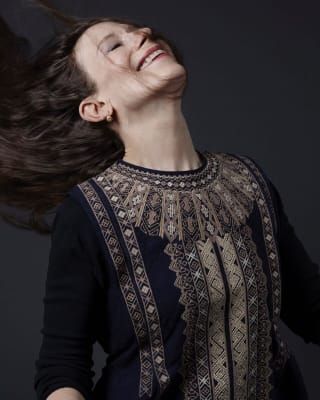
"Dancing Voices"
Meredith Monk and the Young People's Chorus of New York
Lincoln Center White Light Festival
New York
October 20, 2017
As an artist Meredith Monk has never done just one thing at a time. With “Dancing Voices,” which helped kick off Lincoln Center’s White Light Festival this weekend, she attempts both a retrospective of her own career as composer-choreographer and a transmission of her dharma to a new generation of artists.
“Dancing Voices” is divided into two parts. Part One is a selection of her early experiments, from the Sixties to the early Nineties, performed with a chorus of young kids. Part Two is more recent, reflective works, with older children joining in. The first part was the most fun, and the most moving.
Monk’s early work was characterized by inspired nonsense, her persona a troubled girlchild paying the world back for its absurdity by going it one better. I have a dim recollection of her sitting at a piano in one of her early downtown works, singing out the things that kept her sane – “I have my allergies!” she concluded triumphantly. In Dancing Voices she reprises the role, this time as an eccentric matriarch. She still has her hands, her money, her memories –- and her allergies! And once again she cracks us up.
An eccentric matriarch is what she is in her opening section, surrounded by a cloud of elementary school kids from the Young People’s Chorus of New York. Two of them join her in a sing-song game –- “Choosing Companions” –- in which they try out steps and introduce themselves in a gentle parody of adult socializing: “I have a wry sense of humor,” says one kid mock-solemnly. “Nice hiking boots!” observes the other.
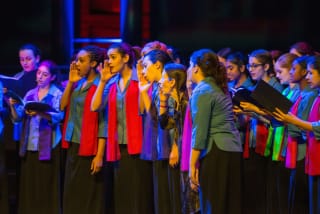
Children watch and listen as Monk and Katie Geissinger perform a wordless vocal duet, a seamless dialogue of deep arpeggios and falsetto chirps so complex that it leaves you imagining a third source of sound. But it’s just the two of them.
All join in a big circle for Monk’s “Panda Chant,” endless variations on a funny word for a fuzzy animal.
But for me the high point was a duet for Monk and a girl of about 12, Milena Manocchia – a wordless, wondering “nigh-nigh-nigh” that the young girl begins and the older woman joins, with a generous sweep of the arm that draws her young companion’s eyes outward, to the universe. God is nigh.
This was the Monk of the 20th century: a cosmic clown, a graceful weirdo, all over the spectrum, creating her own art form out of stuff that just pleased her, just came out.
Part Two of the program is with older kids and a more recent Monk; still playful but more philosophical, addressing questions of life and death, Heaven and Hell. “Three Heavens and Hells” is a choral koan without much of a payoff. It’s all the same, says the ending. And the ending of “ascent” has musicians lying on their backs, making music to the spheres -- an upside-down apotheosis.
That might be a good antidote for the general overreach of the White Light Festival, Lincoln Center’s annual series on arts and the spirit. This year’s selections range from Monteverdi to Mark Morris to Samuel Beckett. Festival director Jane Moss says they delve into “not only religious faith, but also …faith in love, faith in a better future, faith in one’s self, and most important for us, faith in the transformative power of art.”
copyright 2017 by Tom Phillips