Missing Alchemy
“Untitled, 2023,” “Yugen,” “Quantum Souls”
Wayne McGregor: Alchemies
The Royal Ballet
The Royal Opera House
London, United Kingdom
May 1, 2026
Most creators, even of the genius sort, cannot produce exclusively masterpieces, and The Royal Ballet’s evening of three Wayne McGregor works titled “Alchemies” was an example of that humbling notion: a sampling of ballets from the creative incubator that generates great art, united by musical experimentation and abstraction, but ultimately unable to fully alchemize into gold. On their own, or in mixed bills alongside less inventive choreographers, each work would have made a statement. As paired though, they bled together, showing the churning innovation of this master, but never particularly rising above any of each other. Still, to this New Yorker, they were their own sort of a revelation: a precious peek behind the curtain at what shares the creative space with, and helps birth, “Woolf Works,” “Infra,” and the like.
The company performed two older works – the gloriously abstract 2023 creation “Untitled, 2023,” and the award-winning, liturgical 2018 ballet called “Yugen” – alongside “Quantum Souls,” which had its world premiere only days earlier, and was receiving just its fifth performance. In that progression, the evening moved from visually stunning to emotionally rich to sonically inventive, each ballet a different lesson in how far McGregor reaches to explore new ways for physical expression. Danced by second casts, the star power was mostly absent, but in its place was something equally precious: a deep bench of talent not yet in the worldwide spotlight.
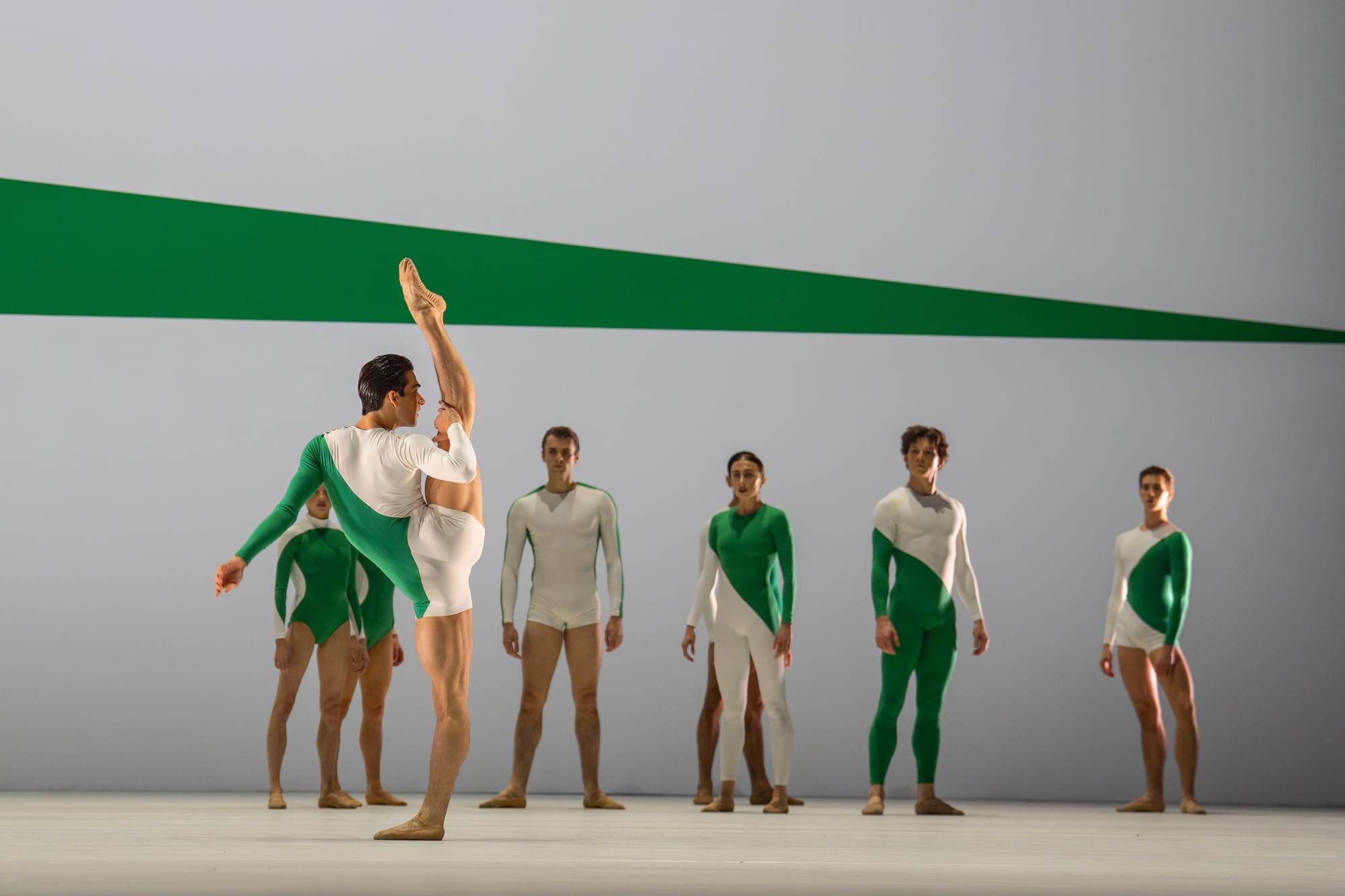
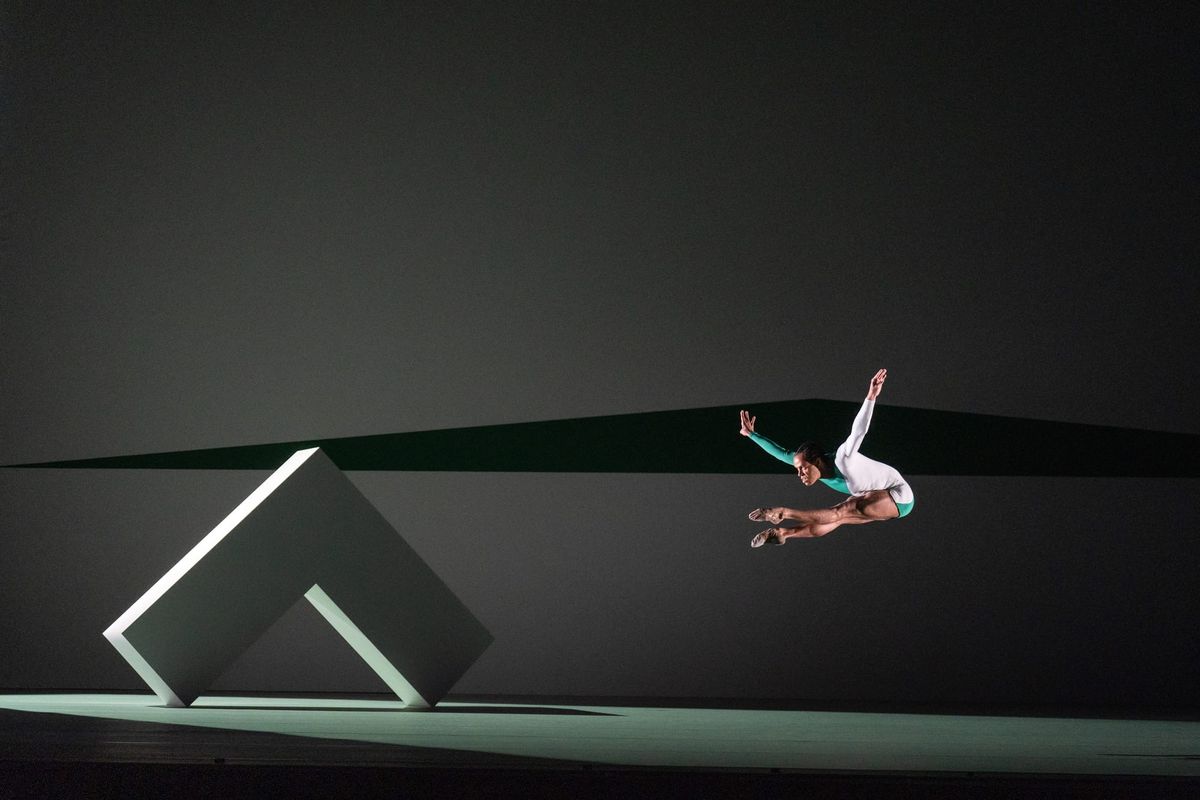
“Untitled” is set to music by Anna Thorvaldsdóttir that felt as crisp and clean as Carmen Herrera's white, angular set design — and that was entirely intentional. McGregor has spoken of choosing Thorvaldsdóttir's composition to evoke the same expansiveness he found in Herrera's visual world. The dancers, beginning with a lone man moving as if simultaneously overreaching and reaching out for rescue, frequently pierced this mostly linear world of sharp lines and sudden breaks. The costumes helped: designed by Burberry, the dancers were in white and green unitards, blending with the scenery, and sometimes each other, but also, as was particularly the case with one couple, making them look like two sides of one whole (their steps in one section echoed that message).
The choreography was pure McGregor in its exploitation of these dancers' physical range, yet fluid in the way steps by one performer would converge with another's, pollinating expression and passing energy between bodies like a shared current. In one section, Akane Takada yo-yoed brisés forward and moved back with her partner, his supportive split lifts gradually rotating her until her leg was being guided forward rather than propelled – a subtle inversion of agency. Whether it was the dancing or Herrera's set that made the stage feel deeper than it was remains genuinely unclear, and perhaps that ambiguity, too, was the point: a visual and sonic infinity, where bodies connect and spread away.
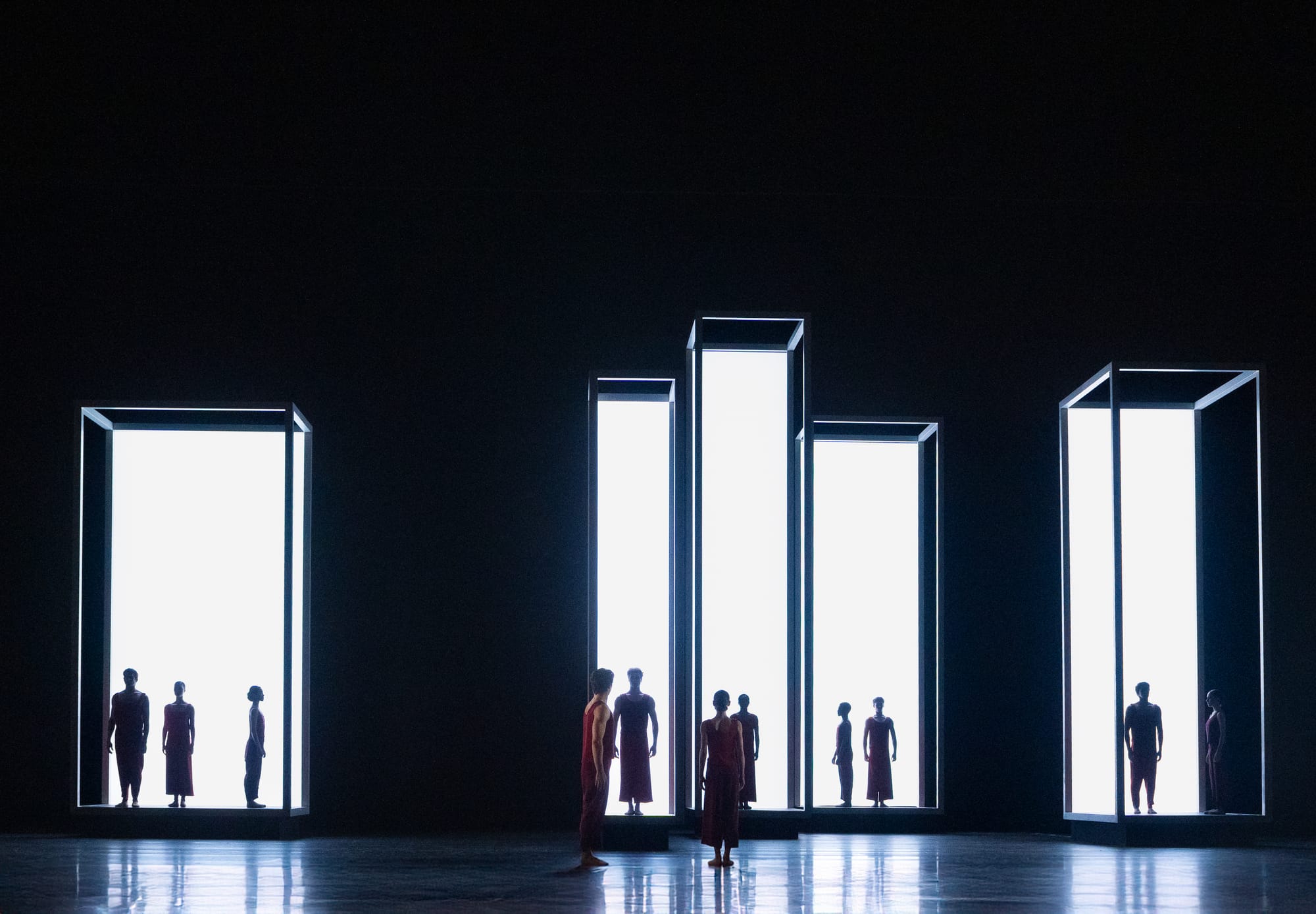
“Yugen” was different. While it opened with beautifully backlit architecture and light play by Edmund de Waal – precisely of the geometrical sort one frequently expects from McGregor’s visual collaborators – that was where abstraction ended. Yes, the dancing still had plenty of flexibility (it's McGregor, after all), but the bodies were softened and concealed by loose red costumes by Shirin Guild, and it was the emotions embedded in music that were on prime display.
McGregor’s choice of Leonard Bernstein’s “Chichester Psalms,” expertly sung by the Royal Opera Extra Chorus, was a quietly daring one. Sung in Hebrew, blending biblical text with Bernstein's distinctly modern harmonic sensibility, the music here was the main event – the dance its devoted servant, present not to interpret but to embody, and certainly not to overshadow. That act of choreographic restraint was itself a kind of grace: the vocals were given the grand gestures, the arabesques and deep leans, but also hands rising to faces and falling away. The musical interludes opened space for faster movement, dancers rushing on and off stage like tides.
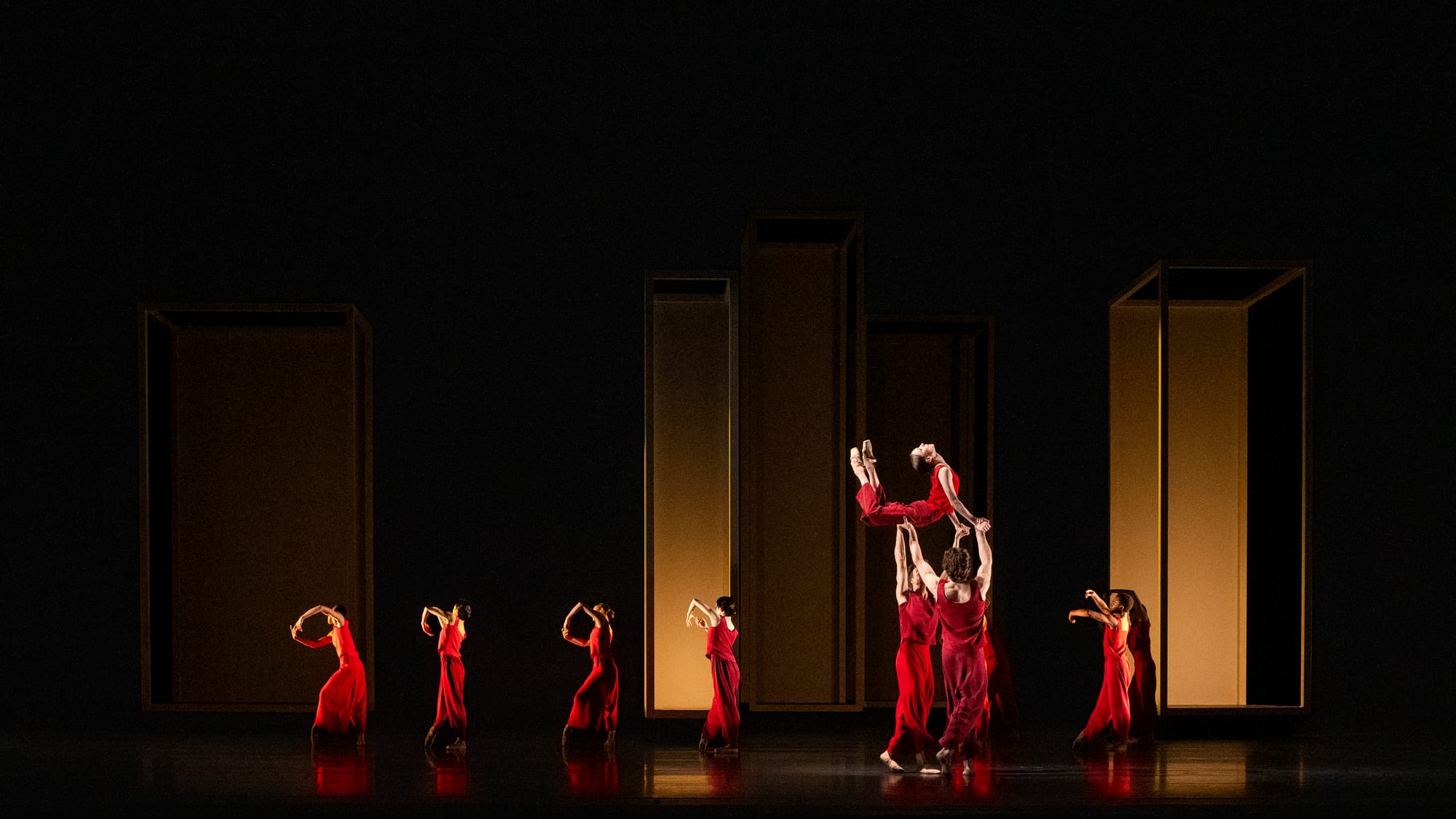
Lyricism was everywhere, but manifesting through presence, not wordy steps or pantomime. From the very first duet – with grand pliés in second position asserting and measuring the space – the dance bloomed and contracted with each musical section, never overburdening the stage or competing with the sound it served. There was a three-person lead to the cast, with the company's great Lauren Cuthbertson anchoring the trio alongside Ryoichi Hirano and Liam Boswell. They shared frequent exchanges of movement text, even if not always appearing on stage together, and toward the end, after a series of culminating sideways lifts, she was carried off, leaving the two men looking broken yet rich with emotion. It was not the daring or overtly charged type of dancing that marks McGregor's big works, but instead lushly spiritual – lyrical, harmonious, and genuinely transportive.
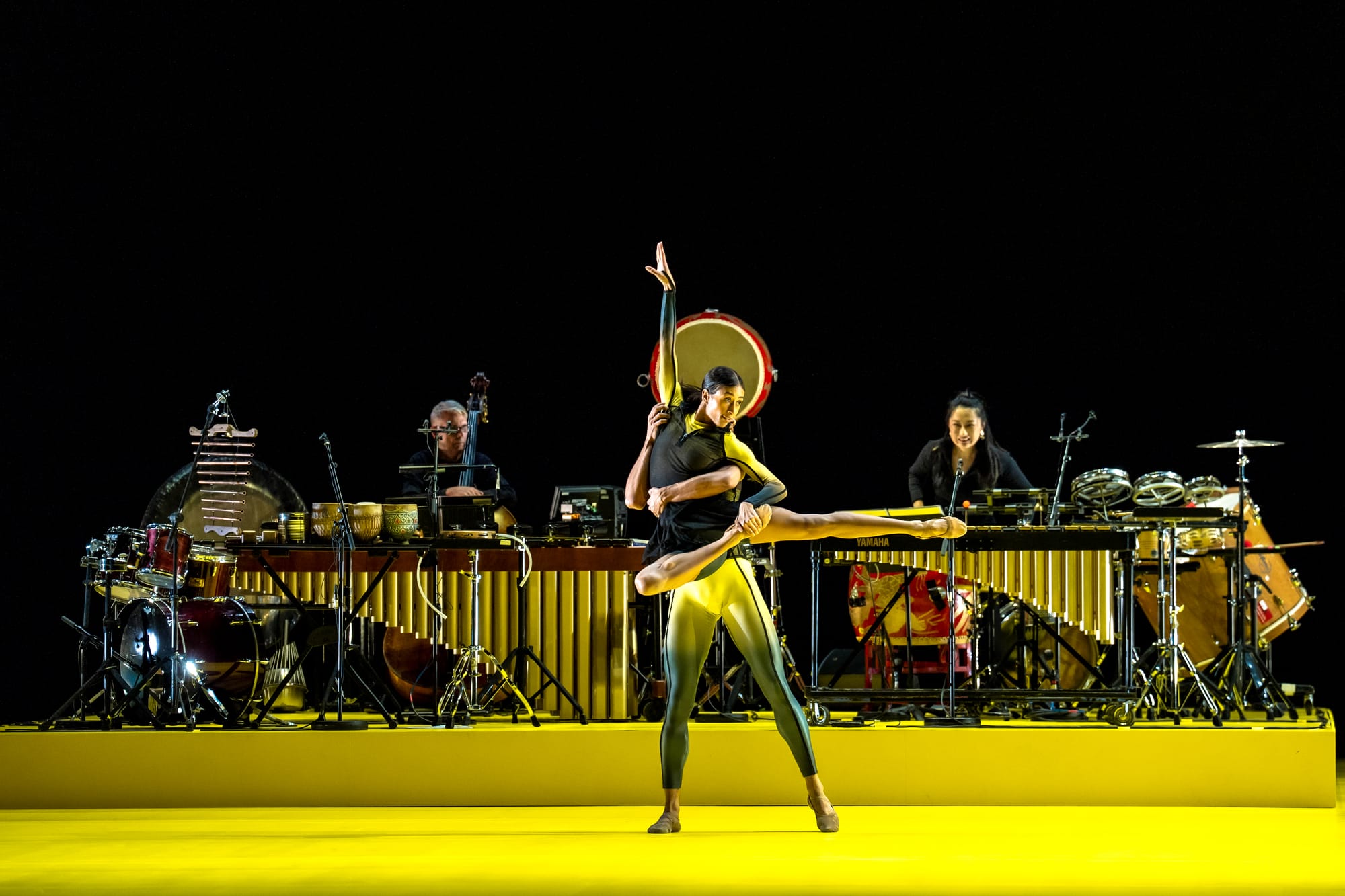
After an intermission, “Quantum Souls” arrived with a tonal shift. Literally. The focus here was sound and improvisation – the ingredients mixed live, in real time. Bushra El-Turk provided the percussive framework, but the true magic was Beibei Wang's live performance at the back of the stage on numerous instruments, some of which she built herself, inspired by traditional Chinese forms. Wang both guided the dance and responded to it in the moment, creating a feedback loop between body and sound that felt genuinely alive.
Yet “Quantum Souls” never quite fulfilled its own ambitions. The costumes by Saul Nash – ombre unitards, with organza pieces the dancers added as the work progressed – offered little visual counterweight to the abstract sonic experiment at the ballet's core. The dancing, liberated from pointe shoes for the first time in the evening, over-relied on static poses and slow leg descents – though for dancers like Melissa Hamilton, whose exquisite line made even the most grounded shapes compelling, the approach had its rewards. When the artists moved, their steps were too frequently off-center, rooted in parallels rather than the vertical axis, so that where one might have expected the percussive, live-built score to animate the body upward and outward, it instead pulled sideways and earthward, culminating at one point in a female dancer being lowered by her partner into a full plank. For all the novelty, this sustained vocabulary ultimately grew monotonous, the dance never reaching a climax. At forty minutes run time, it asked for patience the experience didn't entirely earn.
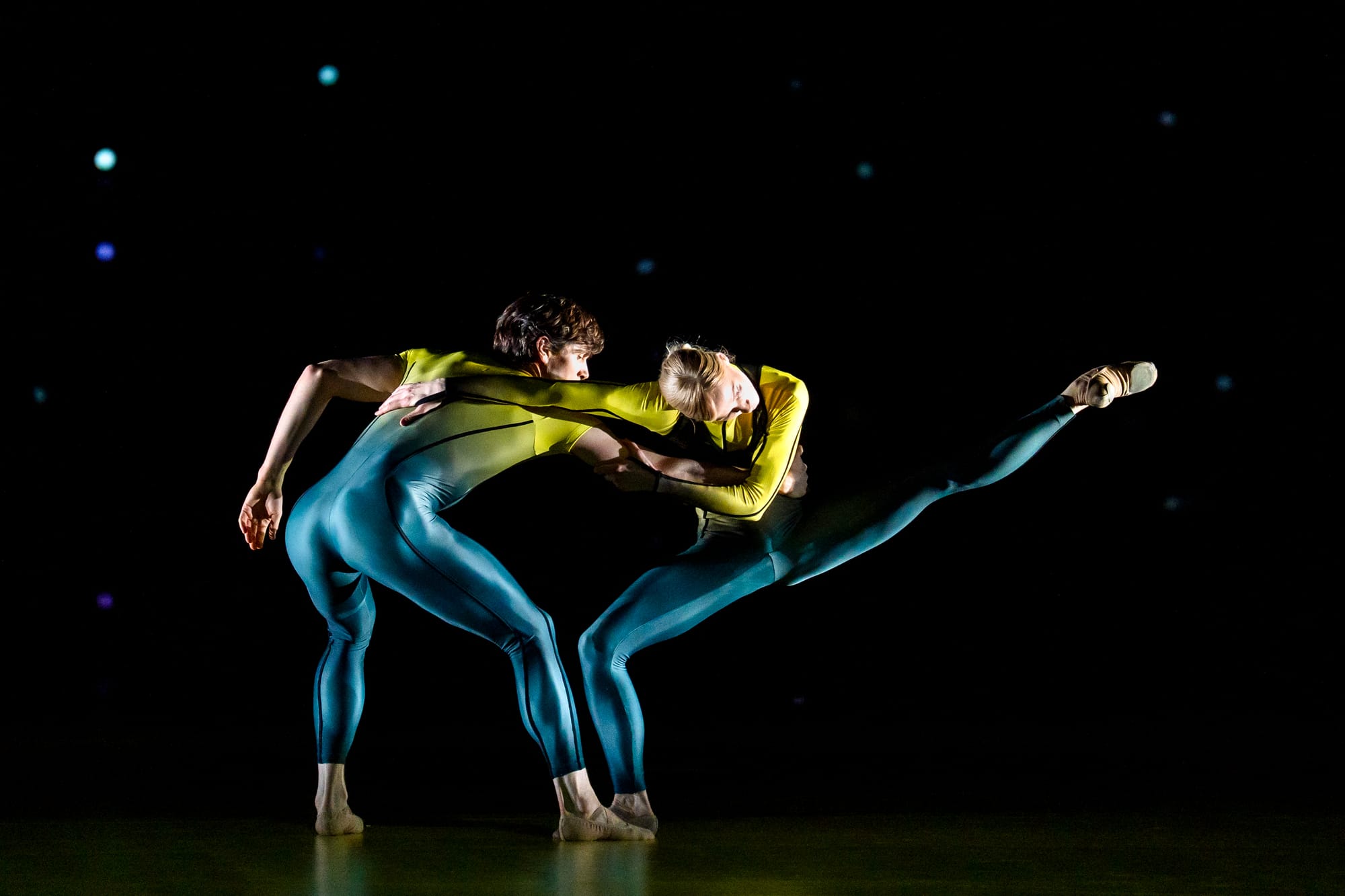
Still it, and the whole program, were examples of what McGregor calls the echoes of American Postmodernism’s great lessons: the medium is the message. Be it space, song, or instrumentation, all working as one in an evening of dance, the exploration of those forces can at times feel too cerebral in their abstraction – yet that challenge and ambition are precisely what make it worthwhile. This kind of daring creative inquiry, with an artist willing to reach into the unknown and ask what dance might yet become, may well be the alchemy missing in dance on our shores.
copyright © 2026 by Marianne Adams



