Milking a Classic
“La Bayadere”
The Mariinsky Ballet
Opera House
The John F. Kennedy Center for the Performing Arts
Washington, DC
October 17, 2017
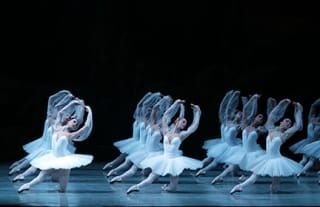
The plot for this exotic and bravura ballet keeps being altered. Right now at the Kennedy Center the story stops short with the hero immersed in a dream of his dead beloved among a bevy of similar bayaderes beckoning him to join her. Bayaderes were dancing girls who served in Hindu temples. The hero, an outstanding Hindu warrior, has been commanded to marry another girl, one from a very high caste. He isn’t told that the bayadere he dotes on will be murdered before his very eyes. For the current conclusion, he has fled from these facts into fantasy, presumably with the help of an opium pipe. Final curtain! Yet I didn’t want to leave, expecting to see the temple come crashing down as the gods’ punishment for human misdeeds. The so-called Shades Scene of the beckoning bayaderes starts simply, purely, with one woman stepping down a ramp, balancing in arabesque, then stepping and balancing further and further but being followed by another woman, and again another and still more. It is the ballet’s choreographic climax, but it isn’t an apt dramatic ending.
On previous visits here, Russia’s Mariinsky Ballet from St. Petersburg has brought better versions of what was originally, in 1877, a work in four acts with choreography by Marius Petipa and music by Ludwig Minkus. I remember fondly a staging by the late Sergei Vikharev in which the hero’s beloved didn’t have to sneak out of the temple’s main door but sat in a window playing a string instrument and was lifted out by the young warrior’s arms. For this first of seven performances, the role of the beloved bayadere Nikiya was danced by Viktoria Tereshkina, known for her marble manner. Tereshkina looks sculpted. Security and authority inform each pose she takes. Her balances are remarkable. Yet, as Nikiya, she modulated her perfectionist approach, molding her stance in response to the touch of the young warrior, Solor, and melting a bit in the ambience of his embrace. Tereshkina’s cool isn’t to everyone’s taste but has a connoisseur following.
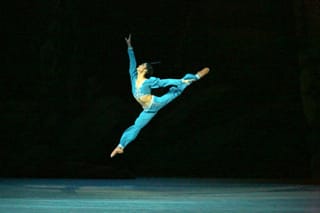
In the part of Solor was Kimin Kim, lightning fast and flashingly light, perhaps too much so for a staunch fighter. Adequate as Gamzatti, the girl that Solor is supposed to marry, was Anastasia Matvienko. Her confrontation with Nikiya is often a dramatic highpoint of “La Bayadere” but on this occasion the timing seemed off and there wasn’t sufficient tension. The part of the temple’s high priest, who also desires Nikiya, requires terse acting which Soslan Kulaev delivered. Lots of divertissements are supposed to build up to the the marriage duet for Solor and Gamzatti. These dances are extremely diverse in style and mood. Nikiya, as representative of the temple, is charged with performing a final blessing on the couple. Of course, she seems forlorn: her solo starts steeped in melancholy but then Nikiya becomes frantically elated just before a poisonous snake, hidden among flowers she is given, bites her. Solor is torn. Should he depart with the wife he has just wed? It turns out, after all, that he is drawn to kneel next to the expiring Nikiya. From her side he rushes off to smoke his pipe and dream the Shades Scene.
The Mariinsky’s Gavriel Heine conducted the Kennedy Center’s Opera House Orchestra. Vladimir Ponomarev, Vakhtang Chabukiani, Konstantin Sergeyev and Nikolai Zubkovsky were credited with altering or adding to Petipa’s choreography.
copyright © 2017 by George Jackson



