Miami High
Miami City Ballet
"Raymonda Variations", "Sonatine", "Tarantella", and "In the Upper Room"
Tilles Center for the Performing Arts
Long Island University, New York
April 25, 2008
The Miami City Ballet made one of its too rare and too brief visits to the New York vicinity, appearing for two days in the spacious and well-designed Tilles Center of Long Island University; the company has yet to appear in Manhattan. This visit confirmed the virtues seen in earlier performances, and showed a well-rehearsed, well-trained company with a fine sense of style. Of course, dancing only a comparatively few ballets a season allows for more intensive rehearsal, and so it isn't really surprising that Miami's "Raymonda Variations" showed more cohesion and more detail than the recent NYCB version, performed as one of several dozen ballets, but audiences do not watch excuses and explanations, they watch performances, and Miami's version was pure joy. Well, not pure, perhaps, because financial constraints forced them to dance to taped music, so the lush Glazounov score sounded a bit tinny.
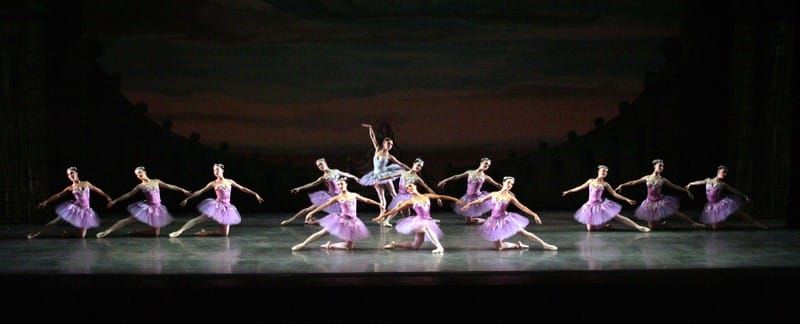
Miami's "Raymonda" has been redesigned, with the corps in purple tutus, and the principals in bluish-purple. This took some getting used to, since the score does seem to exude pink, but the cut was elegant and the flower chaplets gave the dancers a piquant old-fashioned look. This production was rehearsed by Roma Sosenko, and had many of the virtues of that lovely dancer--elegance, musicality, precision, and modesty without diffidence. "Raymonda" is one of Balanchine's softer after-Petipa explorations, without the bright majestic grandeur of "Theme and Variations" or "Ballet Imperial", and it suited the company well. The five female solos that Balanchine modeled on the Petipa original were all given individual shadings, and danced as miniature ballets rather than performed as a collection of quite difficult steps. Even the hop on point solo, which can look brittle and jerky, was smooth and elegant, with the movement seeming to come from the hopping foot and floating out through the arms.
Mary Carmen Catoya danced the lead with a gentle expansiveness and a soft elegance that exploded into wonderfully clear jumps in the final solo. Her partner, Renato Penteado, though he didn't have all the elegance or sense of mystery that Balanchine's poets can bring to the pas de deux, danced his solos very well, with elegant beats and soft landings.
The middle section had two contrasting Balanchine solos, the rarely seen "Sonatine", set by its originators Violette Verdy and Jean Paul Bonnefous, and "Tarantella", with no stager credited, but which presumably was overseen by Villella. They both had the advantage of live music, performed by the pianist Francisco Renno. "Sonatine" was choreographed for the 1975 Ravel festival and broke no ground, since having a couple stare lovingly at a pianist and then ooze into dancing was a familiar conceit, but, like the five soloists of "Raymonda" (and "The Sleeping Beauty", "Divertimento No. 15", and so on), this idea has many facets. Haiyan Wu and Jeremy Cox gave the piece an improvisational, conversational quality, and danced with a limpid spontaneity that came across as a whisper.
There is no whispering in "Tarantella", but it shouldn't be one long shout either and Jeanette Delgado and Alex Wong made the piece seem much more than a raucous bit of dancing by emphasizing the folk-inspired charm of the choreography. Wong's beats were sharp and clear, and his soft landings gave his solos a flow; there wasn't a feeling of "look how high I can jump, and watch me pause on the ground while the audience gasps", though they did gasp.
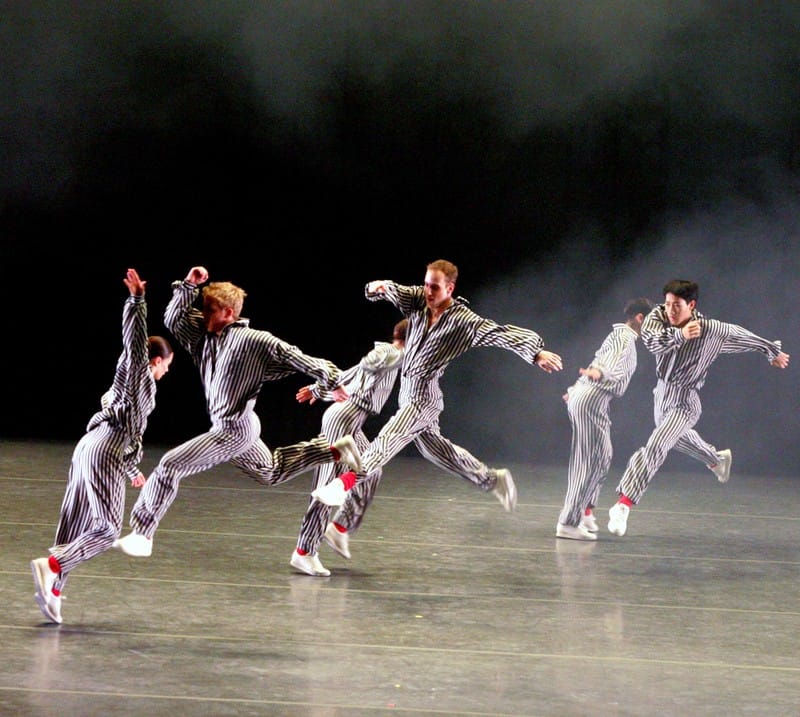
Gasping seemed in order for the final dance, Twyla Tharp's "In the Upper Room". It is a crowd-pleasing finale, but I find the Philip Glass music a bit one-dimensional and repetitive (I know, that is the point), and the choreography, with its non-stop, frenetic energy, doesn't build. It certainly has some striking images, from the smoke-filled stage, with the dancers emerging mysteriously into view, to the black and white, prison-stripped pajamas with their red accents, but there doesn't seem much more to watch than the constantly changing shapes and quirky physicality of the dancers. That was certainly enough for the audience, and the dancers seemed to be having a wonderful time.
The quality of joy seems to be the company's most basic characteristic; another way, I expect, of saying they have an distinctive charm. Everyone dances as if performing to that music with those people on that stage is the most wonderful thing in the world; it is a privilege to watch.
copyright © 2008 by Mary Cargill



