Miami City Ballet's Robbins Program
"Circus Polka," "In the Night," "The Cage" and "West Side Story Suite"
Miami City Ballet; Jerome Robbins Centennial
Adrienne Arsht Center
Miami, Florida
January 12, 2018
The Friday January 12th opening of Miami City Ballet’s Program II rocketed a packed Adrienne Arsht Center out of the box with three carefully chosen company premieres that complemented established company favorites for an evening that presented Jerome Robbins as a creatively complex choreographer whose works still cast a relevant lens onto American popular culture.
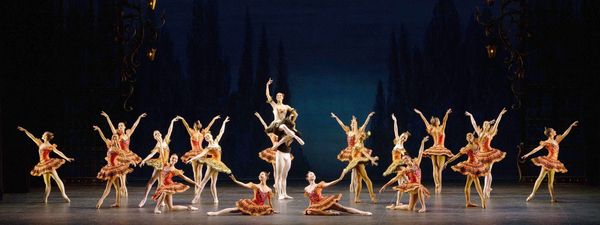
Robbins’ "Circus Polka" opened the evening, showcasing forty-eight students from the Miami City Ballet school with the company’s artistic director, Lourdes Lopez, in long red coat and black boots as Ringmaster. Stravinsky composed "Circus Polka" for a Balanchine ballet that originally included Ringling Brothers elephants. In the Robbins version, the young dancers circled the stage kicking emboité or stretching arms forward when Lopez tapped the floor, their movements miming those original baby elephants.
Set to four Chopin "Nocturnes," MCB favorite "In the Night," presents three versions of love –- the new, the established and the wild. For all six dancers, the Friday performances were a debut. Emily Bromberg with Jovani Furlan and Tricia Albertson with Rainer Krenstetter gave competent portraits of new and established love. Katia Carranza presented the most persuasive argument for wild love as firebrand to Reyneris Reyes, whose slight comic touches gave their performance an added dimension that overcame the pas de deuxʼs over the top melodrama.
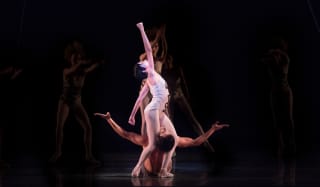
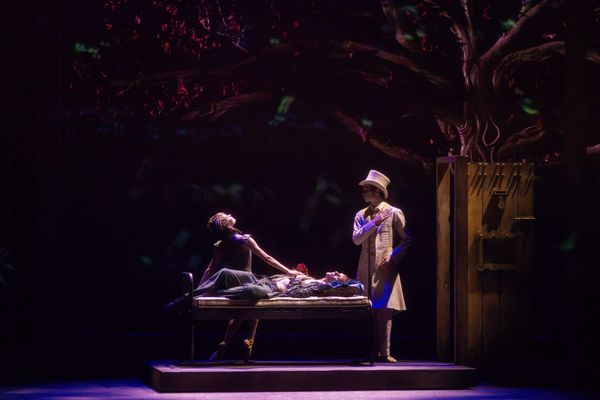
Stravinsky’s Concerto in D for Strings furnished the soundscape for Robbins’ "The Cage" -– the evening’s second company premier and program II’s most thought-provoking piece. Similar in mood to another MCB favorite –- Ratmansky’s "Viscera" – "The Cage" presents the dynamics within a female dominated hive and foregrounds the ruthlessness of wild nature.
As she did in the role of demonic mistress during Program I’s "Rubies," Jordan Elizabeth Long demonstrated again on Friday an innate feel for Stravinsky’s sudden shifts and often unnerving lyricism as a spectacular hive queen.
Also brilliant here was Natalia Arja in the role of larval novice. Arja accommodated the sudden shifts in musical dynamics with terrifically placed accents while sustaining dramatic modifications of many features of traditional ballet technique – thumbs out, hands arched, wrists bent, elbows sharp. She was wonderful to watch during the first movement as she achieved her first kill.
Though odd to call it a pas de deux (since the movement ends with the theatrical consumption of the male dancer) Ariel Rose formed an excellent partner to Arja’s ferocious newborn performing with her a gorgeous moment of insect sex, Arja balanced on Rose’s knees, her legs and arms stretching forward as Rose anchored her from behind.
The Friday performance would not have had the impact it did without the investment made by corps dancers Alaina Andersen, Adrienne Carter, Julia Cinquemani, Maya Collins, Samantha Hope Galler, Suzette Logue, Lexie Overholt, Helen Ruiz, Alyssa Schroeder, Raechel Sparreo, Nicole Stalker, and Ella Titus – their timing and visual savagery made The Cage a delight.
Simone Messmer, Renan Cedeiro and pianist, Francisco Rennò, performed the evening’s third company premier, Robbins’ "Other Dances" choreographed to four Chopin mazurkas and a waltz. With their attention to transitions and technique Cedeiro and Messmer provided one enduring mental snapshot after another as when Cedeiro slowly circled Messmer and from a simple walk went straight to vertical leap and a cabriole, his legs snapping shut in the air like a pair of scissors. Magically intimate, the chemistry between Cedeiro and Messmer and the intensity of their awareness for one another, for Rennò’s gorgeous Chopin, and for the audience made the piece the evening’s deepest pleasure.
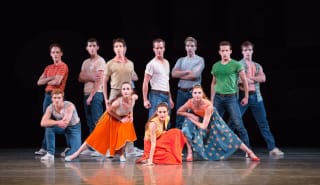
Robbins’ "West Side Story Suite" was just as much a genre-busting shock on Friday as when MCB first presented the piece in 2014. During the "Suite," dancers break ballet’s code of silence, exchange verbal barbs, and belt out the iconic songs of the Broadway musical that sets the Romeo and Juliet theme amidst the rivalry of New York gangs.
Though the Bernstein score and Sondheim lyrics energize the dancing, "Suite" is less about steps and more about characters. So much of its action depends on communicating the intensity of the friendship between Tony (think Romeo) and Riff (the slightly unhinged but charismatic leader of the Jets).
Both Chase Swatosh as Tony and Bradley Dunlap as Riff laid out those dynamics powerfully making the subsequent clash between Riff and the more self-contained Bernardo (leader of the rival Sharks and brilliantly captured by Reyneris Reyes) an arresting clash of personalities during the ballet’s fight scene. In the role of Rosalia, Christina Spigner formed a lovely theatrical and vocal counterpoint to Arja as Anita (Bernardo’s girlfriend) during the performance of America.
During the finale, Somewhere, the Opus I orchestra led by guest conductor Beatrice Jona Affron was spectacular. With a gorgeous solo performed by a professional vocalist delivered offstage (sadly not given credit in the program notes) and the MCB cast as choir, the song’s refrain of “Somewhere a place for us” closed the evening on an especially poignant note in the wake of this year’s hurricane impact on Puerto Rico.
copyright © 2018 by Sean Erwin