Miami City Ballet’s Redesigned Nutcracker
"The Nutcracker"
Miami City Ballet
Adrienne Arsht Center for the Performing Arts
Miami, Florida
December 20th, 2018
Miami City Ballet’s Thursday, December 20th second casting of George Balanchine’s “The Nutcracker" was packed for the mid-week showing of the 2018 reformat of the Balanchine classic. The new sets and costumes by Ruben and Isabel Toledo were gorgeous, and they anchored the MCB production to the Hoffmann short story, deepening the ballet. Add to that a cast hailing from the four parts of the globe, the show struck a powerful counterpoint to a Federal government shuttered over immigration issues.
For instance, Ruben Toledo’s version of the Stahlbaum family drawing room layered the walls with sapphire, emerald, and ruby medallions against a cinnamon background. His sumptuous remake not only dazzled but presented the Stahlbaums as representatives of a social class vying for the top of the social pyramid (important to note when a Queen presides over Act II).
Digital artist Wendall Harrington made other nods to Hoffmann by repeatedly repurposing Toledo’s interior with virtual reality accents. Right before the toy dances, Drosselmeier, ably mimed by Didier Bramaz, cast brief silhouettes of the dolls on the wall with a pinwheel projector. It’s over in a flash but the touches of animation here and elsewhere both emphasized the judge's role as inventor and winked at Fantasia’s early role in popularizing the ballet. At another point hundreds of mouse heads appear on the drawing room medallions, a clear reference to the Hoffmann passage where Marie sees hundreds of mouse eyes sparkling between the floor boards.
Isabel Toledo’s costumes played visual games all evening. During the party scene, the nutmeg pattern in a mother’s gold dress appeared in her husband’s bow while her daughter’s frock swapped out the nutmeg for bands of white. The motifs also reached across Acts. The persimmon shade of one party girl’s dress emerged from the tulle of the mature lady Flowers who escorted Dew Drop.
But in the end the evening was about dance. So – how was the dancing?
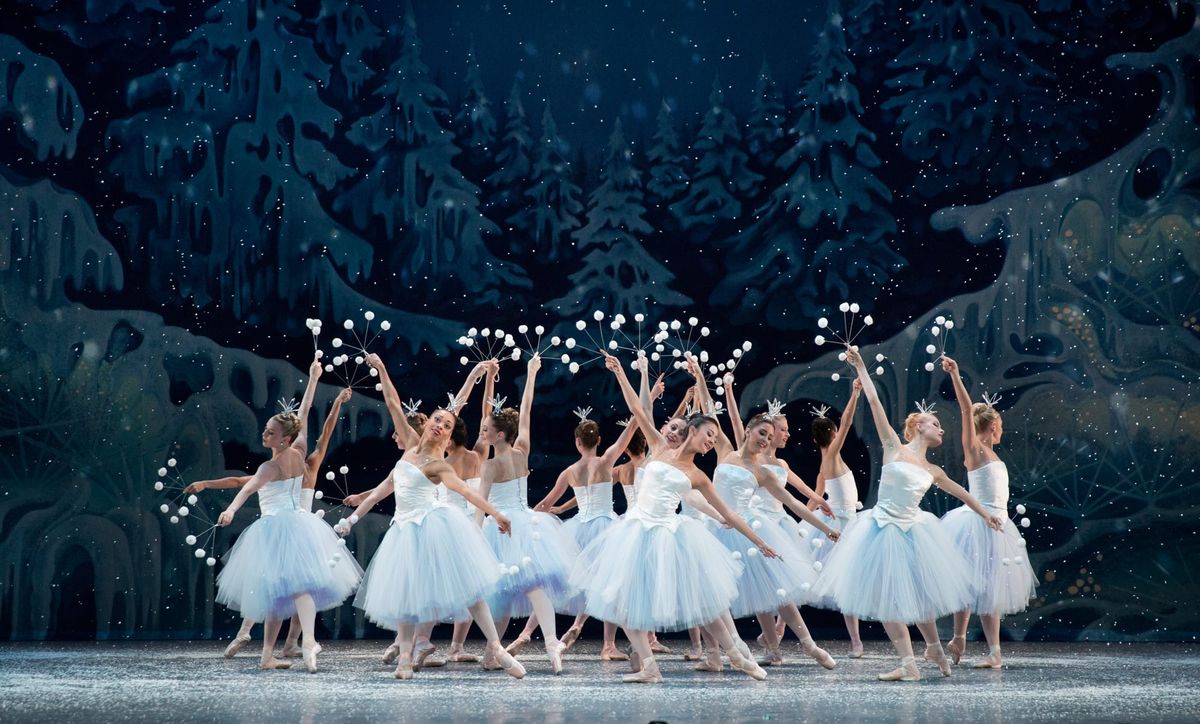
Both Mia Niebruegge as Marie and Alastair Page as the Nutcracker were consistent on Thursday with a believable young crush and clearly pantomimed sequences. Memorable as well was Shimon Ito as Toy Soldier. There is a trick to this sequence – dancers must mix in enough machine to be mistaken for 18th century automata and yet be human enough to be mistaken for toys performing a trompe l’oeil. Only Ito’s performance managed to hit the mark with terrific double tours and a sequence of whipped pirouettes that ended on the knee. Also powerful was the MCB corps in the waltz of the snowflakes. The corps lavished attention on the waltz rhythm whether pirouetting out from center with a snap in cabriole or circling in jeté before floating to a final V held en pointe to the strike of the chimes.
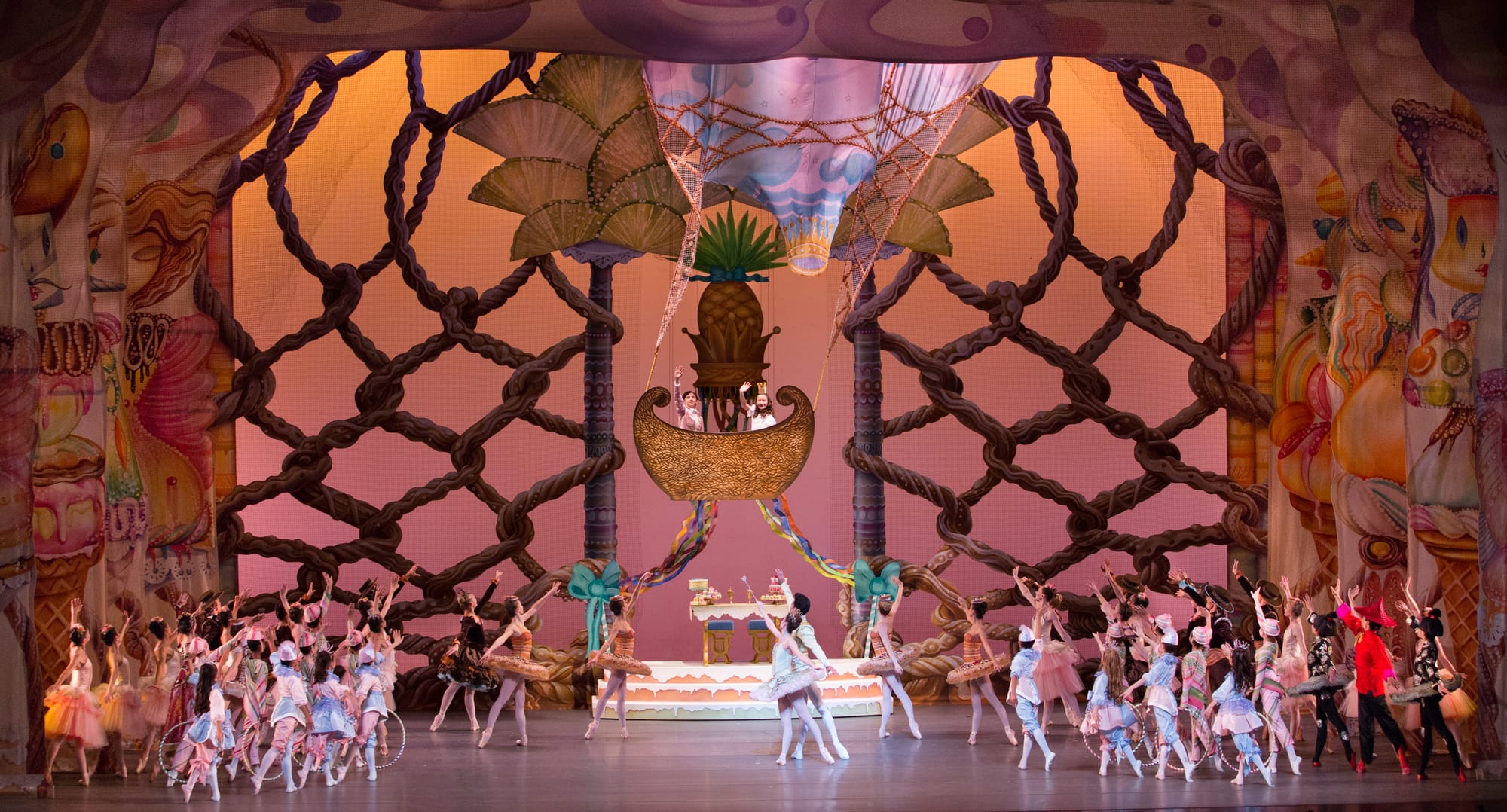
Act II opened to palm trees topped with lime slices and stage wings draped with gorgeous floor to ceiling pastel beings. Lighting engineer James Ingalls made the stage bloom with a gorgeous papaya light for the Angels to float through.
Satoki Habuchi, Tsukino Ishii and Ling Minucci were also gorgeous, Habuchi’s crimson jacket accented with fuchsia cuffs, the women in tight-fitting black printed with gold leaf. Though impressive in the jumps, Habuchi rushed the transitions. On the other hand, Ishii and Minucci communicated wonderfully with synchronously timed skips and snaps into equal-angled arabesques.
A replacement for Jeanette Delgado, Natalia Arja was strong as Dew Drop, but in the slower first half she missed the feeling of the waltz, wrapping up sequences too quickly. With the shift in tempo at the end, Arja shone, her chainé turns breathtakingly crafted, her piqué steps to the staccato and fouettés sparkling with definition. Led by Emily Bromberg and Samantha Hope Galler, the Flowers showed a terrific group feel for the waltz accent whether step-kicking to the chimes or folding over in fifth.
Katia Carranza and Renato Penteado were jaw-dropping in the roles of Sugarplum Fairy and the Cavalier. As in Program I’s “Concerto Barocco”, Carranza exhibited sublime musicality with a talent for catching the swell in the adagio whether by accelerating subtly the stretch of her leg or gradually unfolding her upper body in the back bends. Again Ingalls outdid himself with a gorgeous ruby light for the Cavalier’s variations where Penteado ate up the floor with jetés or wowed the hall with à la seconde pirouettes. During the gimmick sequence when the Fairy floats across the floor, it’s not unusual to see a bit of jerk and shake in the wrists and hands of both Cavalier and Fairy. Carranza and Penteado were impressive maintaining the illusion of the float with no perceptible waver in either’s arms. Finally, when Penteado released her into the stand-alone arabesque Carranza remained motionless until the pile up of staccatos signaled her to quit the position. It was more impressive than the gimmick completed measures before, and the audience showed its appreciation.
copyright © 2018 by Sean Erwin



