Miami City Ballet’s Program III – A Taste of the Future
“Theme and Variations,” “One Line Drawn” and “The Concert”
Miami City Ballet
Adrienne Arsht Center for the Performing Arts
Miami, Florida
February 9, 2018
On Friday, Miami City Ballet artistic director Lourdes Lopez first addressed the audience and expressed her commitment to keeping ballet relevant. Referring to that night’s world premiere by post-modern choreographer Brian Brooks, Lopez added that with Program III, “we have the future sandwiched between two masters of the past.”
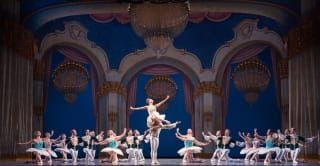
The evening opened to a ballroom in turquoise and white four columns deep and George Balanchine’s, “Theme and Variations,” set to the fourth movement of Tchaikovsky’s Suite #3 in G Major. In their pas de quatre Emily Bromberg, Samantha Hope Galler, Ashley Knox, and Jordan-Elizabeth Long carefully picked out the melody in the strings and winds. On Friday their sense for the lush score and attunement to one another was marvelous.
In his solo Kleber Rebello paced turns to the percussive staccatos in the Tchaikovsky and thrilled with a series of seven double tours before ending on a knee. During the bassoon adagio Jennifer Lauren was a sculptural snapshot, careful and precise as she slowly transitioned from arabesque devant threading the leg behind to an arabesque penché, framed by dancers from the corps weaving through one another’s arms.
In their pas de deux Rebello and Lauren respected one another’s timing and were remarkable in their attention to the gorgeous phrasing of soloist, Mei Mei Luo. This dance was one of the evening’s highlights. The world premiere by Brian Brooks’ “One Line Drawn” followed, choreographed to new music by composer and Miami Beach native Michael Gordon.
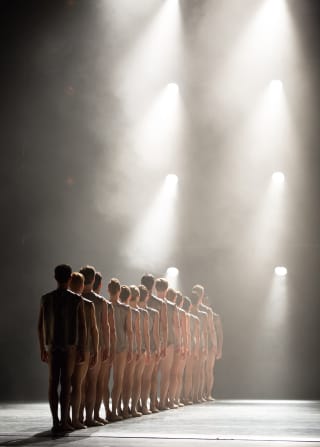
The piece opens with sixteen dancers in silver shorts and loose fitting shirts forming a line at the center of the stage, backs to the audience, an array of thirty spotlights overhead. As strings and piano pulse, they scattered then leapt forward back into the light, dancers tasked with presenting variants of Brooks’ kinetic logic. Movements would begin in a shoulder but then domino through to the knee. A dancer’s weight transfer often generated a spring that angled off unexpectedly. Arms scooped the air, crossed behind, or folded in with elbows sharp.
Several interesting passages emerged from the first half. The pas de deux of Shimon Ito and Alexander Peters devised ingenious points of support, dancers taking turns delaying the other’s forward momentum with a grip on the nape of the neck or the scapula, re-directing the angle of the step with a quick twist to the other’s hip.
Also striking was the pas de deux between Simone Messmer and Renan Cedeiro whose Brooks-inspired sequences expanded to include lifts where Cedeiro held Messmer across the stomach and displaced her, legs extended, from one side of the stage to the other. The effect was gorgeous and recalled William Forsyth’s, “In the Middle Somewhat Elevated.”
Half-way through, Gordon’s music shifted to an echo pattern that edged out the insistent rhythm of sixteenth notes. Nathalia Arja rocketed Brook’s technique to a new place filling the sound bubbles of held tones with rapid progressions that churned movement through the elbow down her abdomen or, springing into arabesque-like extension, closed with shoulders hunched, knees inward.
Toward its close, “One Line Drawn” lost the conviction of its opening and though the cadence in piano and strings returned, the piece seemed unsure how to resolve the contrasts it had established or, if resolving them was out of the question, to transform them into something new.
Jerome Robbins’, “The Concert,” closed the evening and, yes, this Robbins classic is funny and MCB delivered its punch-lines well. However, "The Concert" is also very meta in the strategies it employs for removing the wall between performers and audience. The cast of quirky characters assembled on stage to listen to pianist Francisco Rennó execute gorgeous Chopin is the stand in for the audience members doing exactly the same. Robbins does this – as he does in "The Cage" – not just to be clever but to make unpleasant aspects of the social condition bearable. For instance, when the young man brimming with insecurities and endearingly performed on Friday by Ito can’t contain Tricia Albertson’s exquisitely played exuberant woman he reveals an inner Neanderthal, cracks her on the head and carts her offstage.
Utterly convincing as the matron, Callie Manning demands respect from her cigar-chomping husband (Reyneris Reyes showed a terrific knack for physical comedy in the role on Friday) who would prefer her dead. Suzette Logue, Helen Ruiz, Raechel Spareo, Emily Bromberg, Adrienne Carter and Manning were dazzling dancing the Mistake Waltz, but the clarity of their comic performances uncovers a web of characters ruthless in their critique of self and other. Still, treat people like mannequins and how else could they turn out?
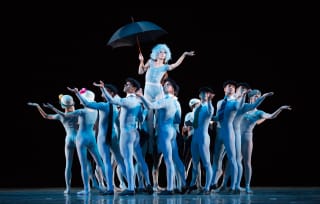
The piece concluded in the natural world where butterflies, for all their pastoral associations, behaved just like the humans. It seems Robbins’ message here is that comedy acts as a necessary remedy to how people behave since, after all, it’s hardwired in our nature. At this point, a frustrated Rennó slammed on his piano and reached for his net. The artist may have to put up with the human dramas, but these crazy butterflies – well, they’re a different story!
copyright © 2018 by Sean Erwin



