Miami City Ballet Ends Season with Ratmansky's Concerto DSCH
“Apollo,” “Concerto DSCH” and “La Valse”
Miami City Ballet
Adrienne Arsht Center for the Performing Arts
Miami, Florida
April 13, 2018
Artistic director, Lourdes Lopez addressed the audience before the start of Miami City Ballet’s Program IV and recalled the trajectory of the 2017-2018 season that began with Balanchine’s Emeralds, saw the company’s first post-modern ballet in Brian Brooks’ “One Line Drawn” as well as an all Robbins celebration. The night opened to George Balanchine’s 1928 version of “Apollo” with music and libretto by Stravinsky, and dancer Jordan Elizabeth Long seated on a platform in the role of the goddess Leto.
MCB last performed “Apollo” in 2013 when it danced Balanchine’s reworked, shorter 1979 version of the choreography. The later version removes the opening prologue, which presents the birth of Apollo. The choice between the 1928 and 1979 iterations is a decision to give a nod to history over tight artistic unity. The prologue’s modernism and the odd gestures neo-natal Apollo makes as he experiments with movement carry interesting resonances with Martha Graham. However, the narrative connection between the two parts of the 1928 version is a loose one and contrasts with the second movement’s pronounced, tightly coordinated theme of ascent.
Throughout the second movement Cedeiro danced Apollo’s part effectively as he summoned the three muses Terpsichore, Polyhymnia and Calliope, respectably performed by Tricia Albertson, Jennifer Lauren, and Emily Bromberg. Simultaneous and successive repetitions structured the group dance as Cedeiro anchored the three whose movements echoed one another through a series of arabesques and attitudes that ended in a slow weave at the center.
Leg snapped back in attitude, open hand reaching from her mouth, Bromberg was exuberant miming the part of Calliope reciting verse. As Polyhymnia Lauren snapped up passages offered by the strings through a series of animated pivots and arabesques. Albertson and Cedeiro were clean throughout their pas de deux but overall the dancing was too safe to sparkle, and when Cedeiro lifted Albertson onto his shoulders in a key lift they were visibly unsteady.
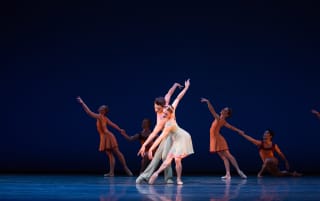
“Apollo” was followed by the company premiere of choreographer Alexie Ratmansky’s “Concerto DSCH.” The letters of the title stand for the letters in the German spelling of Shostakovich’s name whose Piano Concert No 2 forms the backdrop of the piece. The title expresses an air of intimacy of choreographer toward composer – like nicknames used among neighborhood children – and it fits with the dances that explore themes linked to young friendships and love.
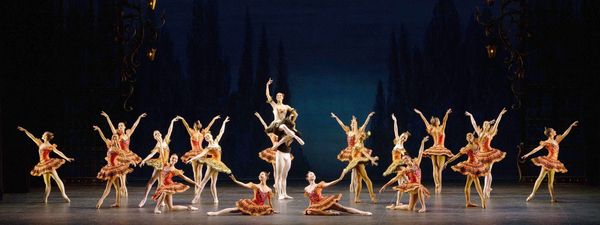
The choreography opens to a circle of dancers whose orange and burgundy tights resemble 40s swim suits. Ratmansky kept the dancers in motion sprinting from one side of the stage to the other or running in circles. With no space free, Chase Swatosh simply sprang up and down in place.
Simone Messmer and Jovani Furlan were wonderfully paired, and the intimacy of their pas de deux contrasted with the love-for-a-day vibe of the other couples. In MCBs Program III, Messmer showed during Robbins’ “Other Dances” a knack for treating pianist Francisco Rennó as a co-equal performer, and she did that during “Concerto DSCH” as well. Rennó was astonishing - prestissimo doesn’t capture the velocity of his playing in the first and third movements.
Furlan not only supported Messmer wonderfully (which he has consistently done this season) he also complemented her level of musicality. For instance, during the adagio second movement, Messmer animated a simple arabesque in very different ways depending on the piano’s dynamics. Throughout the sequence Furlan matched Messmer’s sense for the music gesture by gesture. When they played a game of re-direction, Furlan folded Messmer like a gorgeous rag doll first over one forearm, then the other, with fine attunement to Rennó’s phrasing. This was among the best couple dances of MCBs season.
Also important here were the threesome formed by Nathalia Arja, Kleber Rebello and Renan Cedeiro. The choreography is fun, high energy, but most interestingly the three generated a wonderful confusion of ballet protocols. First Rebello lifted Arja, then the petite Arja returned the favor – repeatedly and convincingly. At one point both Arja and Rebello supported Cedeiro before the sequence ended with the much taller Messmer staring down Arja after she stole a sequence with Furlan.
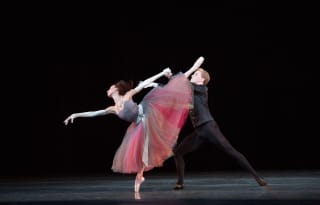
Balanchine’s “La Valse” closed the program. It has been at least a decade since MCB danced this piece set to Ravel’s gorgeous Valses nobles et sentimentales (1911) and La Vals (1920). The staging and costuming of the ballet reek glamour with the women in full length dresses of ashen tulle flashing accents of lavender and fuchsia beneath a midnight blue backdrop crowned with black chandeliers.
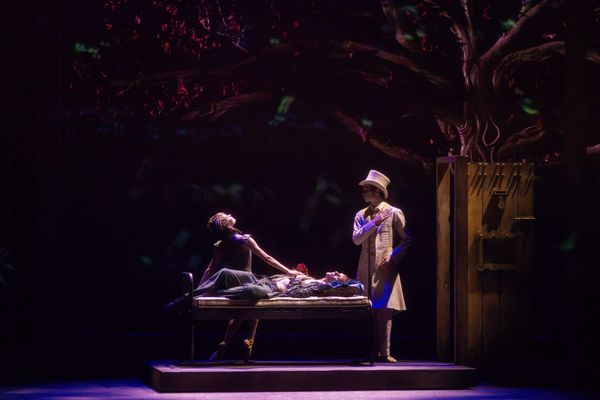
The Opus 1 orchestra with guest conductor Ormsby Wilkins – current Music Director at American Ballet Theatre – often commanded as much attention as the dancing, which was uninteresting during the first two movements. Only in the third Act did the ballet come alive when Tricia Albertson, all in white, met Death, performed by Reyneris Reyes. As Reyes methodically costumed her for a final waltz with black cape, black bouquet, and long black gloves, Albertson was lovely, her gestures sculptural, and she projected an innocence ultimately betrayed by the societal glamour that can distract from the hard fact of mortality but can’t erase it.
copyright © 2018 by Sean Erwin