Metabolisms: Persistent, Eroding, Human
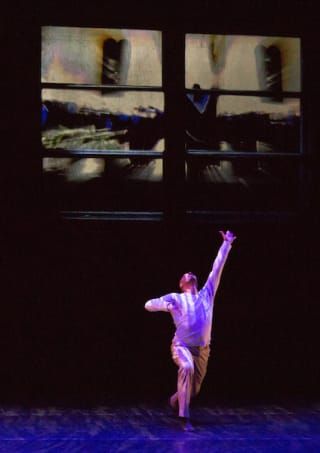
Helanius Wilkins's "Triggered"
Terrace Theater
The John F. Kennedy Center for the Performing Arts
Washington, DC
December 3, 2017
Was it bold of Wilkins to start with three male solos in a row and continue with a male duet? A sign at the theater's entrance had alerted the audience to strong language and mature topics. Yet, what met the eye possessed a harmony that was totally unsensationalistic. Different bodies, so it seemed, moved as a matter of course - quite naturally. The first body ran a couple of circles, and then stopped to explore such actions as leaning, bending, twisting the torso and balancing. Dressed in a flowing white shirt over tight dark trousers, this figure declared that its life pulse was smooth despite some "Wasted Time ...On Luvin' U". Swaying, turning, a jump and a still stand, plus walking slowly away from us, were moves that underscored this individual's temperament. The second man looked somewhat different. Shirtless and wearing jeans, he too was steeped in expressive motion. He bent like the first man, but also did floor work, a somersault and a hand stand. Yet he staggered more and suffered a collapse. With his dance titled "Bitter", was he younger and less experienced than his predecessor? In the third solo - "To the One I ... With Love" - pliant arms dominated the body's action. The port de bras did not become pathetic but gave the figure a lonely, buoyant dignity.
Wilkins, performing the first and third solos, was like two different men - at least as individual as Reginald Cole in between. All three figures' mobility appeared as something organic. It was this quality that gave the two dancers' appearance together, in the very energetic "The Letter", its point/counterpoint aspects. They danced in parallel sometimes and also partnered. Images triggered their mirrored reflections and interactions established a terse sense of dialog.
Using a female soloist, Stacie Cannon, Wilkins' choreography for "Warning" seems to play with the dancer asserting her body's mobility and with retreats into lethargy. A "Media" trio had less to do with expressing gender - Arneshia Wlliams the feminine, and Aaron Allen Jr. and Keith Haynes the masculine - than with trying to achieve unified action. Both "Warning" and the "Media" piece meander somewhat whereas the male solos and duet seemed to end on the dot.
The program concluded with "A Bon Coeur", a work in progress, in which Wilkins partners with a view out a window (video by Roma Flowers). Predominantly, Wilkins' protagonist is stooped. Age, presumably, has eroded his posture. He depicts a poetry of pain, except for passages in which his muscles suddenly remember their younger selves, resist transpired time and swagger. Sometimes what happens outside the window - such as vigorous marching - stimulates the protagonist to try to stretch, stand straight and step high. At other times the curve of his back reflects the contours of a mound of earth that could be his grave. But this "Heart" piece isn't yet finished.
Wilkins used to live in DC and is now on the dance faculty of the University of Colorado at Boulder. For this performance he brought some of his Colorado dancers along and also used some he had worked with formerly in DC. The audience that came to see Wilkins crossed paths with that going to the Kennedy Center 2017 Honors. As is well known, this year's dance honoree is the luminous Carmen de Lavallade. There was no presidential presence at these Honors, nor was there a designated deputy. I noticed that quite a few women going to the Honors had dressed in either white or black. Are those the current in-fashion colors, or were those wearing black in mourning for the missing presence while those celebrating its absence were the ones who wore white?
copyright © 2017 by George Jackson



