Makarova's Gift
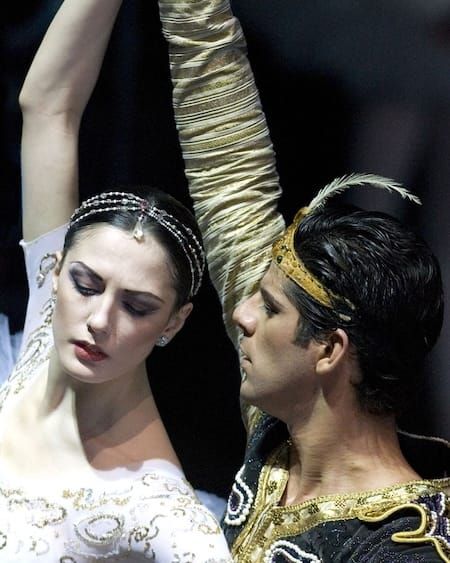
"La Bayadère"
American Ballet Theatre
Metropolitan Opera House
New York, NY
June 23, 2006
The audience at the opening night of ABT's "La Bayadère", as it stood and cheered, probably wasn't thinking about Natalia Makarova, but her production is one of the most valuable gifts ABT has ever received. Over the years, it has become richer and more layered, but she put the basic structure in place. It is strongly based on her memories of the Russian production, but she streamlined the more grandiose scenes, and brought the drama front and center. The original libretto has been translated by Roland John Wiley, and Makarova's follows it almost to the letter. (Though the original makes it clear that the High Brahmin is told about the poison snake trick, and that is why he has the antidote on hand, rather than appearing, as in this production, to be a South Asian boy scout, prepared for any emergency.)
The opening night cast, Veronika Part and Marcelo Gomes, were as powerful and moving a pair as I have seen in some thirty years of watching this production. Gomes, with his natural authority, was absolutely convincing as the noble warrior of the opening scene; walking on stage and creating a world with a few simple gestures is far harder than the now common jump, jump, and jump some more entrances that more modern productions seem to think is necessary. Gomes made the act of swearing on the eternal fire so resonant; just raising his hand brought to life the period when a man's word was important.
Gomes played Solor like a noble innocent, unable to cope with the web the Radjah and Gamzatti put together. He didn't reject poor Nikiya, he just didn't know what to do. His helpless regret during the betrothal scene developed into his yearning in the shades scene, where his expansive dancing and soaring jumps seemed a natural expression of his feelings. In the wedding scene, he appeared trapped in a circle of dancing girls, still dazed by his dream of Nikiya; in a stunning piece of acting, he just stood there with slight slump of his shoulders, so different from the bold, confident bearing of the first scene, a man beaten down by sorrow.
Part was a Nikiya to be sorrowful for. Her astounding beauty helps, of course, but her lyrical, expansive dancing gave Nikiya life. She captured Nikiya's many moods, from her horror at the Brahmin's lust, to the innocent joy of the first dance with Solor, to the sorrow of the betrothal dance. Her brief moment of joy, when she thought Solor had given her the flowers was followed immediately by such heartbreak that her death was as moving as many "Giselles" I have seen. She made it clear, in the shades scene, how this act differs from other Petipa white acts. Nikiya is not the loving ghost that Giselle is, or the attainable vision of "The Sleeping Beauty" or the enchanted human of "Swan Lake" or the generic beauties of the "Jardin Anime" or "Don Quixote", she is only a memory of what had existed. Part's moonlight and marble had no condemnation or forgiveness, she danced it as if it were something that came from Solor's imagination. Part is more comfortable in adagio, but she didn't force the more technical aspects, and her turns with the scarf were secure and flowing. She made the final turns float, and the effect was magical.
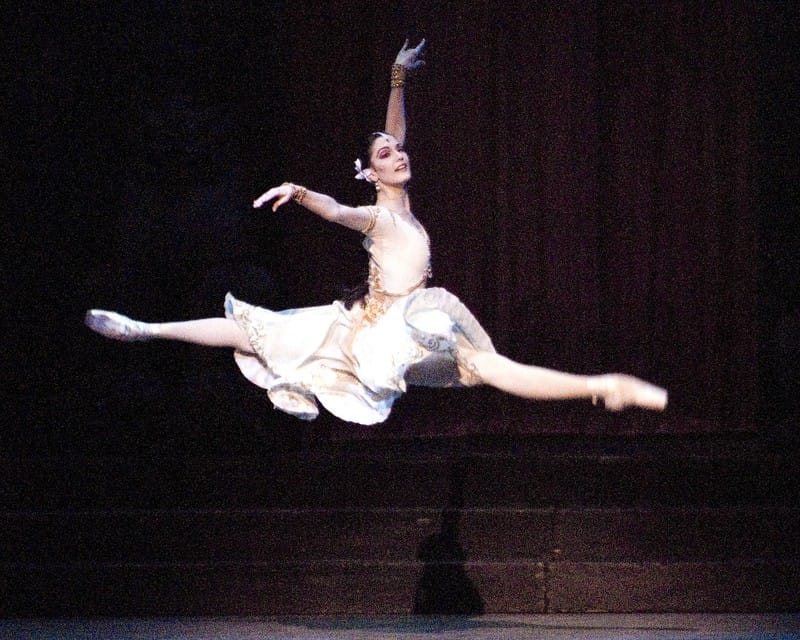
Her rival, Gamzatti, was Michele Wiles, who is a wonderful turner; her betrothal scene fouettés were spectacular. Her jumps, though, were problematic; she has developed a strange hiccup, as if she were struggling to push forward, which gave some of her dancing a staccato feel. Wiles also didn't quite have the malignant triumph that Gamzatti should portray. She was basically a fairly nice girl in love with the best looking man around, not the spoiled darling who could watch her rival be murdered.
Her father, the Radjah, was much more believable. Gennadi Saveliev gave Dugumanta an ominous weight and power. He was completely the autocrat, and this showed in so many details, both big and small. I especially noticed his behavior when the High Brahmin in asked to speak to him alone--Saveliev politely asked Gamzatti and Solor to leave, as they were equals, but dismissed the rest of his court in a curt, sharp gesture. This brief moment made it clear that to him, most of humanity was contemptible. Victor Barbee, as the High Brahmin, did not need subtlety, but he too was dangerous to cross, and his mime was powerful and clear. I especially liked his eagerness to force Solor to wed in the last act; if the Brahmin could not have Nikiya, making his rival miserable was the next best thing.
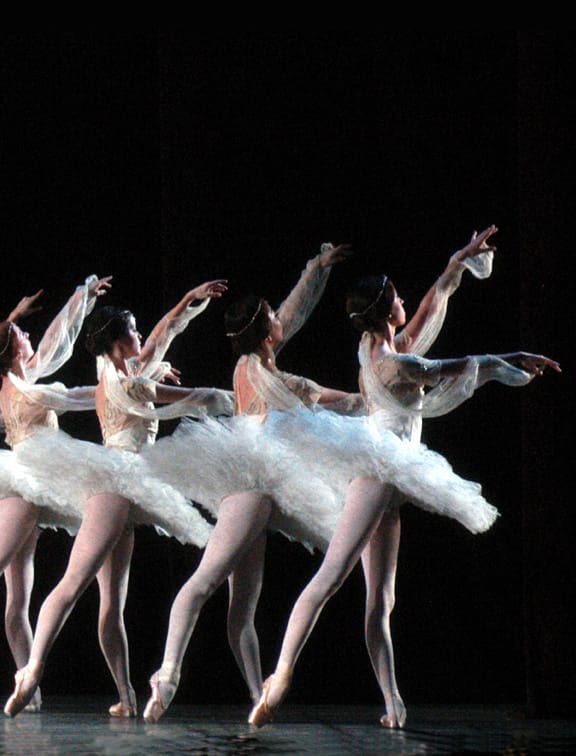
The corps deserved their resounding applause in the shades scene. That pearl necklace of an entrance really needs no analysis, it is just perfection, and the dancing was measured and uniform. (Yes, there were a few minor wobbles, but nothing to break the spell.) The three shades were Sarah Lane, Yuriko Kajiya, and Melissa Thomas. Lane's little hops on point looked effortless, and Kajiya seemed to float. Thomas had a bit of trouble with the difficult balances in the first half of her solo, but recovered for the second half. But she didn't let it affect her presentation, and had a lovely air of gentle melancholy throughout. Their trio was beautifully timed, with lovely little hesitations. But there was no hesitation about this extraordinarily moving performance.
copyright 2008 by Mary Cargill



