Made in Canada
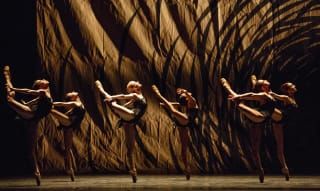
"The Dreamers Ever Leave You", "The Four Seasons", "Emergence"
The National Ballet of Canada
Four Seasons Centre for the Performing Arts
Toronto, Canada
February 28, 2018
The National Ballet of Canada's recent triple bill gave Toronto audience members an opportunity to experience three very different works commissioned by the company from Canadian choreographers. Though stylistically varied, each featured strong ensemble work and found inspiration from the natural world, be it the austere beauty of northern landscapes, the idiosyncrasies of insect behavior, or the cycle of changing seasons.
The evening began with the newest of the three works, "The Dreamers Ever Leaves You", from NBoC choreographic associate Robert Binet. This atmospheric and intimate piece is a chamber work for 13 dancers originally created in partnership with the Art Gallery of Ontario in 2016. The 40 minute ballet was presented as part of an exhibit of the paintings of Lawren Harris, a member of Canada's celebrated Group of Seven. Surrounded by Harris' distinctive landscape canvases, audience members could move through the gallery while viewing the ballet as part of an immersive experience. There is literally no fourth wall. Later, it was performed by the Royal Ballet, again in a unique venue, The Printworks in London's Docklands area. Transplanting a work that is so tied to dance as art installation on to a traditional, not to mention cavernous, stage was problematic. While Binet's piece has some starkly beautiful passages that deserve to be seen by a wider audience, the ballet lost its personal and private feel when taken out of context. It also felt a touch too long and repetitive when viewed in a theatre setting, even though the ballet was re-worked. The ballet has no arc or trajectory, in part because the score (performed and composed by Lubomyr Melnyk) does not. Melnyk's piano technique, described in the program as "Continuous Music", is unrelenting.
Nevertheless, the ballet had its moments. It also showcased several up and coming dancers in the company, young contemporaries of Binet. Skylar Campbell had a powerful solo, moving with weight and sweeping gestures to take up as much space on the large stage as possible. Second soloist Rui Huang was also featured prominently. She looked perfectly at home in this abstract, pure dance work. Her technique and facility, solid and unadorned, had a clarity that highlighted Binet's expressive choreography. The group of dancers move in and out of unison, in a naturalistic and at times improvisational style. In lieu of Harris' spiritual paintings was a backdrop of gradually shifting shapes. There were silhouettes suggesting mountains and a large, asymmetrical white sheet that floated down slowly like a blanket of snow. Shifts in lighting mimicked sunrise and sunset.
The evening ended with Crystal Pite's "Emergence", created for the company in 2009. In an age of often generic new works that can blend into one (plain costumes, ironic music selection, feats of extreme flexibility or strength for the sake of it), "Emergence" is refreshing in its commitment to a specific vision. Pite's work is a reflection on the complex social hierarchies of insects and swarm intelligence. Visually, the piece is absolutely unique, bringing the audience into a dark, subterranean hive of creatures that are at once macabre and mesmerizing. "Emergence" begins, arrestingly, with a pas de deux for Sonia Rodriguez and Ben Rudisin as larvae-like insects, awkward and unsteady before finding their place in the larger group. Rodriguez appears virtually boneless here, contorted into strange, unfamiliar positions. Then the viewer is invited into the hive as an army of women and men in black filter on stage. Their precision and uniformity draw obvious parallels to the order of a corps de ballet or a military march. At some points, the dancers actually chant the counts out loud in a communal whisper. Pite expertly moves the large cast into different formations. The women form a line with a crescendo of darting arms. Later, the entire group performs the same sequence of steps en masse for a hypnotic effect. While there are special moments for soloists, including an electric pas de deux for Svetlana Lunkina and Harrison James, "Emergence" is truly great in its ensemble work.
Rounding out the program was James Kudelka's "The Four Seasons", a timeless, signature piece for the company. It is not easy to set a ballet to music as familiar as Vivaldi's violin concerti, but Kudelka succeeds with that rare calibre of choreography that feels inevitable, and once seen is forever associated with the music. The choreography mirrors every shift in theme and tone heard in the score. Each season has its own movement motifs and vocabulary. The work centres on the cycle of one man passing through the proverbial seasons of life. Originally created for the incomparable Rex Harrington, it is difficult to separate the ballet from memories of Harrington's moving interpretation. However, if there is a dancer who could put his own stamp on the role, it is Guillaume Côté, who danced on opening night. An artist in his prime, Côté made the transition from the vitality and ebullience of youth to the wisdom and frailty of old age smoothly and with great care. In each season, he is visited by a different woman or muse, who were all excellent in this cast. In Spring, Jillian Vanstone was quick and light in her petit allegro, carefree and easy. Greta Hodgkinson, for whom the summer role was created for, brought both daring attack and whimsy to the sultry pas de deux. Jenna Savella brought an earthy, grounded quality and understated confidence to autumn. Throughout, there is some foreshadowing of the harshness of winter. The natural world is depicted as beautiful yet impersonal and unforgiving. Men are knocked down by others who do not make eye contact. In winter, Robert Stephen is like the grim reaper, hovering menacingly over the Man. Côté's struggle to evade Stephen is less desperate compared to other dancers' interpretations and it works for him. He has had a full life and is able to surrender in the end. Xiao Nan Yu is at his side, a nurturing, maternal figure. In the powerful final tableau, he is on his deathbed while the women from each of the seasons cradle his body, in a version of the Pieta.
copyright © 2018 by Denise Sum



