Mad World
"MADDADDAM"
The National Ballet of Canada
Four Seasons Centre for the Performing Arts
Toronto, Canada
November 30, 2022
Wayne McGregor's "MADDADDAM", a new work inspired by Margaret Atwood's prescient MaddAddam trilogy (published between 2003 and 2013), has been many years in the making. In an alarming example of life imitating art, the premiere of this dystopian ballet set during a global pandemic was delayed by an actual global pandemic. Of her frightening work of speculative fiction, Atwood has written "it does not include any technologies or biobeings that do not already exist, are not under construction, or are not possible in theory." Lest audience members get too comfortable distancing themselves from the horrific hypothetical scenarios of "MADDADDAM", the message that they could occur in the near future is sobering. It is heavy and dark content, hardly an obvious choice for a classical ballet company. Then again, McGregor has shown with "Woolf Works" that he is not one to shy away from complex, literary material. A large scale, big budget work, "MADDADDAM" brings together many repeat collaborators of McGregor in this joint production between the National Ballet of Canada and the Royal Ballet. It features an original score by Max Richter, design by We Not I and film design by Ravi Deepres. British designer Gareth Pugh created brilliantly imaginative costumes. Atwood is listed as "creative consultant", but has said in interviews that she gave McGregor and his team carte blanche in reimagining her books for the stage.
So how do you synthesize three novels into one full length ballet? In short, you don't. McGregor wisely chose not to take a literal approach to translating Atwood's narrative into dance. Instead, he pulled key archetypes and themes from the trilogy and presented them in broad strokes across three acts. The first act, "Castaway", begins with the apocalypse. There is mass destruction and death, leaving behind only a few survivors. The second act, "Extinctathon", provides a snapshot of the circumstances that led to the plague (or "waterless flood" as it is referred to in the books) -- corporate greed, scientific experimentation without checks and balances and exploitation of the environment. The third act, "Dawn", envisions a regenerative future that occurs beyond the last book of the trilogy. Although the ballet does not attempt to follow the events of the novels chronologically, some familiarity with the books certainly helps. Characters and creatures from the Maddaddam world are referenced, frequently without context or introduction, in a sort of shorthand that is confusing to anyone who did not at the very least read the program notes.
Each act comes with its own distinctive sets and musical style with some recurrent motifs and overlapping visual effects to tie things together. There is some text in the work, in the form of quotations from the books read in creepy, distorted voice overs using a child's voice with a great deal of static and interference. At times, the words are so distorted they become almost unintelligible. Videos projections, so de rigueur in new productions these days, are use extensively. While they create a layered visual effect and immersive experience, it can also be difficult to know what to focus on with so much happening on stage simultaneously. At times, less is more.
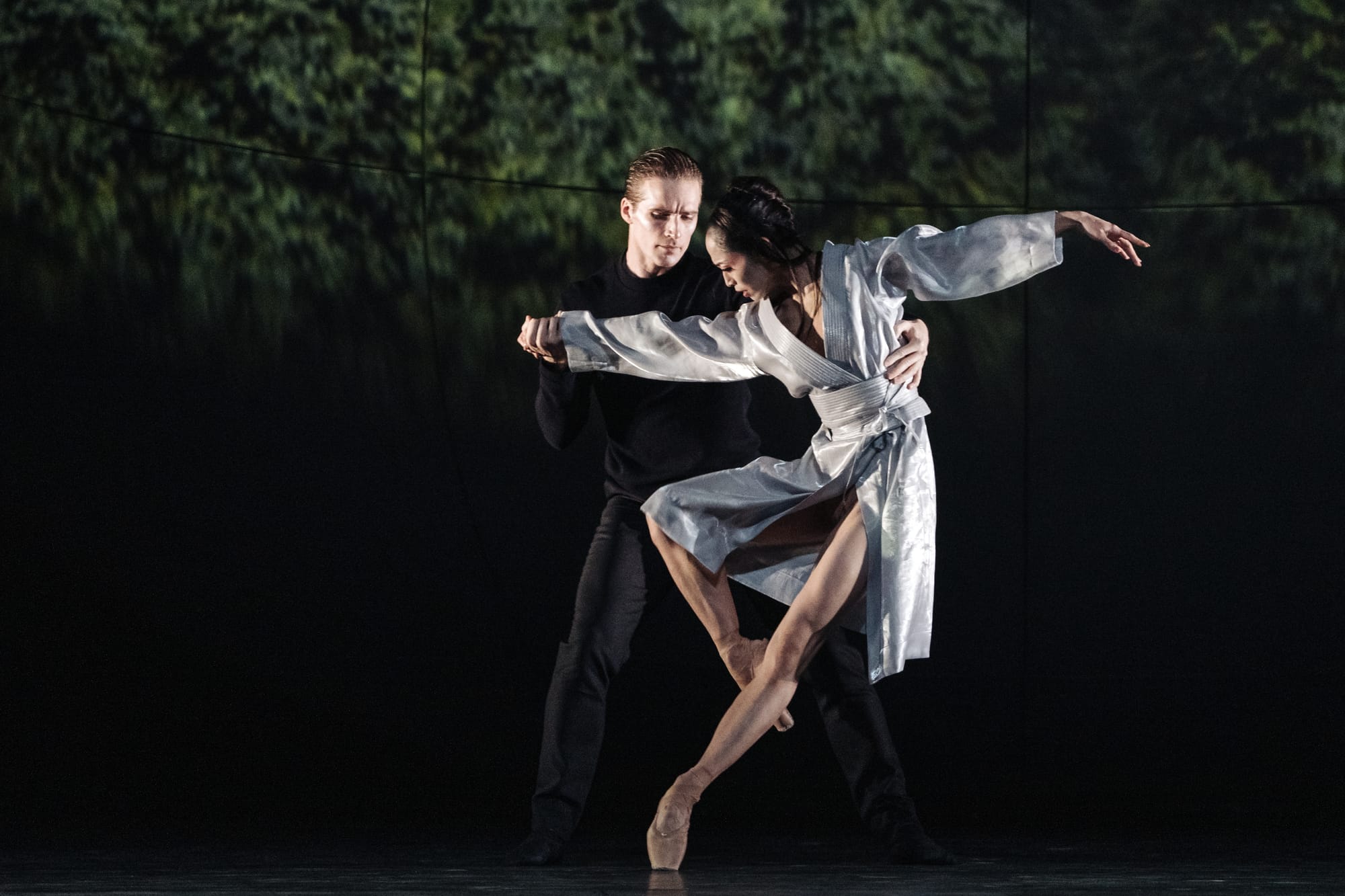
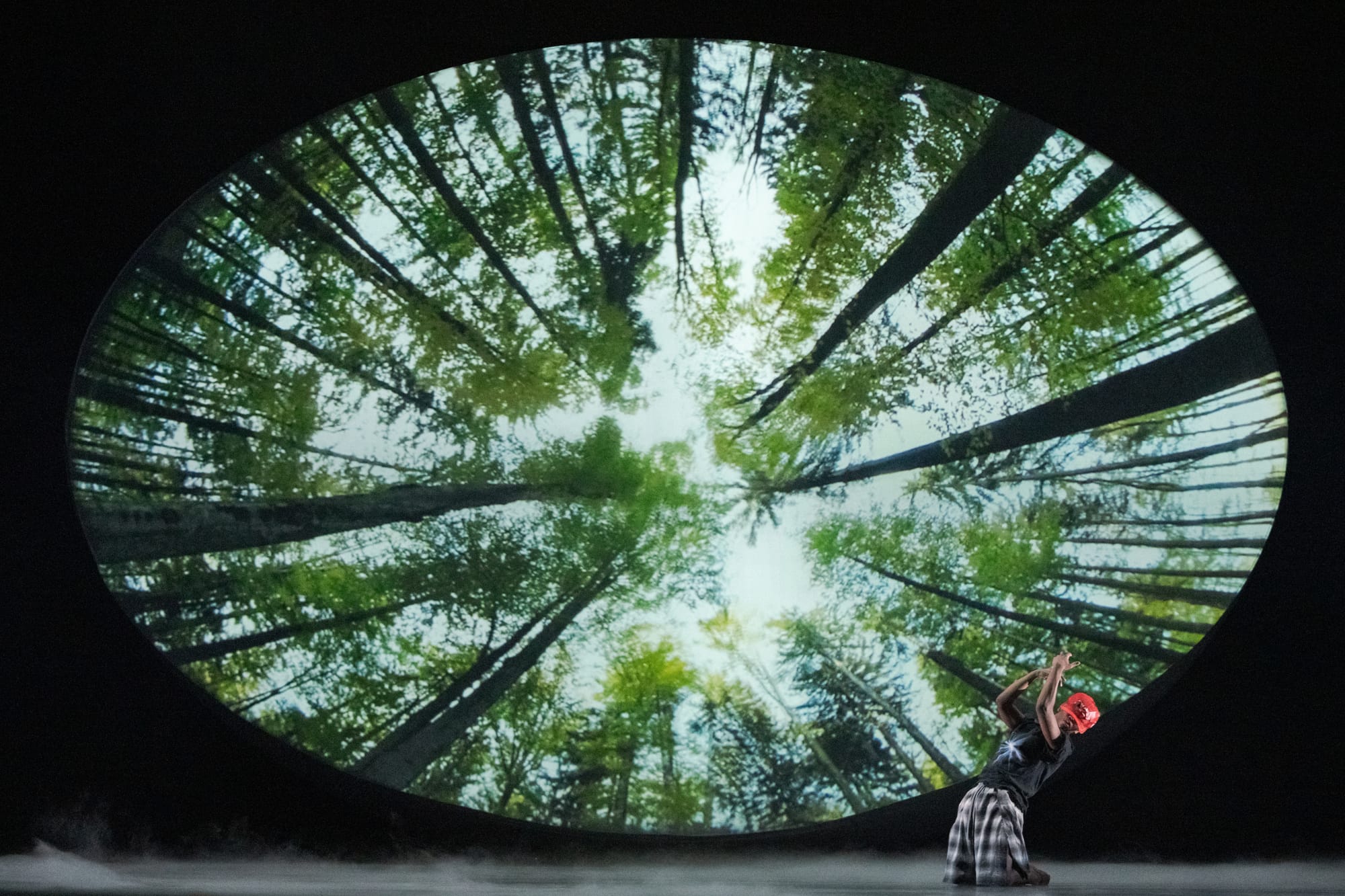
The first act depicts a pandemic, a great metaphorical flood of Biblical proportions. A screen projection shows scenes of destruction and anarchy on a scrim in front of the stage – burning cities, riots, war. Behind it, dancers move in slow motion flashbacks. The centre of the set is a giant egg shaped orb. Initially it shows stunning, untouched Canadian landscapes, but later this shifts to urban sprawl. There are recognizable cityscapes from modern day Toronto and Montreal, blurring the line between fact and fiction. The audience is introduced to key characters who have survived. There's Jimmy (Siphesihle November), the protagonist, the son of a genetic engineer. He looks like an average teen, wearing baggy shorts, a t-shirt and a red baseball cap. In a cautionary reference to current times, Jimmy's hat is a "Make America Great Again" hat. His childhood friend Crake (Harrison James) is the sinister scientist and mastermind behind the bioengineered virus that causes the plague. James, dressed in all black with slicked hair, brought a chilling presence to the role, which he impressively danced in every show of the run as there was no alternate cast. Koto Ishihara was Oryx, a goddess-like mysterious woman in a silky white kimono who is involved in a love triangle with Jimmy and Crake. Long and lithe, she towers over November, making her seem even more otherworldly. In one pas de deux, with her floating white kimono and Jimmy's plaid knee length shorts, it looks like a dance between James and the Sylph. However, she is not in fact a spirit, but rather an actress that Jimmy and Crake recognize from child pornography they watched together, not that there is any way to actually communicate this in the ballet.
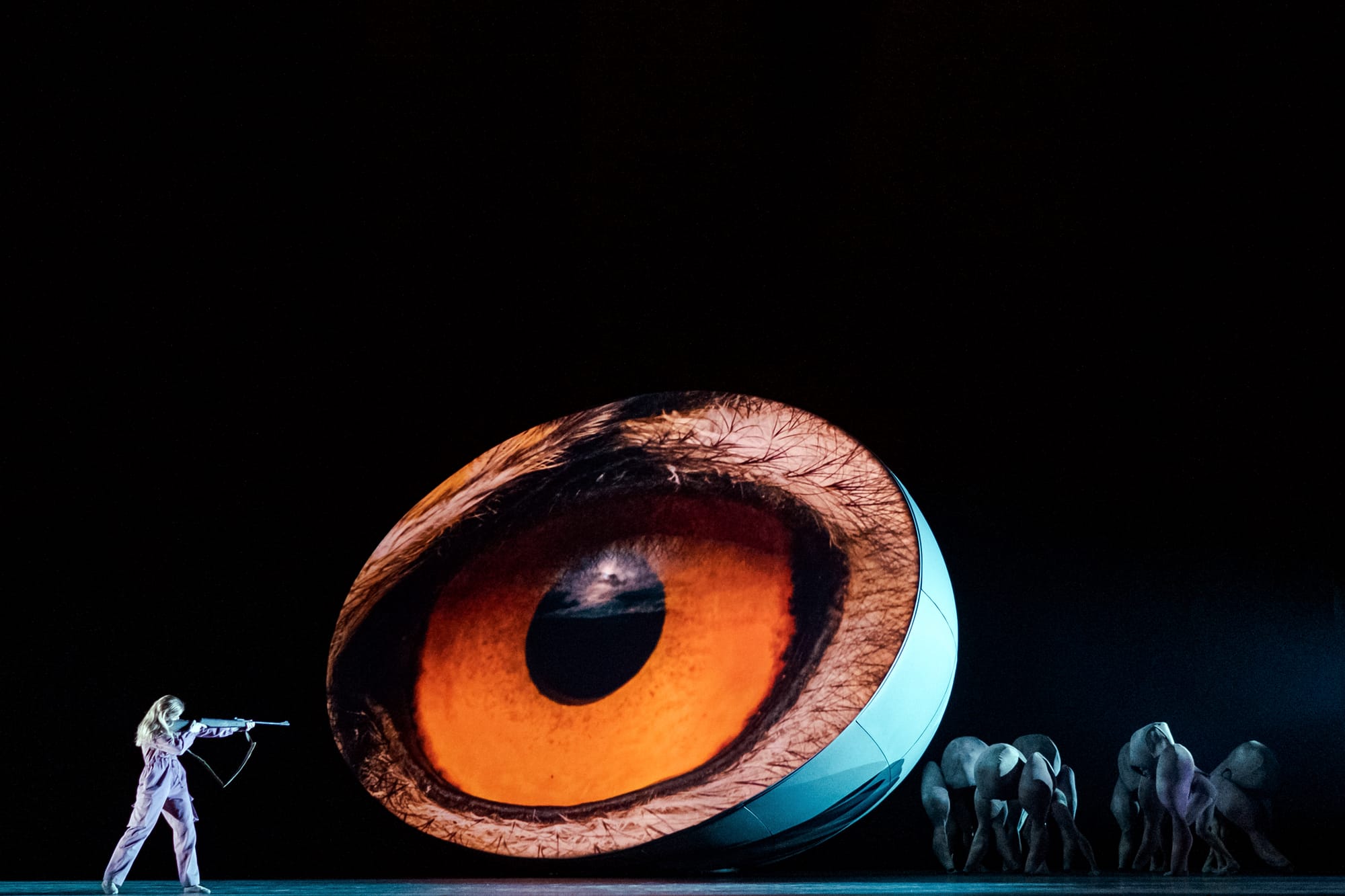
Outside of Crake's sanitized lab compound, other survivors like Toby (Heather Ogden) struggle to survive off the land while contending with chimeric animals like pigoons -- trangenic pigs designed to harvest organs for human transplant. They look like huge, headless turkeys. It's a dog eat dog world fraught with daily assaults and sexual violence. The ballet comes with a trigger warning as there is a gang rape scene. A graphic projection of wolves devouring their prey on the orb drives the point home.
While the first act is the closest to presenting a traditional narrative, the second act is depicted as a video game with projections on the screen indicating player names and when players die or become extinct. The set involves a series of hanging rectangular columns. The dancers are in plan white costumes and soft shoes. With the first act setting the scene and introducing the characters, this section allows for more intricate choreography and group formations with long strings of chaînés and series of precise assemblés. We see the genetic splicing that leads to the creation of the ultimate plague that almost wipes out humanity, with close up images of chromosomes. In another scene, people dance frantically together in a rave, while Richter's music brings in elements of electronica. A close up video of a pill suggests their experience is being chemically mediated, rendering them oblivious to what is going on around them. If the large meat grinder on the side of the stage or constant buzzing sound of flies does not hint at a sense of (moral) decay, a voice over reading from Atwood's essay "Burning Questions" makes the social commentary clear. It speaks of the problematic and often contradictory desires of humankind, often capitalized upon by corporations: invisible servants we'll never have to pay, weapons that will never miss, excitement and adventure, safety and security. She writes about hubris and the danger of playing God.
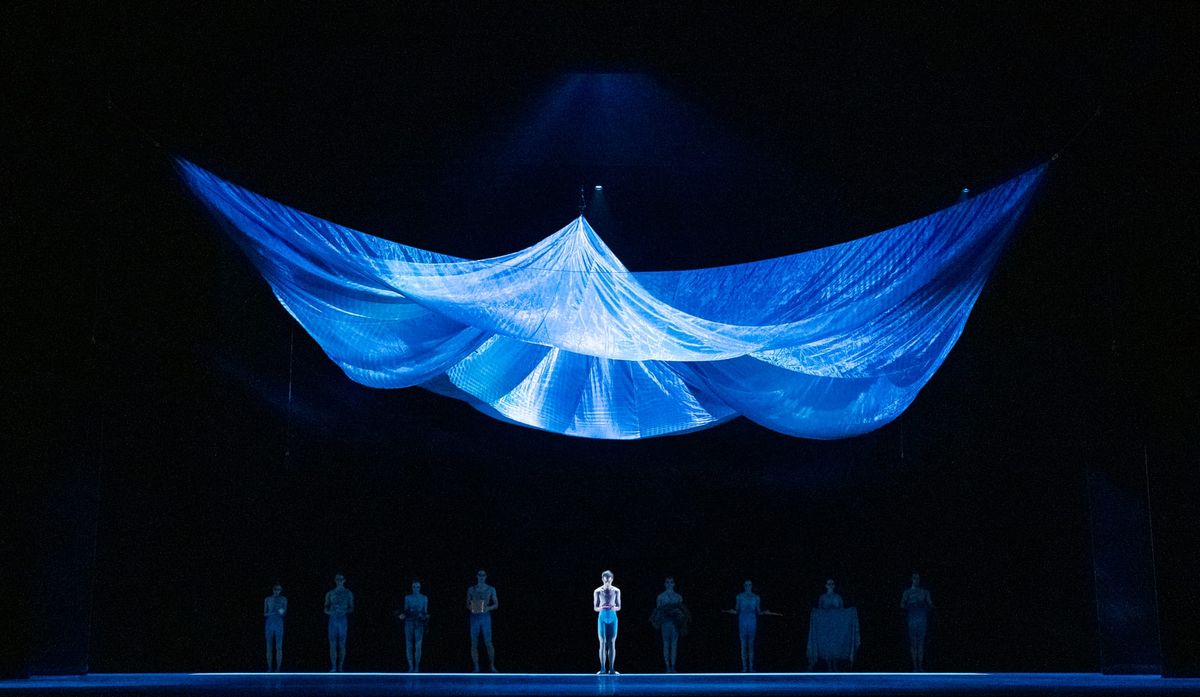
The final act attempts to shift the perspective to one of hope and rebirth. Not all is lost. There are survivors that are critical of the systems that created the plague and who tell the story to the next generation to learn from. They literally enact this storytelling, by fashioning puppets from sticks, sheets and hats to depict the horrific past and transform it into a digestible tale for the children (here, students of the National Ballet School). In terms of visual effect, a large sheet hangs over the stage. It could be a safety net, a parachute or a surface of water. The same characters are back, but some are in a different guise and labeled in the program as "ancestors" and "descendants". The dancers wear blue ombré biketards with bold turquoise eye makeup and look like almost a new species. They have gone back to nature and their movements are more languid and primal. The pigoons are back, but less vicious than before. The presence of the children symbolizing hope combined with choral music is perhaps too obvious. Nonetheless, the yearning ensemble pieces in the third act are a choreographic highlight of the work, matched with a dramatic and moving crescendo in the score.
McGregor's "MADDADDAM" is one of the most ambitious new productions that the NBoC has ever mounted. The themes and content are novel, timely, thought provoking and challenge the audience. Choreographically, fans of McGregor's athletic and contemporary style will find much to appreciate here. The music is rich and varied, while the set and costume designs are striking. However, there are many moving parts in this production that do not always come together as they should. It is a lot to digest and likely would benefit from a subsequent viewings. The production would also benefit from some editing as some sequences are needlessly long and cluttered or do not make sense without the text of the book. Some aspects of storytelling in "MADDADDAM" fell short. Certain commentaries were hammered into the audience heavily, whereas other messages were muddled or lost. Nonetheless, there is much innovation in this production. For ballet to continue to grow and evolve, dance makers must try new approaches even if not fully successful. In this regard then, "MADDADDAM" is a worthwhile experiment and an impressive feat.
copyright © 2022 by Denise Sum



