Lydia Johnson
"Change of Heart", "Dusk", "Night of the Flying Horses", "Night and Dreams"
Lydia Johnson Dance
Ailey Citigroup Theater
New York, New York
June 7, 2013
Lydia Johnson's appealing group of dancers, augmented by Carlos Lopez, a former soloist with ABT, presented a series of four dances at the intimate Alvin Ailey Theater. The music, which ranged from Bach to Osvaldo Golijov, unfortunately was taped, but the dancers managed to make their movements seem spontaneous. Johnson's dancers have a firm ballet base, but she weaves everyday gestures (walking, reaching, crouching) into the vocabulary, which gives the dances an intimate, conversational feel. I don't know if it was intentional, but each piece had a similar motif of reaching up, bending down, and crossing one arm in front of the body, which tied the evening together, though each piece had its own emotional variety.
The opening work "Change of Heart", began with the dancers grouped together stage right, facing the rear, while one dancer emerged and faded back into the group. The movements had a slightly mournful feeling, as if the group were trying to connect with someone, reinforced by the reaching up and dropping down motif, which was repeated with variations.
"Dusk", to music by Henryk Gorecki, also opened with a group picture with four women in long black tunics, looking like pillars, observed by four men. There was a feeling of both restlessness and defiance in the various crouching motifs, which turned to exhaltation in the second half, as the women reappeared in white.
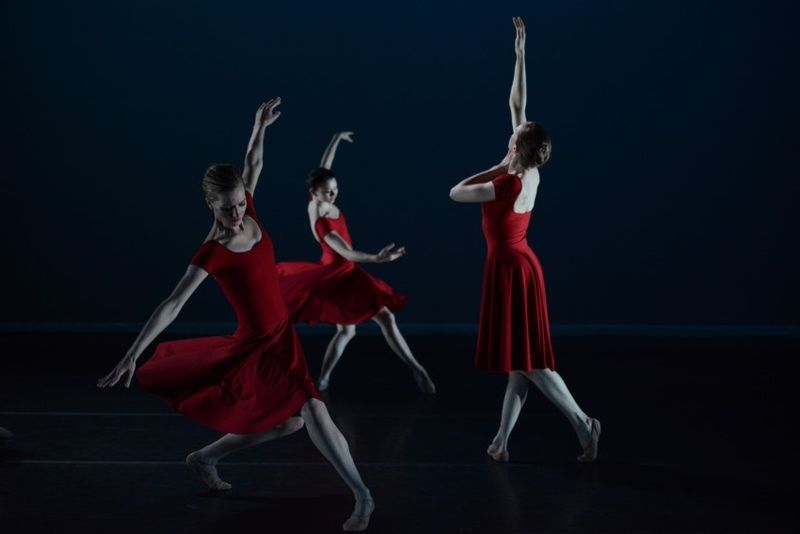
The rather obscurely titled "Night of the Flying Horses", to pieces of music by Osvaldo Golijov, (one of which is the origin of the title) premiered this year. The women wore very attractive, danceable red dresses (designed by Jessica Sand Blonde) and the men grey pants and knit shirts, everyday clothes that were easy to move in. The music had many moods, which the dancers echoed. Kerry Shea was especially impressive as an outsider.
"Night and Dreams" was another premiere, set to six of Schubert's most haunting songs, sung on a recording by the British tenor Ian Bostridge. His light, clear voice gave these songs a slightly impersonal, universal feel, which the simple costumes (white slips for the women and white shirts and black shorts for the me) reinforced. Dancing to Schubert songs can be tricky, since perfection generally doesn't need to be augmented, but Johnson used very simple moves to echo the feeling of the songs without making the lyrics explicit. Arabesques merged into floating, gentle walks, and the partnering was often small rocking moves. The final song "Nacht und Traume" ended with the same grouping that began the evening, the dancers gazing off into the back of the stage, so there was a sense of completeness, of coming full circle. And it made me want to rush home and listen to Schubert.
copyright © 2013 by Mary Cargill



