Looking, Thinking, Listening
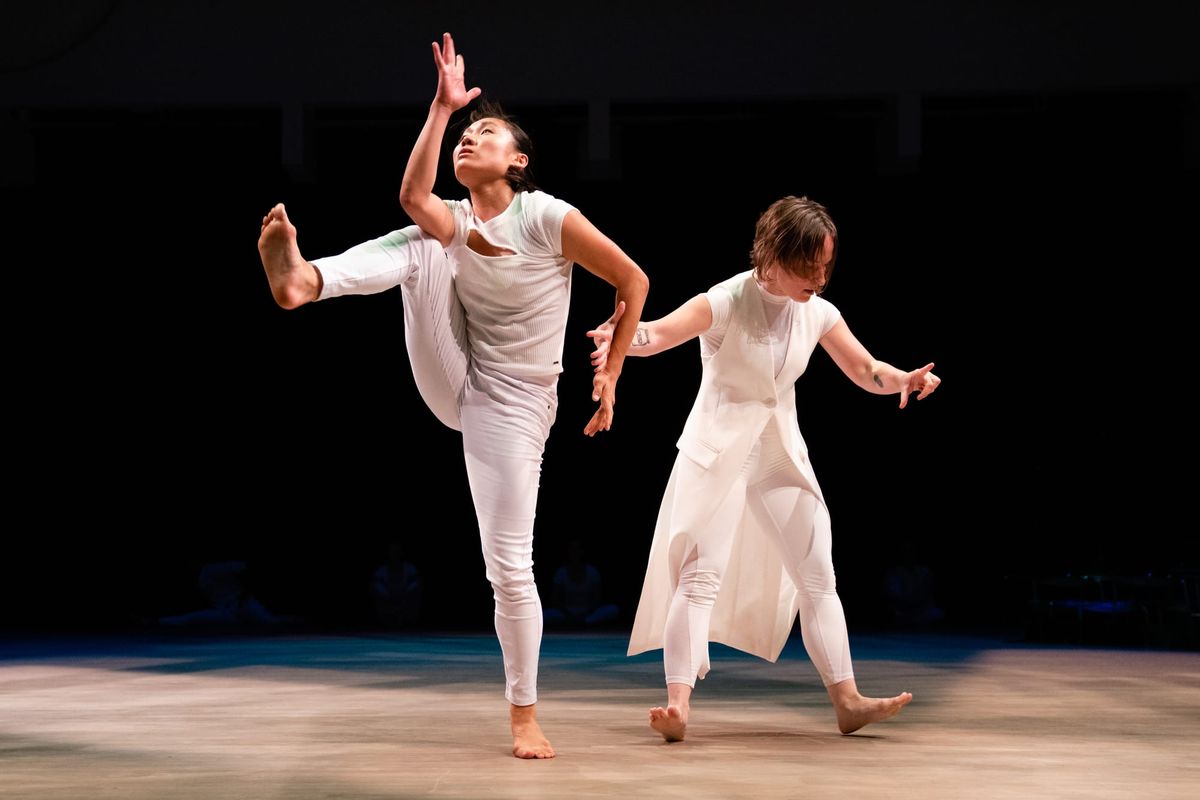
"The Exceptionally Elderly Overweight Black Man Phoenix"
Robert Moses' Kin
Yerba Buena Center for the Arts
Forum
San Francisco, CA
June 14, 2019
While it’s true that most works of art on one level are about their creators, it’s also true that few artists manage to weave personal experience, artistic challenges, as well as social and philosophical issue into a seamless whole without overburdening the final product. But that’s exactly what Robert Moses attempted in his brave “The Exceptionally Elderly Overweight Black Man Phoenix.” The show opened with a recording of Moses in his street poetry mode. While the force and speed of his language threatened to drown us much like the storm waters from a dam that broke its confines, its patterns and rhythms showed Moses as a formidable spoken word poet. Here are some of the fragments that I managed to hang on to: “the imperfect beauty of the body”, “the legacy you embrace,” “every move changes space” and “we are citizens of these territories.” References to growing up in his family suggest that Moses threw his net far and wide.
Guest artist and former company member Amy Foley opened the hour-long piece elegantly and with consummate grace. Her dancing expertly rode the flood of Moses’ droning voice with sharp attacks, quick shifts of direction and limbs that shot every which way. The idea, it became quickly clear, was that her presence and her action could erase the drawn barriers with which David K. Elliot's lighting design had defined the floor of the performing area. This concept of space – in every sense – as flexible and changeable worked beautifully. Foley’s solo, dancing so musical to language, was the most cohesive and individually expressive part of this premiere. With some modifications, it could stand on its own. The rest of the “Exceptionally Elderly” was given over to an octet of multi-racial Moses dancers, almost half of them new to the company.
In his twenty-five years of choreographing Moses has proved over and over how much dance is a multi-lingual discipline, entirely at his disposal. Here, he didn’t so much create a logical choreographic trajectory as a tapestry of his dancers’ possibilities. Still, in a time-based art form, sequential connections are underestimated at one’s own peril.
The group choreography for the eight dancers strongly focused on duets and unison duos. Performed with the audience seated on three sides in YBCA’s Forum, the dancers sat against a back wall. They watched from the sidelines and took over an empty space or inserted themselves into an existing group.
After a while, Moses’ voice began to fade out and was replaced by one of his musical scores that featured insistent metallic percussion. Details packed, at times almost overburdened, the choreography. Where there still was text it commented, sometimes quixotically, on the choreography. The dancers kept to their tasks even as they heard about “stepping from one life to another.” In a (still-rare) male duet for Vincent Chavez and Victor Tallegos the invisible voice talked about “children in danger.” Were these interjections planned or accidental? I couldn’t tell.
In a “girl friends” mirroring duet Emily Hansel and Cora Cliburn hopped while holding hands. They dropped to the floor, created mirror images and, still together, slithered off of the stage. Even though formally rigorous, the duet had the flavor of popular dance traditions. Later on, the whole ensemble's unison circles felt the same.
In another duet ArVejon Jones and Liv Schaffer, both small-boned and new to the company, got to know each other with small tight movements and mirroring imagery. Schaffer, with twitches that consistently traveled through her torso, appeared as close to a character as the invisibly self-reflecting Moses.
Besides modern dance, athletic configurations, both in the air and on the floor, and street moves, Moses for a few moments mused on ballet. In an evenly spaced unison sextet, he placed the women in front, the men behind, exactly behind. It was about as clear a nod to frontal perspective as you might want to see. At another point, Chavez turned three lined-up women in what, I am pretty sure, were finger turns.
A duet for Jones and Khala Brannigan, tall with spectacular arms, made me rethink strength and power. In whatever partnership — men or women — Brannigan aimed for being in charge. Breaking out on his own, Jones’s solo –- fast, furious and yet ever so lyrical –- showed him a fine addition to the company. If Moses’ poetry wove a dense texture of who we are, the fiercely danced choreography was a much more loosely woven fabric in which deep plies and headstands were as much at home as lifts in “splits” and drops and rolls. I also seem to have noticed more unisons, duets and mirror images than I remember from earlier work. Was he trying to say something about community despite complexity? Even though “Black Man’s Phoenix” began to drag towards the end — so many duets! –- ultimately, this “Black Man’s Phoenix” offered an impressive accumulation of dance images through which we could look at ourselves.
copyright © Rita Felciano 2019



