Looking Forward
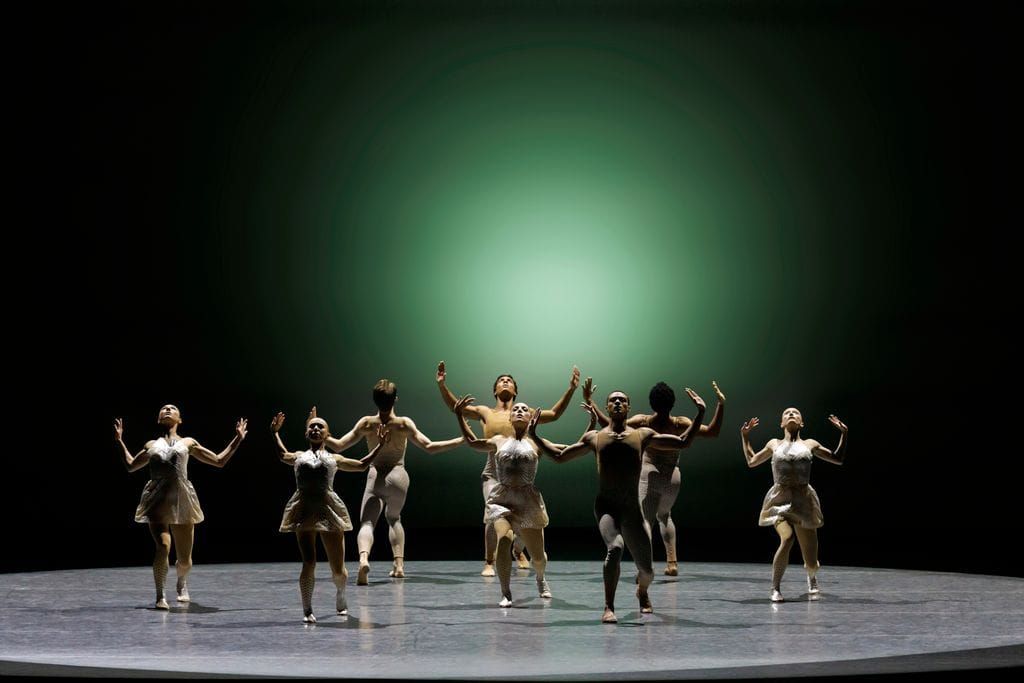
"Voices", "Composer's Holiday", "Herman Scherman Pas de Deux", "Forseeable Future"
New York City Ballet
David H. Koch Theater
Lincoln Center
New York, New York
October 9, 2025
The current City Ballet practice of programming ballets by themes meant that the evening, called “Contemporary Choreography I”, had no tutus, limited point shoes, fantastic dancing, and a gradually diminishing audience. Contemporary, in this case, ranged from 1993 (William Forsythe’s “Herman Schmerman pas de deux”) to yesterday (Jamar Roberts’ “Foreseeable Future”, which premiered at the October 8 gala), and included Alexei Ratmansky’s “Voices” from 2020 and Gianna Reisen’s “Composer’s Holiday” from 2017
Ratmansky’s “Voices” lived up to its title. The work was set to selections from Peter Ablinger’s “Voices and Piano”, where a live pianist (Stephen Gosling) accompanied recorded interviews by six women. The music captured the cadences and rhythm of the speakers, echoing the sounds rather than emphasizing the meanings of the words, so the voices, mostly unintelligible, merged with the music. Ratmansky’s choreography, too, seemed to be based on syllables, not on sentences, on sound and not meaning, yet as a whole, it seemed to be an affirmation of the power of art. (The final voice is the abstract painter Agnes Martin saying clearly “I object to being called a mystic. You’re not a mystic when you respond to beauty.”)
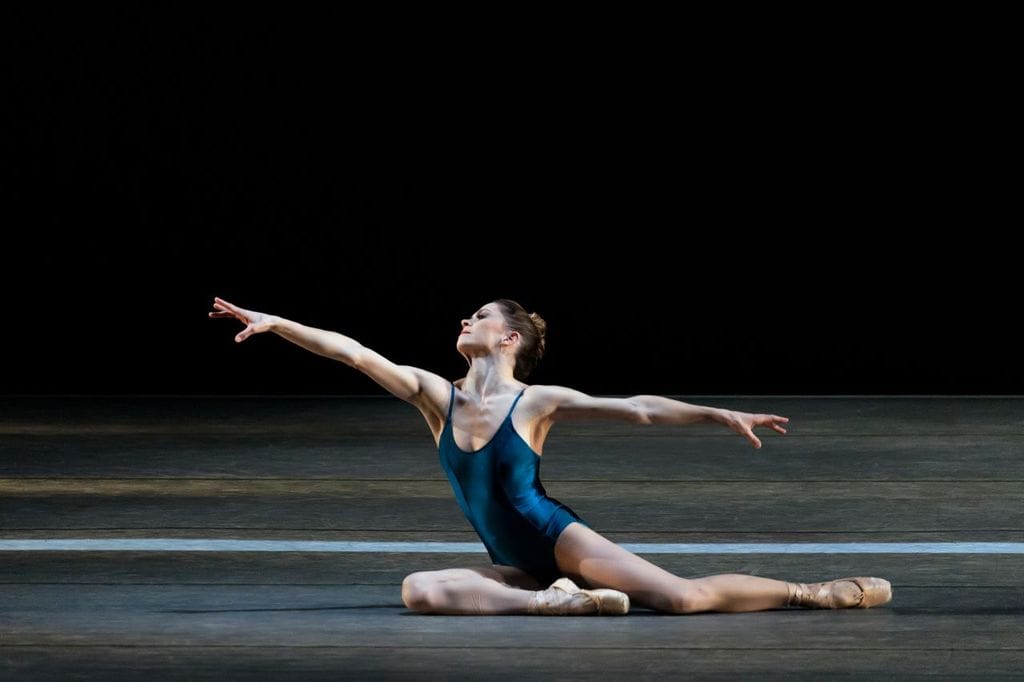
There were five powerful solos for the women (Emily Kikta, Megan Fairchild, Isabella LaFreniere, Naomi Corti, and Alexa Maxwell—LaFreniere and Corti were making their debuts), as the women, in bright leotards (the costumes were by Keso Dekker) leapt, hopped, turned, and shifted unexpectedly to the sounds. Kikta was especially dynamic, using her long, strong legs to carve out shapes. Fairchild’s solo was full of skittery little doll-like moves, while both LaFreniere and Corti devoured the stage, LaFreniere with a luxurious, almost preening control, and Corti sweeping her arms through the air. Maxwell, in the final solo, had a wary, fragile air; she moved with a haunting beauty.
The five men (Owen Flacke, David Gabriel, Joseph Gordon, Mckenzie Bernardo Soares, and Peter Walker) appeared, marching in unison, at the end of each solo like a comma, until one of them burst into an exclamation point of male bravura. The five rapid fire demonstrations of brisé volé, turns a la secondé, saut de Basque, and other pyrotechnics were all done in silence, almost daring the audience to enjoy the sheer physical perfection for its own sake, as the women worked through the tangle of words and music; the audience responded enthusiastically.
The men joined the women in the final section, as Ratmansky seemed to pull everything together in a complex geometric construction, as lines and circles formed and reformed; it had an austere beauty. “Voices” will probably never become one of Ratmansky’s popular works—the music is a bit too dry and repetitive—but it has a multilayered complexity and experimental imagination.
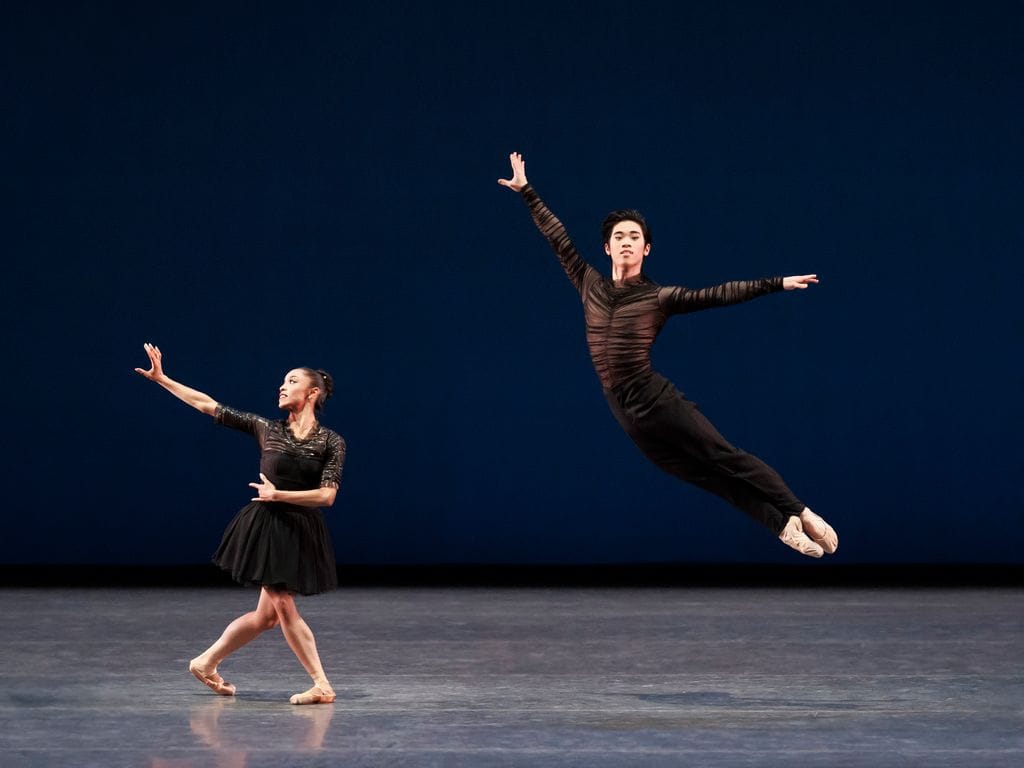
Reisen’s “Composer’s Holiday”, choreographed when she was just eighteen, has a surface charm but meanders pleasantly and forgettably through Lukas Foss’s “Three American Pieces for Violin and Piano”. (What his holiday had to do with the ballet was not clear.) The youthful original cast showed that Reisen has a clear eye for talent; the two lead couples at the premiere were Emma von Enck with Roman Mejia and Christina Clark with Gilbert Bolden III, (Clark and von Enck were in the corps and Mejia and Bolden were still apprentices) and her eight member corps included Baily Jones, Olivia MacKinnon, Sebastian Villarini-Velez, and Andres Zuniga.
Both Clark and Zuniga appeared in their original roles; Clark danced with Kennard Henson (he was originally scheduled for the debut) and Mia Williams and KJ Takahashi, two of NYCB’s vibrant young dancers, danced the second couple. The choreography had a youthful enthusiasm as the dancers flowed through various shapes in the seemingly inevitable pools of light in a dark stage, but, perhaps in part because the music had so many shifts of mood, there was little emotional or choreographic development, and it did seem longer than its twelve minutes.
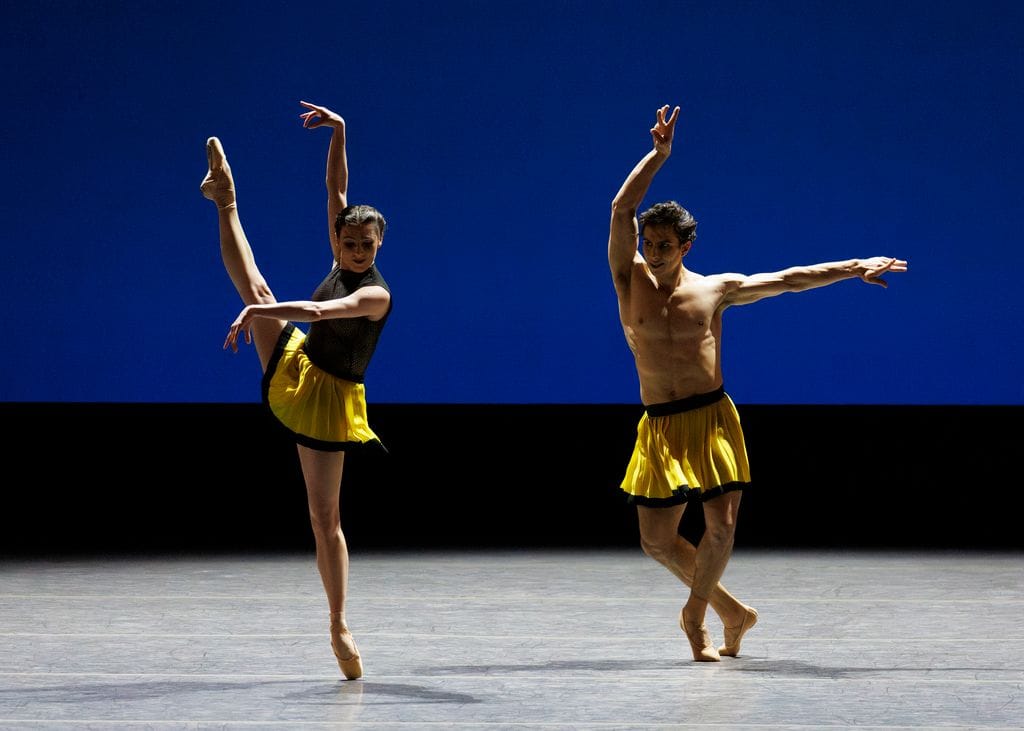
There is little development in William Forsythe’s “Herman Schmerman Pas de Deux, either, it is a ten-minute energetic slink-fest to Thom Willems’ thudding electronic music. Tiler Peck and Roman Mejia danced the pair and gave it an unusual classical sheen, so different from the almost insolent, don’t give a damn air of Wendy Whelan and Albert Evans, the dancers so closely associated with the piece. Peck didn’t have the knotty aggression that Whelan showed, and gave her dancing a lighter, smoother flow; she seemed to circle warily around the odd, off-center, slouching wiggles and shrugs, as if dipping her toe in only so far. It was a brighter, happier approach.
Mejia gave his dancing an upright, heroic strength, so different from Evans’ slinky, hard-edged approach. When Mejia appeared in his little skirt, he could have been a Greek soldier, parading proudly, instead of Evan’s preening runway strut. It seemed that they were deconstructing Forsythe, circling back to his classical roots, a perfectly valid comment on his style.
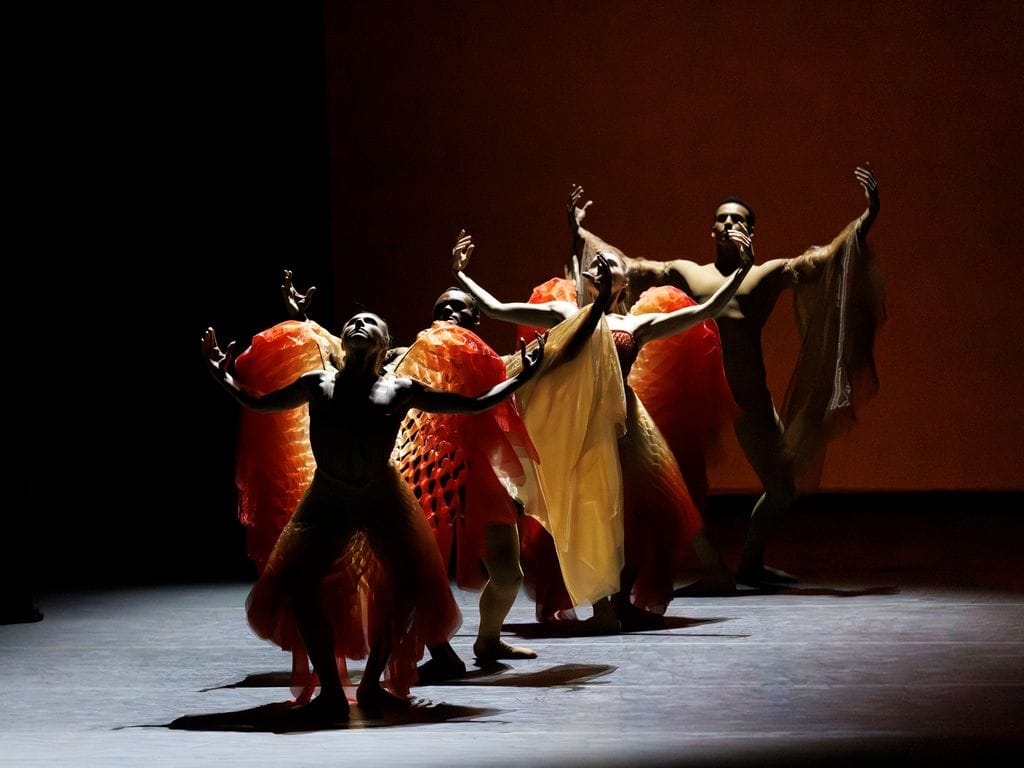
There was no circling back to classical roots in Jamar Roberts' “Foreseeable Future”, whose costumes and lighting tended to overwhelm the rather pedestrian steps. It premiered at the Fashion Gala, where fashion designers team with choreographers on a new work. Roberts worked with Iris van Herpen, a Dutch designer who combines fashion and technology. Her designs were striking, with huge wings for the main foursome, Sara Mearns, Taylor Stanley, Isabella LaFreniere, and Ryan Tomash, and slivery outfits or leotards for the six corps dancers.
The electronic music, by the Venezuelan composer Acra, opened with an ominous crash and the four angelic dancers posed with their enormous wings—the costumes restricted the dancers but their rippling arms made their wings catch and reflect the light in a very Loie Fulleresque vibe. The scene shifted to the corps moving with mechanical precision in brief staccato bursts; their blank expressions and symmetrical moves made them look like aliens in an aerobics class.
The two groups met up during a magical moment, where the lighting (designed by Brandon Stirling Baker) made it look like the dancers were floating waist high in water, then a luminous light brightened the stage, as some of the silvery dancers seemed to drown one of the angels. According the the NYCB website, Roberts has said that the ballet expressed “ a contradiction between the beauty of the natural world and rapid technological evolution”. This unfortunately was not clear from the work, and the rather harsh music did seem to drive some of the audience out early. Nor did there seem to be any realization of the irony of protesting technology by using mechanically precise and technologically sophisticated lighting to do so.
copyright © 2025 by Mary Cargill



