Long Live Spring
"Zéphyre and other ballets by Jean-Philippe Rameau"
The New York Baroque Dance Company
Symphony Space
New York, NY
September 21, 2010
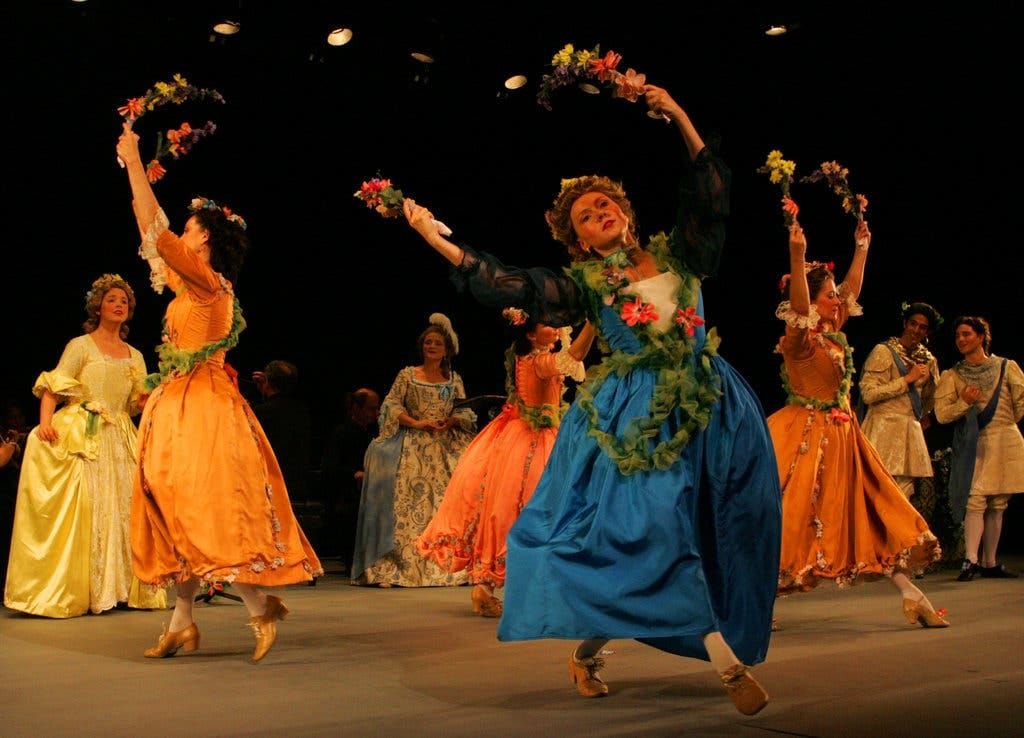
Nymphs, muses, and goddesses invaded Symphony Space with the New York Baroque Dance Company, led by Catherine Turocy, and the New York premiere of Rameau's chamber work "Zéphyre". According to the detailed program notes, there is no record of this at the Paris Opera, and may have been written for the court of Versailles and Madame de Pompadour. The somewhat Spartan Symphony Space evokes nothing of baroque elegance, and the casual, appreciative audience was a far cry from French courtiers, but the evening was elegant, sprightly, and uplifting.
It opened with a potpourri of Rameau, played live on period instruments by the Concert Royal. "The Daughters of Memory", ie, the Muses, was a brief but delicate evocation of the past, complete with masks. The style, with its quick little steps and calm, elegant upper bodies, is un-exaggerated but full of variety and charm. This was followed by the more elaborate "Dance Suite from La Dance", a jaunty celebration of Terpsichore accompanied by a group of fauns, satyrs, gnomes, and sylvans, a charming introduction to the style of dance before the various sylphs and wilis conquered the stage, apparently never completly to surrender. These Dresden figures wove delicate round dances, played at London Bridge, and never confused artifice with artificiality.
The story of Zéphyre is familiar to anyone who has seen ABT's wonderful production of "Sylvia"--chaste nymph of Diana is loved by a male (in this case Zéphyre, the god of spring breezes), and Diana, Endymion in tow (described in the charming pre-performance talk as a ubiquitous boy-toy), surrenders to the demand of Cupid, to the general delight of everyone on stage. This is an opera-ballet, with the story propelled by the singers and the emotion by the dancers. The dancing, re-imagined by Catherin Turocy, since there is no record of the actual (if any) choreography, was elegant and lively, and full of juicy entrechants and double pirouettes.
The three sopranos, representing Zéphyre, Cloris (the nymph he loves), and Diana, sang and acted the semi-staged work beautifully, and the finale, with the three female voices mingling the various emotions, seemed to look forward to Richard Strauss' profound use of the female voice as a male character in his take of the lives of 18th century aristocrats. The feelings are distilled and concentrated, and the performance was full of emotional, not literal, truth and ended in a soaring but restrained triumph to love, youth, and spring.
copyright © 2010 by Mary Cargill