Lonely Passion
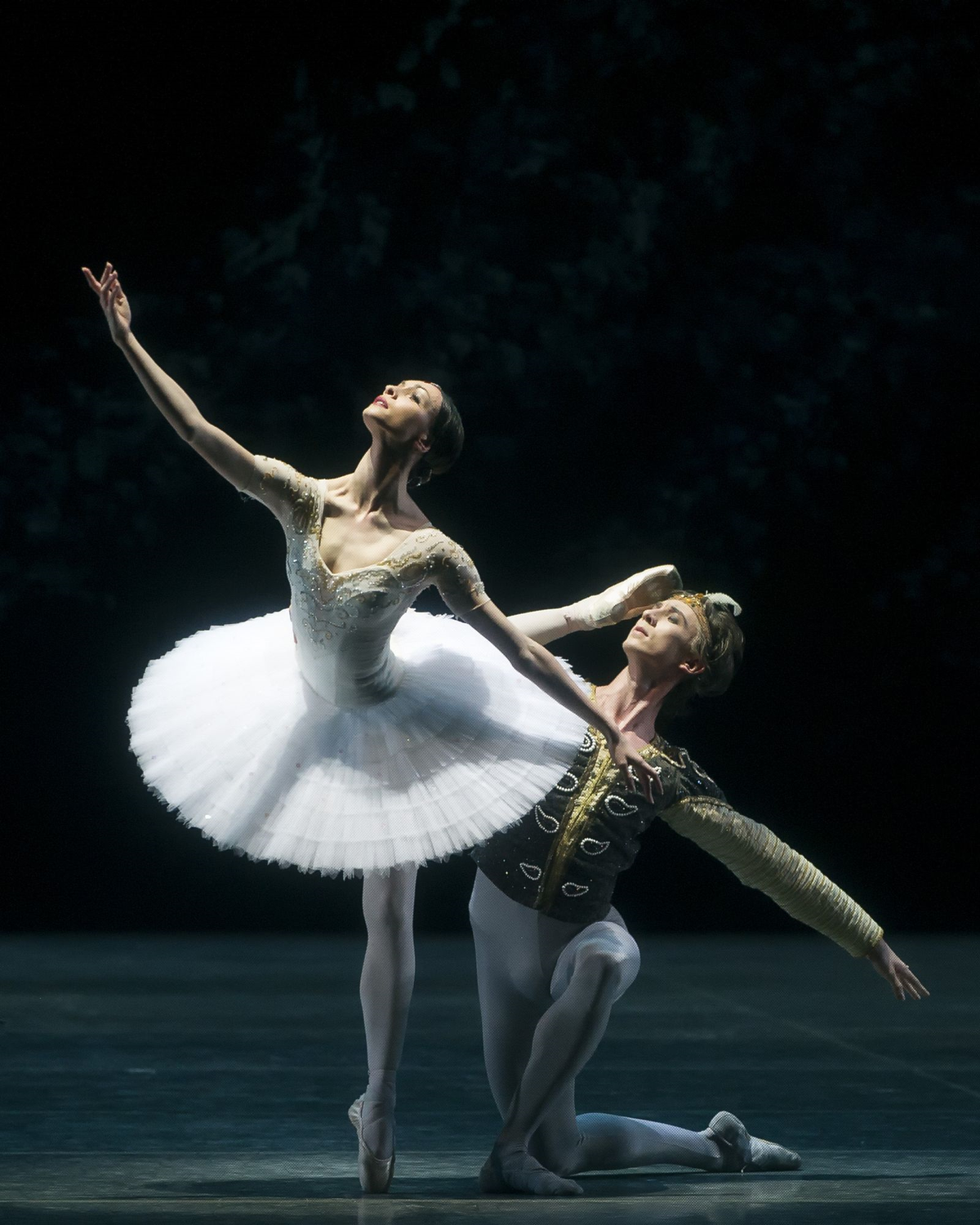
“La Bayadère”
American Ballet Theatre
Metropolitan Opera House
New York, NY
May 28, 2014
Bolshoi Ballet’s latest rising star – Olga Smirnova – appeared as a guest in only one performance during American Ballet Theatre’s run at the Met, but in the three acts of “La Bayadère” she made a bigger statement than most dancers do in a season. The Nikiya she danced was her Bolshoi Nikiya in style and interpretation, and this portrayal contrasted from the rest of the cast as much as her eloquence and refinement.
Nikiya is one of 22-year-old Smirnova’s crowning roles, earning her the prestigious Benois de la Danse prize in 2013, and probably one of the more personally meaningful ones -- it is in this role that she made her leading debut with the Bolshoi only six months after performing it at her Vaganova Academy graduation performance in St. Petersburg and getting the remarkable invitation to join the Moscow troupe (Vaganova Academy traditionally feeds into the Mariinsky, which also invited her). Smirnova’s classical physique, beautiful lines and flexibility make her particularly well-suited for the role, but it is her unique character treatment that renders it special.
Instead of a beautiful and passionate heroine overcome with emotions of true love and its loss, Smirnova’s Nikiya was guarded and a lonely soul. In her first display of real passion during her duet with Solor, danced by another guest artist, Vadim Muntagirov, you believed her love, but you also realized she wasn’t going to show it by draping her arms all over her beloved. In most of the first act she held her head high and her gaze icy and distant, concealing her loneliness with a dignified stance. But despite all of her projected strength, you felt sorry for this young girl who seemed all alone in the world she inhabited until she met Solor.
Smirnova’s Nikiya seemed to sense her destiny and the dancing was interspersed with subtle telling nuances. From the first turn of her head and the deep bow she took before dancing after she was unveiled, her movements were filled with sadness and acceptance of her tragic fate. Her head leaned low in resignation, her arms floating weightlessly in the air as though she was already a mere shade. In the solo before her duet with Muntagirov she clasped her neck, mirroring the later scene when the snake bit her. This gesture reappeared several more times before the critical bite, giving it the quality of a subconscious premonition.
Unfortunately Smirnova’s air of impending tragedy had a sense of finality that didn’t take account of the quasi-happy ending of Natalia Makarova’s reconstruction that reunites Nikiya with Solor after the temple’s destruction. You could imagine Smirnova’s interpretation being much more potent in Yuri Grigorovich’s version of “La Bayadère” staged in Moscow, which ends the ballet tragically and unapologetically after the Kingdom of the Shades, with Solor forever losing the woman he loves. Her expressive, lyrical performance was also hindered by the fast tempo set by Ormsby Wilkins in Act 1, which prevented Smirnova’s expressiveness, beautiful lines and plasticity from fully saturating Minkus’s music. The other dancers were at ease with the pace, which made Smirnova look like she could never quite express all she intended to, even if you knew she had a lot to share.
All was remedied in the Kingdom of Shades. Smirnova’s ethereal Nikiya wasn’t an emotionally detached, somber illusion as we are used to seeing, but instead presented a deeply moving performance, full of tragic solitude and longing for Solor. With each shared moment, she let her body and gaze linger with Muntagirov until the choreography forced her away from him. At the end of their adagio, as she seamlessly bourréed offstage with tight footwork, you hardly noticed any time passed. Like Solor, you yearned for her reappearance.
Muntagirov also flourished in the Shades act. The Royal Ballet Academy-trained dancer recently joined the Royal company as a principal after spending several years with the English National Ballet, and has the makings of a quintessential classical dancer. Muntagirov danced Solor with admirable grace and text-book precision, though at times you wished for more power in his steps and character delivery. In the second act he subdued the boyish naiveté that previously clashed with Smirnova’s knowing and somber coloring, and all that remained was light elegance. Muntagirov may not have been equal to Smirnova in the richness and depth of his character portrayal, but his dancing was clean and its absence of showiness gave the Shades act a refreshingly cohesive, classical feel.
As remarkable as Smirnova was as Nikiya, Hee Seo was a worthy opponent as Gamzatti. Seo has a similarly beautiful line to Smirnova, and her portrayal of the regal and proud Gamzatti worked well against this dignified Nikiya, particularly in their fight scene. Smirnova wasn’t a woman desperately fighting for her love, she was a strong female with her head held high, cold resolve, and no inclination to back down. Seo matched her in pride and determination, and wasted no time to try and bribe her with jewelry. Instead she threw her bracelet at Smirnova almost in disgust: “Well here, take this!” It was interesting to see these different characters stand up to each other as equals.
When this power struggle resumed in the third act, it was a welcome sight even after the mesmerizing Shades. The two powerful women overwhelmed the unassuming Solor in different ways, and made the love triangle exciting. But Smirnova's Nikiya was unquestionably the victor when the ballet concluded, and you couldn't help but hope to see more of her in ABT seasons to come.
copyright © 2014 by Marianne Adams



