Living Legends
A Tribute to Nijinksy
"Les Sylphides", "L'après-midi d'un Faune", "Petrushka"
Sarasota Ballet
Sarasota Opera House
Sarasota, Florida
May 1, 2015
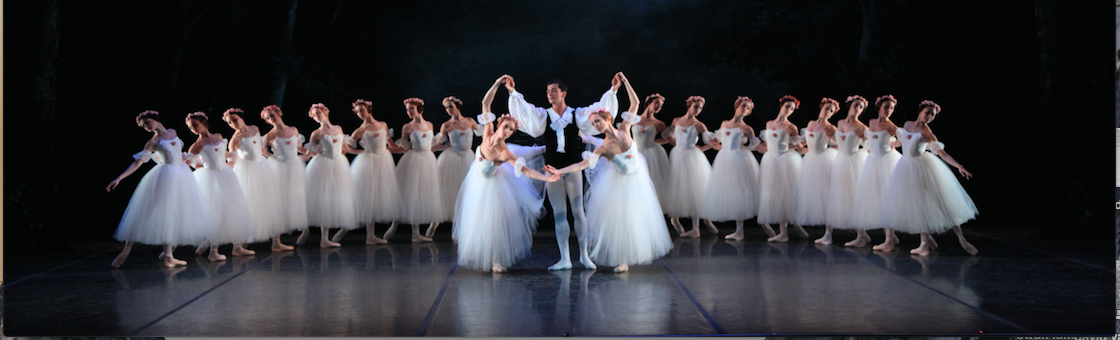
The Sarasota Ballet's "Tribute to Nijinsky" program featured two works by Michel Fokine ("Les Sylphides" and "Petrushka") and one by the dancer ("L'après-midi d'un Faune"). These ballets are now over 100 years old, ancient history in the ballet world, but the Sarasota Ballet's scrupulously rehearsed performances were fresh. Live music, such a luxury in today's economy, certainly helped. Director Iain Webb, as his monumental Ashton Festival showed, has a rich and deep respect for ballet history but his staging of "Les Sylphides" was not an amber-encrusted Diaghilev recreation. He chose the recently rediscovered 1941 Benjamin Britten orchestration made for the American Ballet Theatre, which of course the original production didn't use. The Britten orchestration is clearer and less gooey than some earlier ones and lets the plangent Chopin melodies work their magic.
"Les Sylphides" was staged by Webb and his wife Margaret Barbieri, a noted Romantic stylist. The sets and costumes, borrowed from the Birmingham Royal Ballet, were credited to the original designer, Alexandre Benois. He was quite prolific, it seems, since all versions I have seen use his designs and most are different. The beautiful and evocative Sarasota designs showed a deep blue forest with a lake glistening in the background, without the Gothic ruin that sometimes hovers so atmospherically. The Sarasota sylphs apparently stopped by a florist on their way to the lake, since they had pink rose buds in their hair and on their bodices and wings. This initial polka dot effect soon wore off and the sylphs showed elegant, restrained and lyrical dancing. The dancers seem to initiate their movements from their corps, giving them both power and lightness so their arms seem to float effortlessly, without the drooping filigree that some companies feel indicates the Romantic style.
The three main sylphs – Kate Honea in the waltz, Victoria Holland in the prelude and Danielle Brown in the mazurka and the pas de deux – are all leggy, beautiful blondes and this physical similarity made it seem that their solos were three visions of a single idealized woman. Brown danced her mazurka with a slightly remote air, as if she were looking out onto her own world, which drew the audience in. I especially enjoyed the brief moment when she whispered her secrets to the poet. She gave it a weight and significance, pausing just long enough for the magic to register while resisting any self-satisfied photo-op feeling.
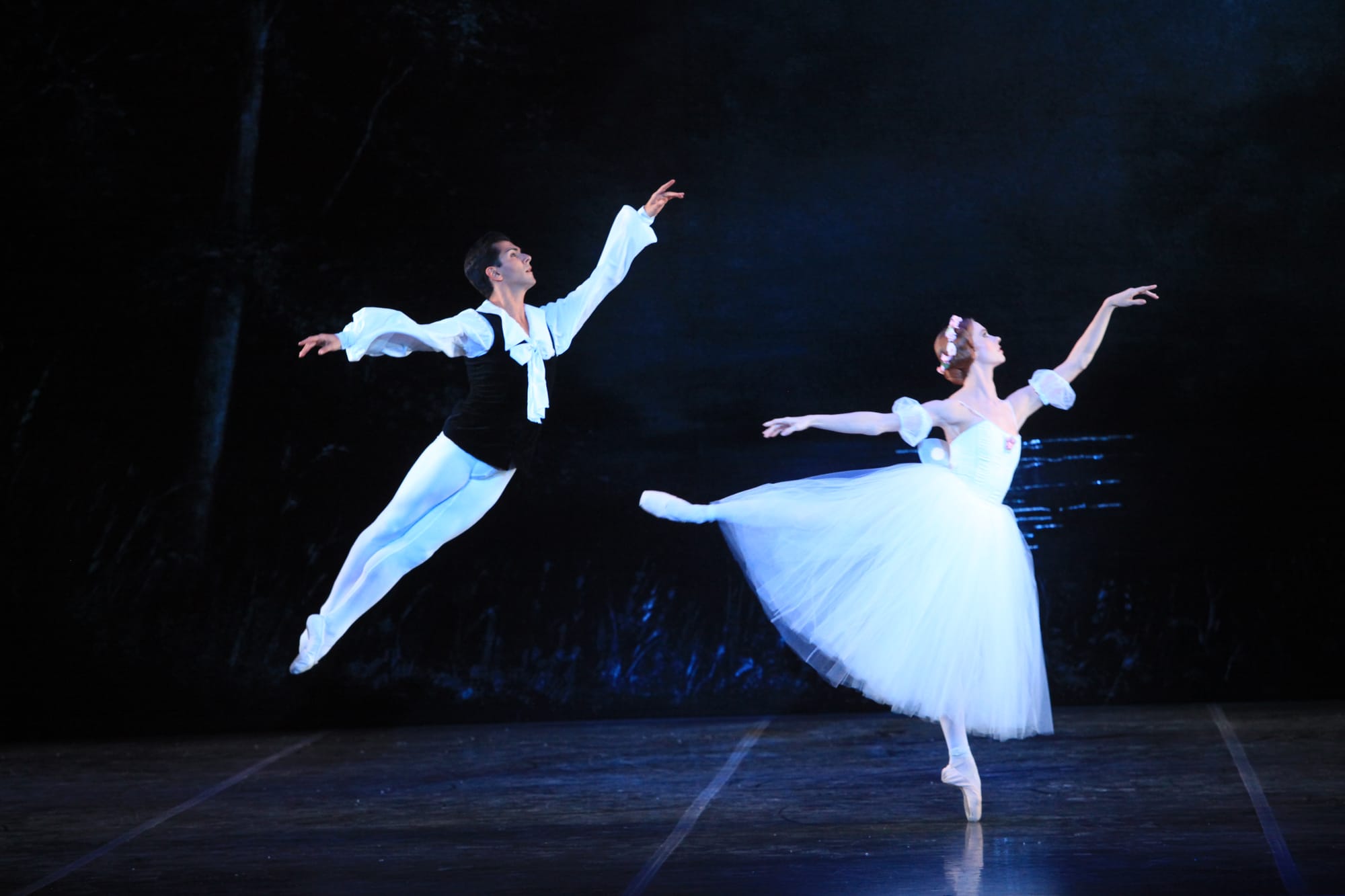
Ricardo Graziano was her poet. He danced with a noble gravity, combined with a soft upper body and a rich plié. The pas de deux was full of beautiful moments, as their physical symmetry (probably the result of a lot of rehearsal) evoked a magical emotional symmetry. The costume, with its billowy sleeves and floppy bow, is a bit wispy for modern eyes and fortunately the homage to Nijinsky didn't include the long blond wig.
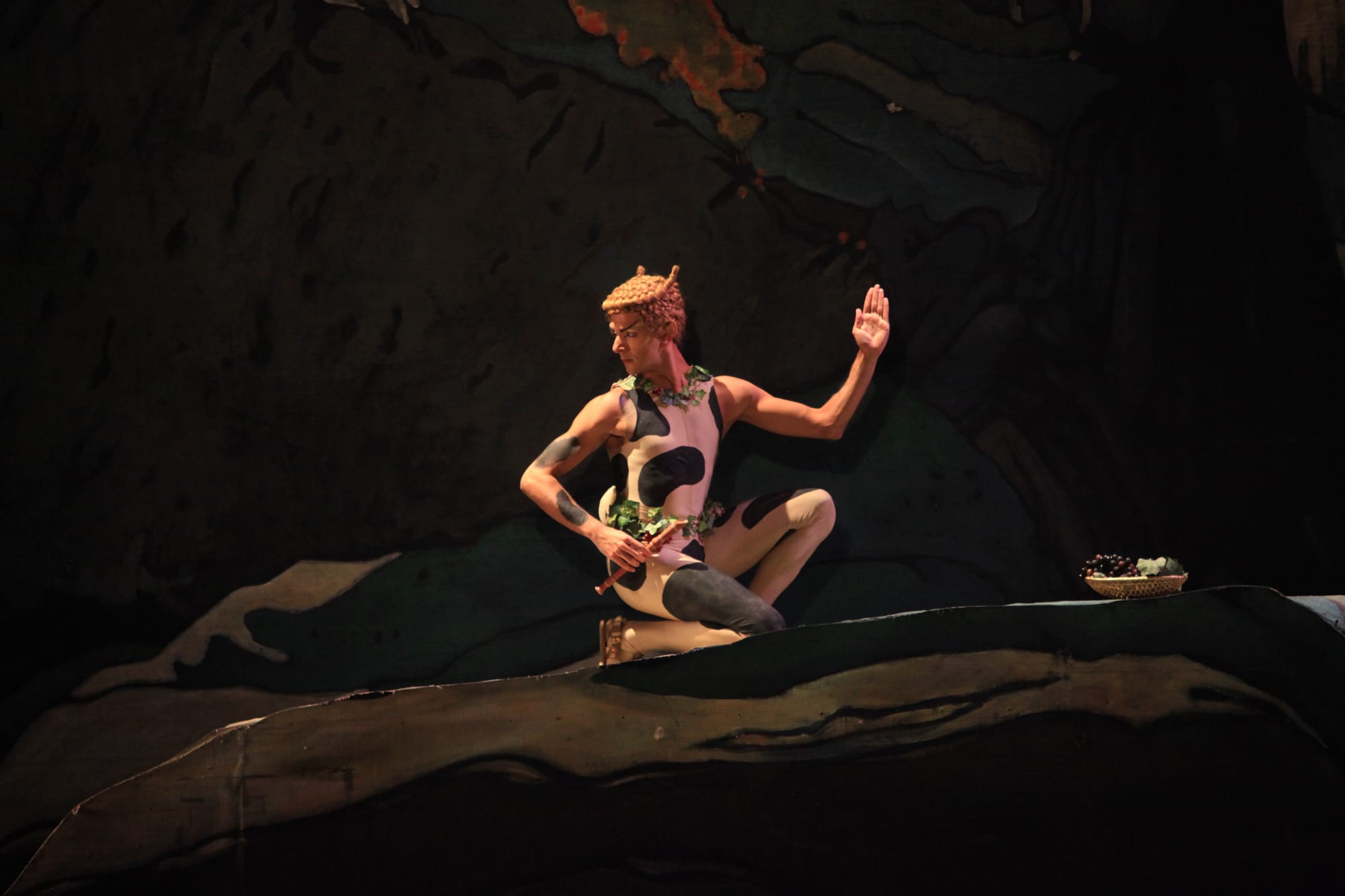
Graziano did get a wig in the second ballet, Nijinsky's "L'après-midi d'un Faune". Webb invited Ann Hutchinson Guest and Claudia Jeschke, who had worked for several years in the 1980's to translate Nijinsky's own notation of the work. The stagers worked for a month with the dancers (the ballet itself lasts about ten minutes), an almost unimaginable luxury in this era of "watch a video and learn a role in a day" productions.
Their work certainly paid off, as the performance was stunning, all stylized sideways moves and animal desire. Graziano was completely convincing as the faun, with his glittering, inhuman eyes and alert moves. Oh my gosh, that is so sexy" the man next to me muttered as the faun and head nymph (Amy Young) stood there, not touching as the music swirled around them. The quiet intensity of their gaze and potent stillness of their pose had a palpitating sensuality with a hint of vulgarity. The famous (or infamous) final gesture was on the low-key side; the faun's arm just stiffened and relaxed, a potent echo of repressed and unfulfilled desire.
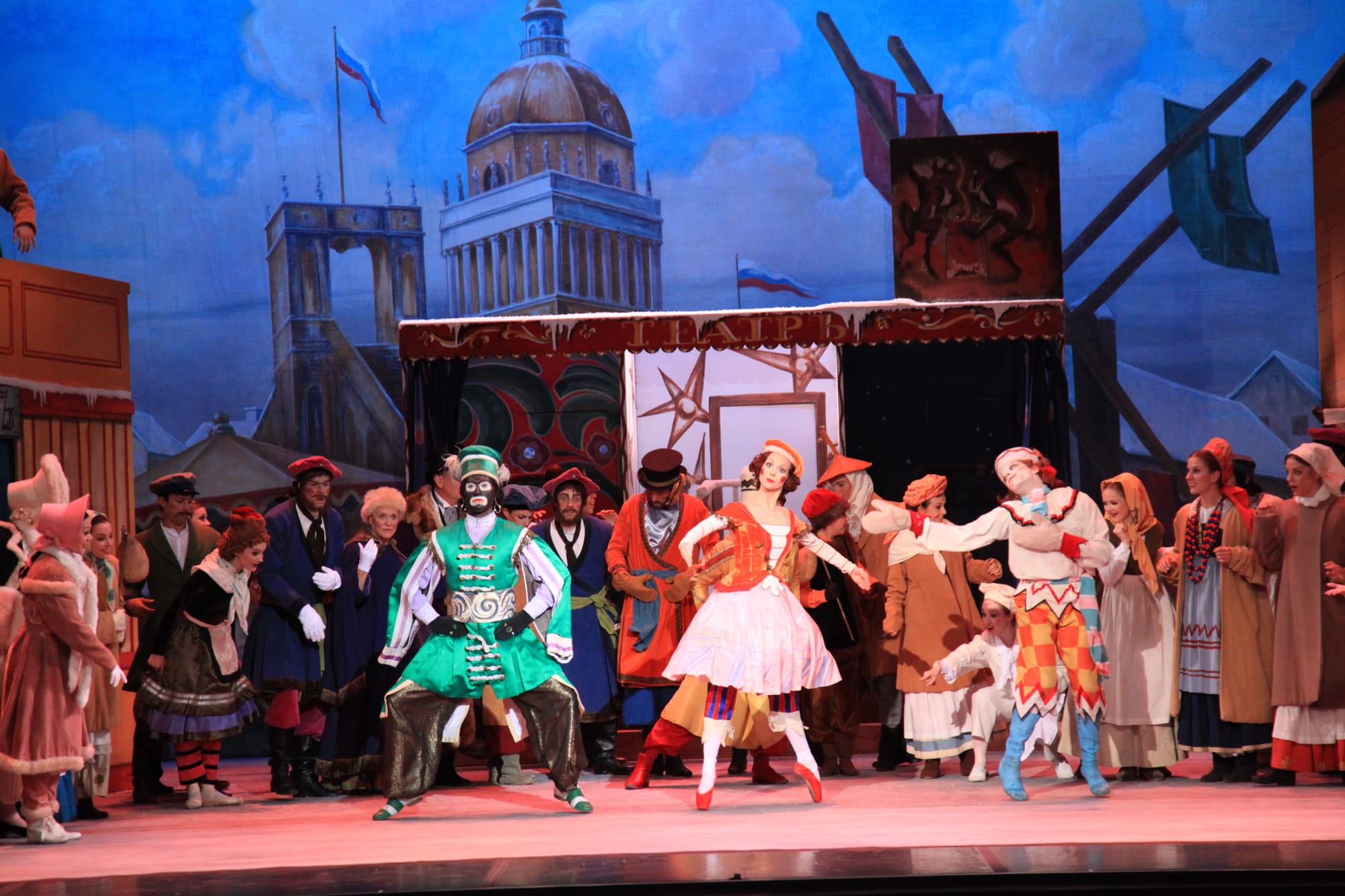
Fokine's "Petrushka" is also about unfulfilled desire. This magical ballet, staged by Webb and Barbieri, was based on the version Webb had danced with he was with the Sadler's Wells Ballet. "Petrushka" is a magnificent work, a perfect example of Diaghilev's idea of a complete work, merging music, scenery and choreography. It has none of the abstract formal geometry of classical ballets and the scene (a fair in 1830 St. Petersburg) bustles with individuals. All of the characters, from the Kitchen Boy to the principals, have their own (Russian) personalities, making it a difficult ballet to bring to life.
This version was clearly well-rehearsed and full of details; I especially enjoyed the poor girls trying to warm their hands with cups of tea. Many of the dancers, though, didn't show the richness and complexity of the characters. Nicole Padilla, as the First Street Dancer, had impeccable turns but lacked the mechanical desperation of a carnival performer traveling from show to show in search of a few coins--she seemed just pert and cute when she saw the other dancer's takings.
Webb had the historical integrity to keep the Moor's original makeup, and David Tlaiye was coal black, looking like a piece of carved ebony. He was properly brutish and smug, a strong, simple-minded brute. Victoria Hulland danced the Ballerina as if she were Coppélia's cousin, with wide, bright eyes and precise wooden movements. She was shallow, rather than hollow, and missed some of the strange terror and coy cruelty that a dark-eyed, empty Ballerina can bring.
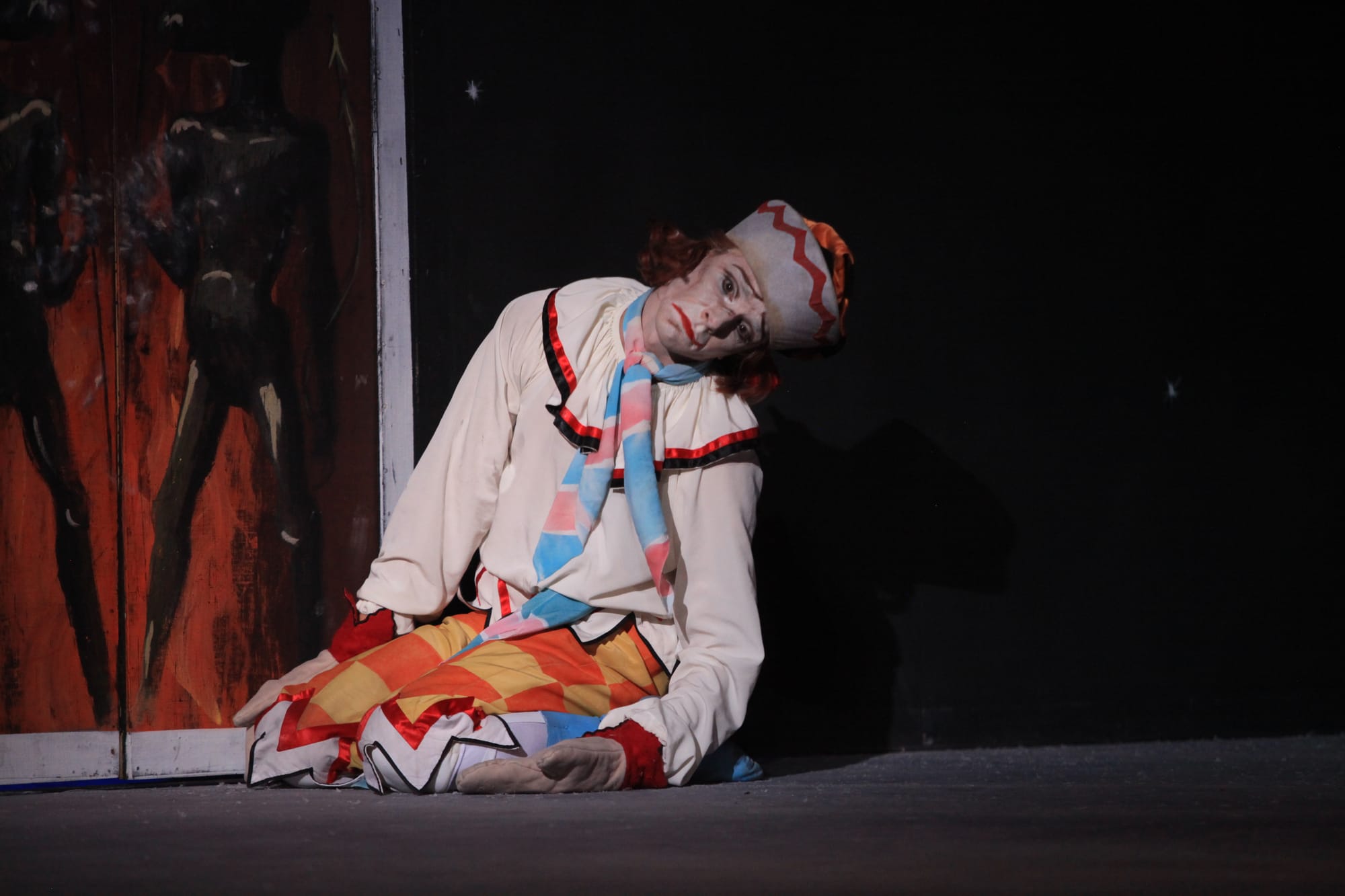
But the ballet ultimately depends on the Petrushka and Ricki Bertoni was an unforgettable sawdust Everypuppet, with weak, floppy limbs and half-dead eyes showing a soul trying to break free. Like the Faun, he used his eyes to create a creature with human emotions and his desperate, helpless moves were both grotesque and tragic. His ultimate victory, as his body lay on the ground while his soul lived on to taunt the Conjurer to Stravinsky's piercing music, was a moment of artistic triumph, and showed, like the rest of the program, how careful casting and coaching can keep these powerful works alive.
copyright © 2015 by Mary Cargill



