Limón Plus One
Limón Plus One
Limón Dance Company
"Mazurkas", "The Moor's Pavane", "Come With Me"
Baruch Performing Arts Center
Baruch College
New York, New York
January 15, 2013
The Limón Dance Company had a brief (just two-day) season at the Baruch Performing Arts Center, with a revival of Limón's 1958 "Mazurkas", which has not been performed by the company for some twenty years, though recently the invaluable New York Theatre Ballet has danced a suite of dances from the work. It was clear from that revival that "Mazurkas", with its on stage pianist, its Chopin music, and its windswept dances with mazurka accents (including a male soloist who reverently touches the ground), informs Jerome Robbins' "Dances at a Gathering"; and it was also clear that it is a very fine work regardless of all the piano ballets which followed it.
Limón had attended a recital of Chopin's music performed at the composer's house during the 1957 tour, and this inspired the work, a tribute to the Polish nation, crushed between the pincers of Russia and Germany for so many years. Limón caught the balance between hope and despair, or rather their dual inevitability, mixing the bright mazurka rhythms with an underlying melancholy. The opening and closing pieces were danced by the whole cast (four women and three men), who then danced in various combinations for the rest of the piece, in an ever-changing emotional landscape. The work is full of small beauties, with folk-influenced movements, from the almost military snap of the men's full-blooded thigh slapping, to the delicate hand behind the head gestures of the women. Like the Robbins' work, there is a strong sense of community, of a group of people sharing an experience, though the Limón work is more grounded, and was exuberantly danced. The veteran Raphaël Boumaïla gave a solemn weight to the centerpiece, a solo where the dancer seems to be pulled down into the ground while taking strength from it. Another veteran, Roxane D'Orléans Juste gave her dancing a delicate power and profound joy. It is a welcome revival.
"The Moor's Pavane" is much more familiar, and in a way, probably harder to dance, since these dancers must compete with so many other performances. Dante Puleio, as the Iago figure, played down the melodrama (there was no sneering), and was cold, so heartless he couldn't even hate. Boumaïla was a rather weak Othello, almost a passive receptacle for Iago's lies, which made his final explosion all the more powerful. Kathryn Alter was a complex Emilia, spirited yet subservient, and her grief when she realized her complicity was shattering. D'Orléans Juste was Desdemona, and she gave an inner strength to the sweet passivity of her character. The moment of awed silence as the work ended was a tribute to its power.
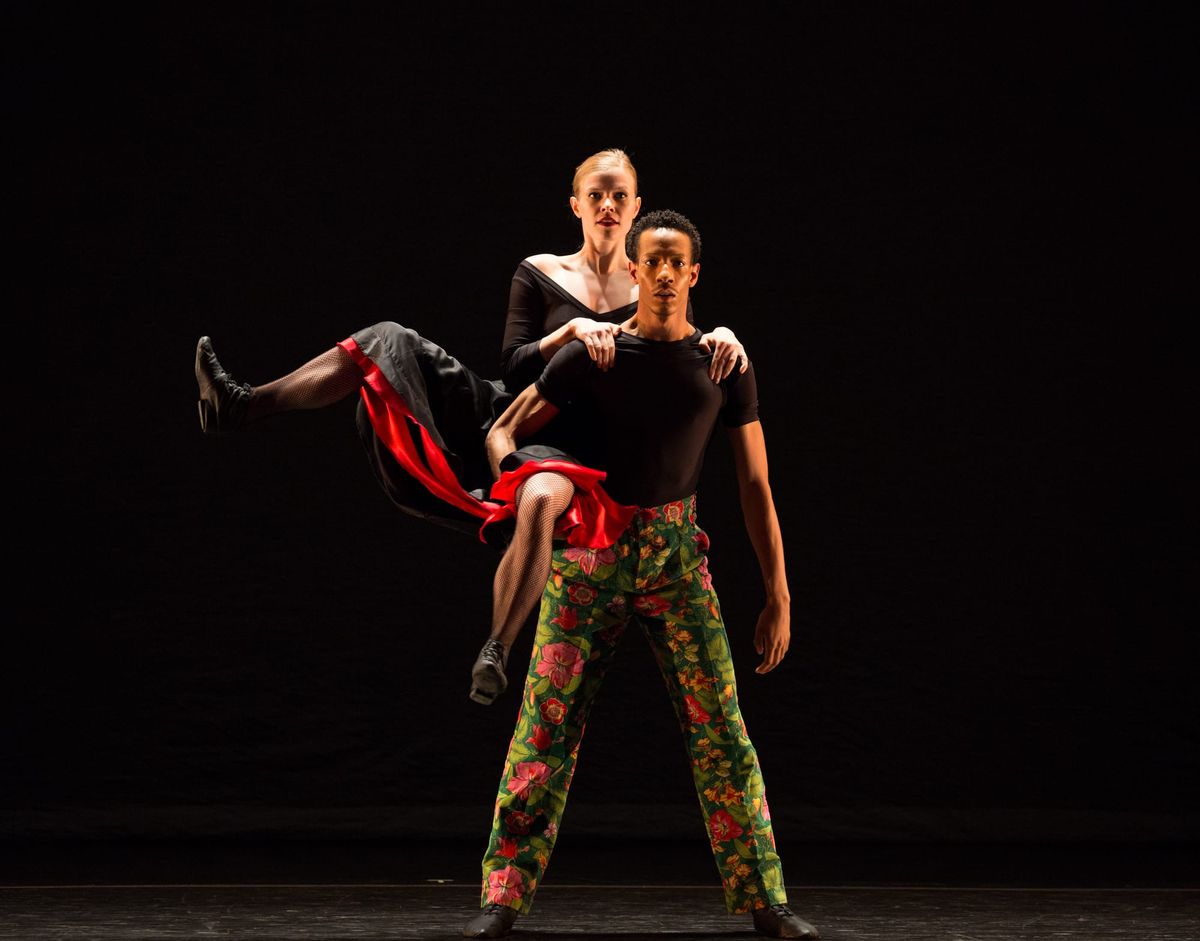
The final work, "Come With Me", a 2012 piece by the Brazilian choreographer Rodrigo Perderneiras to music by the Cuban Paquito D'Rivera, was an odd mixture of bright, rhythmic music with a Latin beat, and energetic but almost sullen choreography. The poor men were dressed in black shirts and flowered jeans, with color combinations which might have been selected by a blind monkey in a crayon factory, while the women were in black dresses with just a hint of color at the hems--why this cheerful music would call for so much black is a puzzle.
The choreography occasionally fizzed, especially the bright quick steps for Kristen Foote. But the dancers looked like they were moving in their own little bubbles, with no connection with others on stage, which muted the joy. There were some pas de deux, but since they were mostly of the grab the woman by the neck and bend her back while staring off in space variety, even the couples were emotionally flat. For all the effort, it was a rather dispiriting ending to the otherwise stellar performances.
copyright © 2013 by Mary Cargill



