Light My Fire
"Equinox", "Diversion of Angels", "Promethean Fire"
Paul Taylor’s American Modern Dance
New York, New York
April 3, 2016, matinee
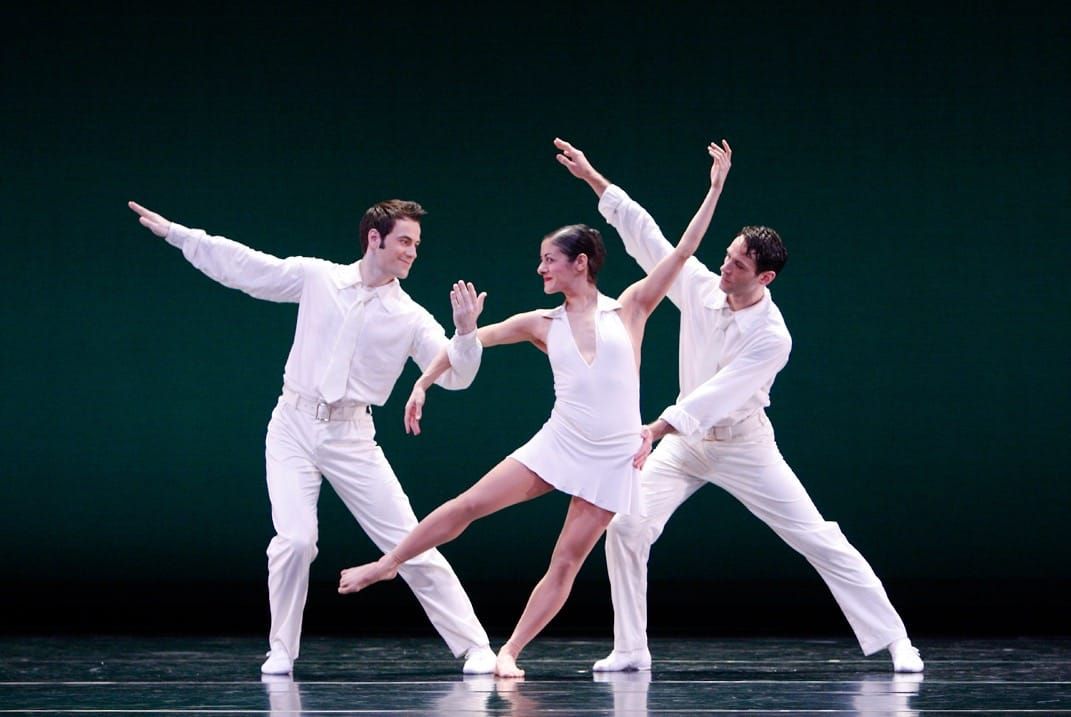
The final performance of the season was a demon- stration of Taylor's musicality, craft, and daring, and a salute to his dancers. The program opened with "Equinox" (choreographed in 1983) set to Brahms' First String Quartet, not exactly a score that brings to mind frisky youths. But Taylor heard his own rhythms, and the deceptively simple work is a salute to the youthful glories we all wish we had. It is a finely wrought, formal work with constantly shifting patterns dance by four couples in "anyone for tennis?" white. The men wore white shoes and ties while the women were barefoot, in short, revealing tunics; perhaps Taylor is subtly observing that men, no matter how civilized, do like looking at bare legs.
And the men (Robert Kleinendorst, Michael Apuzzo, Sean Mahoney, and James Samson) were extremely civilized, dancing the ingenious patterns with a noble reticence and a straightforward camaraderie. The piece is full of Taylorisms, with little sideways jumps and open arms interspersed with soaring jumps and unexpected lifts but these familiar moves are so embedded in the music that they look completely fresh. As in many Taylor works, there were hints of uneasiness in this youthful paradise; there was a mysterious switch in a blackout, when, after a playful pas de deux, Laura Halzack and Kleinendorst were replaced by Parisa Khobdeh and Apuzzo. Halzack then had a despairing little solo, as she kept reaching back to the group.
Khobdeh, it turned out, was enticing Kleinendorst and she had a happy, triumphant little dance with both men (lucky her to have such a choice). But Taylor did not allow unhappiness to survive in this idealized world and order was restored as all the couples paired off, not the worse for wear, gracious inhabitants in the land of eternal spring, a land it was a privilege to visit.
Halzack and Khobdeh remained in character for Martha Graham's 1948 "Diversion of Angels", a new acquisition for the Taylor company. Though this was only their third performance the uneasiness shown in some of the precarious balances on the first night had disappeared and the dancers seemed to grab hold of the choreography, scooping their movements out of the ground.
Khobdeh, in bright red with her hair in a high ponytail, looked like the embodiment of a Biblical bad girl, flying through the air and salivating at the sight of all those men. She was an elemental force without a hint of vulgarity. Halzack, statuesque in white, was her foil, loving and briefly losing Michael Trusnovec. He, as usual, combined immaculate and strong dancing with natural, nuanced emotions. His long balance (unobtrusively supported by Halzack) as he seemed to hover between the two women, was an indelible image of human suffering.
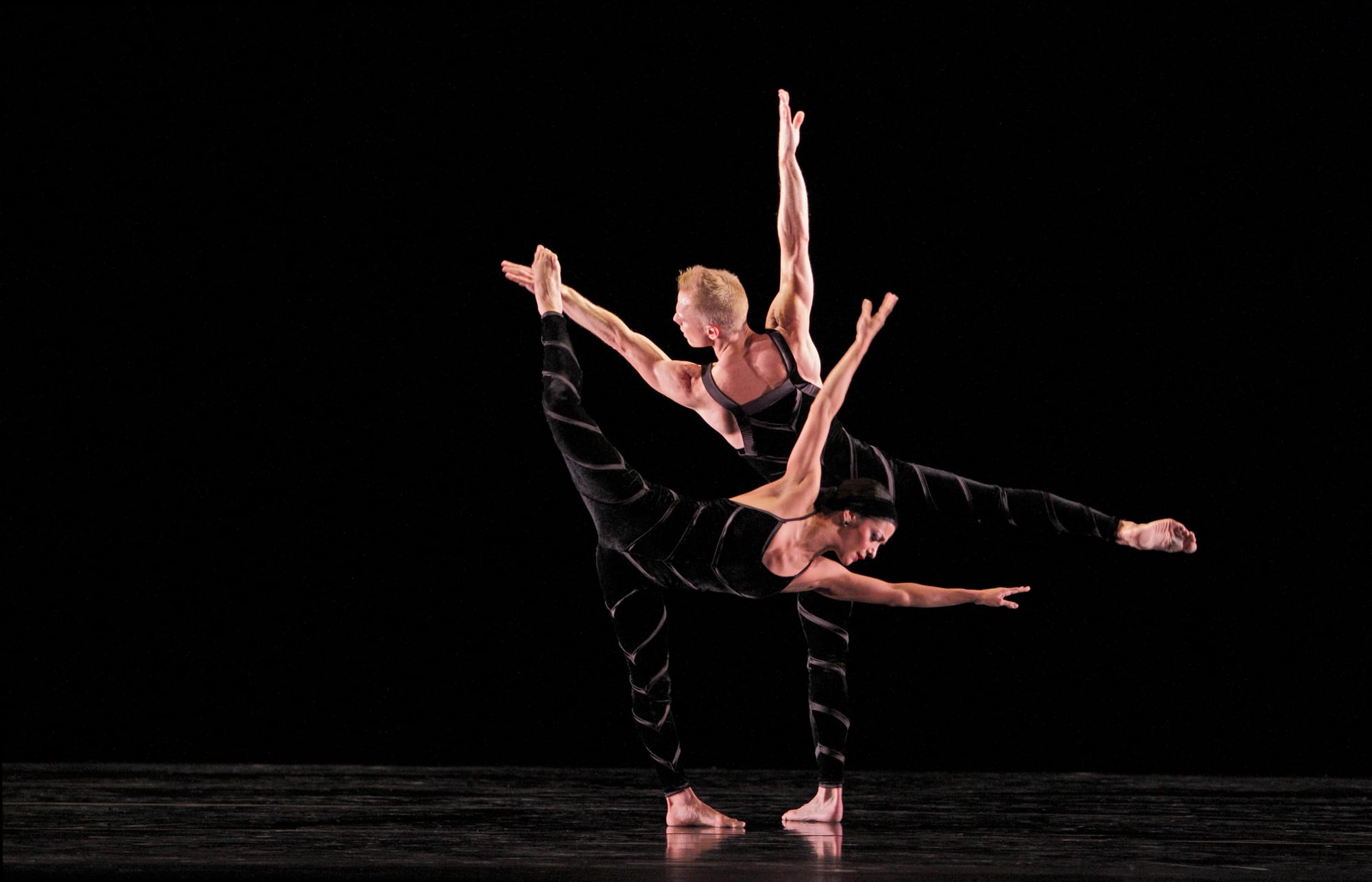
Khobdeh and Trusnovec were paired more happily in "Prome- thean Fire", Taylor's 2002 powerhouse set to music by Bach orchestrated by Leopold Stokowski. When it premiered, economics required taped music; it was powerful then, but Taylor's recent switch back to live music was a revelation as the organ seemed to have an almost physical power, echoing through the theater.
"Promethean Fire," as the title and program note (by Shakespeare) imply, is unashamedly grand, with a cosmic order out of chaos theme. Taylor creates this with sixteen dancers (his entire company), a black backdrop, and black leotards with gold streaks (costumes by Santo Loquasto). The costumes and backdrop merge, so that only the disembodied faces and feet are visible, with the gold on the costumes glowing like some molten element, as the dancers hurl through the sonorous music. The first section ended with the dancers throwing themselves into a massive pile, a gesture perhaps of self-destruction. (Eran Bugge had been hoisted up like the virgin in "The Rite of Spring".)
The second section began with Trusnovec and Khobdeh emerging from the mass of undifferentiated bodies, as if leading the group into a new world of order and safety. The original couple, Patrick Corbin and Lisa Viola, seemed to struggle at this point, fighting for their eventual serenity, but Trusnovec with his innate nobility and the more lyrical Khobdeh had a natural authority; they had a different path to the same goal.
Copyright © 2016 by Mary Cargill



