Light and Darkness
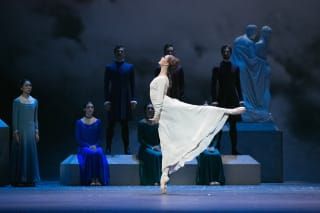
"The Winter's Tale"
The National Ballet of Canada
Four Seasons Centre for the Performing Arts
Toronto, Canada
November 10, 2017
With "The Winter's Tale", Christopher Wheeldon has transformed one of William Shakespeare's "problem plays" into a highly effective dance drama. Many elements of a full-length classical ballet are there: pas d'action which move the plot along using mime, divertissements to showcase the dancers' technique, and a series of distinctive pas de deux for the leading characters. Yet the work has a pared down candor and expressionist movement style that feels fresh and contemporary. This narrative work is compelling because it takes the audience on a journey as the central characters grapple with difficult emotions and their consequences. There is depth and nuance here, which is revealed during this second run of the ballet, which is a co-production between the National Ballet of Canada and The Royal Ballet. It is worth remembering that audiences respond to this type of dramatic work if it is done well. Some of the National Ballet's recent full length commissions have been visually spectacular yet superficial, with little choreographic complexity ("Pinnochio", "Le Petit Prince", and Wheeldon's "Alice's Adventures in Wonderland" come to mind). A ballet like "The Winter's Tale" seems a much sounder investment of the company's talents and resources, as it is a work that can remain in the active repertoire and continue to stimulate dancers and audiences alike for years to come.
"The Winter's Tale" spans 16 years and two countries, oscillating between tragedy and comedy along the way. Wheeldon and his team have streamlined Shakespeare's five acts and taken some artistic liberties with the source material, while staying true to the play's essence. He worked with frequent collaborators composer Joby Talbot, designer Bob Crowley, lighting designer Natasha Katz, and puppeteer Basil Twist. They have created a tight production featuring a colorful Act II set in a fictional Bohemian countryside in the midst of a springtime celebration. This joyful event is bookended by Acts I and III, set in the somber court of King Leontes of Sicilia. The imaginative set and costume designs effectively create two settings that are worlds apart. Leontes' court is cold, austere and dark, with towering statues and bare, concrete-like structures. The sets suggest Italian fascist architecture, perhaps not by coincidence, given Leontes' authoritarian approach. In contrast, the Bohemian setting features a larger than life wishing tree that appears supernatural with its floating roots and glimmering ornaments.
The ballet begins with a succinct prologue introducing the central characters. Childhood playmates, Leontes and Polixenes, go on to become rulers of Sicilia and Bohemia respectively. Their close friendship continues into adulthood. We the marriage of Leontes and the virtuous Hermione and the birth of their first child, Mamillius. Soon after, the happy couple play host to Polixenes who comes (sans wife) for an extended 9 month visit. A backdrop of a tree with falling leaves indicates the passage of time.
The jam packed first Act takes place as Polixenes is about to return home and Hermione is expecting a second child. There is one moment where Hermione, Leontes and Polixenes are together and she invites both men to place a hand on her abdomen. Perhaps the baby is kicking. This becomes a tableau, making it clear that in that instant the seed of suspicion has been planted in Leontes imagination. As they return to action, Leontes recoils, overtaken by jealousy and rage. Once he has entertains the idea that he may not be the father of Hermione's unborn child, he becomes obsessed and increasingly certain that his wife and friend have betrayed him. Again, thoughtful stage craft is used to distinguish between Leontes' delusions and reality. Hiding behind a massive statue, he observes their interactions. The lighting goes dim, as the audiences glimpses the darkness of Leontes' mind. Polixenes and Hermione are caught in erotic embraces, bodies intertwined. A moment later, the lighting brightens, and the pair are conversing in a platonic manner. This corresponds nicely to segment in the play in which Hermione and Polixenes hold hands in a platonic way and Leontes, already convinced of his wife's infidelity, takes this as confirmation. The choreography helps further Leontes' circular logic. On several instances, he literally shoves Hermione and Polixenes into each other, so that, off-balance, they momentarily cling to one another. Then he refers to their physical contact as immoral and puts his wife on trial for adultery. There is a believably tense fight scene between Leontes and Polixenes. After Hermione gives birth to their daughter (in prison), he remains certain that it is not his kin and banishes the child. It is only after Mamillius and Hermione die from shock and distress, that he realizes his error.
Act II takes place 16 years later in Bohemia. The abandoned princess has been raised by a Shepherd and is very much in love with Florizel whom she believes to be of similar humble roots. However, Florizel is actually the son of Polixenes who is disguised as a villager. The mood is light and humorous. There is a scene where Polixenes decides to spy on his son. To blend in, he dresses in eccentric clothing and then steals a guitar from a nomadic, hippie band. He looks completely out of place and the farce provides some much needed comic relief. Act II is rich in pure dance opportunities with its sunny and upbeat divertissements. The choreography is folk-inspired with elements of character dancing well-suited to the eclectic musical style here.
Act III involves Florizel and Perdita fleeing to Sicilia as Polixenes forbids their union. Eventually, Perdita is recognized as the lost princess that she is, happily allowing her to become engaged to her love. Leontes repents and is forgiven by his old friend, Polixenes. Paulina, the head of the Queen's household, takes him to a incredibly realistic statue of Hermione, which comes to life before his eyes. The secret is revealed that Hermione has been alive but kept in hiding by Paulina for 16 years. The sets are the same as in Act I, but the palette of the costumes shifts to whites and soft neutral colours, signifying the rebirth and renewal that occurs after reconciliation. The ending is a happy one, though not without recognition that not all errors can be reversed. Mamillius, for instance, is not part of this happy family reunion. Unlike Hermione's, his death was not an illusion.
One of the greatest strengths of "The Winter's Tale" is the number of varied roles that represent opportunities for a wide range of dancers. The cast on this opening night performance were the same cast who created the roles for the company premiere two years ago. Performances were strong across the board. Piotr Stanczyk was well cast as Leontes, the temperamental tyrant. He has always been more of a Hilarion than an Albrecht, and here he expertly conveys the internal torment that his jealousy causes him. He truly becomes his own worst enemy. He contorts his body into awkward and angular shapes, reflecting a deranged mental state. In Act III, his remorse is heavily felt. 16 years later, he is still punishing himself. His reunion with Hermione is transcendent. He reveres her, cradling her in his embrace and literally supporting her weight on his back in an extended lift.
Hermione was danced by the fittingly statuesque Hannah Fischer, who has risen in the ranks to first soloist since she made her debut in this role. Amidst the tempest of her husband's emotions, she remained a picture of calmness, steadiness, and dignity. She is abused and thrown in jail, but at no point does she doubt or blame herself for Leontes' irrational behavior. Fischer is given choreography with endless balances and controlled arabesque turns, which would be very exposing of any weaknesses in technique. She sailed through these challenges with ease.
Paulina is a character who is present throughout the scenes in the court of Sicilia, but often on the sidelines. However, she orchestrates many of the ballet's events. Xiao Nan Yu brought a perfect balance of strength and softness to this role. In Act I, she seems to be the only person who will confront Leontes, pointing out the injustice of his actions. A voice of reason, she is the one who brings the baby Perdita to him, urging him to recognize his own child. She is also the one who prevents Mamillius from witnessing a violent scene between Leontes and Hermione. She sticks to her convictions when she knows she is right. In Act III though, she is the one comforting Leontes as he mourns, even though if he had taken heed of her advice he would not be in that situation.
Harrison James was a charming and charismatic Polixenes, making it quite believable that Leontes would see him as a threat. He was an ideal foil to Leontes. In Act I, he is an indignant victim to Leontes' crazed aggression. Yet in Act II, he too becomes overcome with anger when he believes his son is rejecting royal life to be with a commoner. James made this flip from one extreme to the other distinct, illustrating how dangerously swift it can be.
Finally, Jillian Vanstone and Naoya Ebe were a delight as the young lovers, Perdita and Florizel. They are lucky to have some of the ballet's most tender and intricate choreography in their pas de deux. The two are frequently cast opposite one another and move beautifully together. Their use of accents in musicality was in sync and they both have a lovely expansive quality in their dancing.
There is a little bit of everything in this ballet and it makes for a truly satisfying evening of theatrical dance. The company perform it well and have already taken it on tour. Certainly, "The Winter's Tale" has all the necessary elements to become a calling card for the NBoC and a contemporary classic.
copyright © 2017 by Denise Sum



