Lakeside Fantasies
“Swan Lake”
Bolshoi Ballet
David H. Koch Theater
New York, NY
July 18, 2014
Just what kind of woman does Prince Siegfried fantasize about? The question is at the core of Yuri Grigorovich’s version of “Swan Lake,” and the answer will vary with every cast.
By shifting the focus of the story away from the romantic fairy tale narrative, Grigorovich invites a philosophical inquiry centered on Siegfried’s psyche: What is his ideal woman like? How does the Prince wrestle with the demons of his darker side (embodied in the Evil Genius character) that keep testing his choices? Is any of it even real? With the right cast, this production has an infinite number of interpretive possibilities.
Semyon Chudin’s Prince Siegfried was a romantic guided by his passions with little interference from reason. The Evil Genius or, as the program indicated, Fate itself, danced by Artemy Belyakov, appeared as a constant shadow to Chudin, drawing him, without much resistance, first toward the vision of the pure ideal of Odette, then testing his commitment with the ravishing Odile. For Chudin, these experiences were revelations. In meeting Odette, he frequently covered his eyes with his hands, as though unable to believe the encounter was real. With Odile he acted mesmerized and followed her moves in awe, but also with some desperation for signs that the object of this powerful attraction was still Odette.
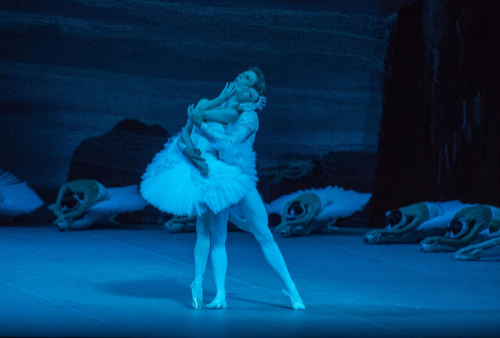
His dream love, portrayed by Olga Smirnova, was either tenderly innocent or fiercely confident, but undeniably independent and mysterious. Smirnova’s Odette may have needed saving from her fate, but her acceptance of Prince Siegfried did not come easily. Chudin’s first meeting with her, after being coaxed to the lakeside by the Evil Genius, looked like a fantasy. Appearing dramatically in the middle of the stage amidst many similar-looking maidens, the perfect Smirnova moved quickly, at times even too quickly, across the stage. In her first interaction with Chudin, her arms moved urgently, as though seeking to fly away from him. He grasped her wrists tightly, and she looked at him not with the usual fear, but with the assured tenseness of a captured bird who knew she could flee, if she really wanted to.
He allayed her agitation soon enough, and the adagio that followed opened Odette up to the possibility of love; she seemed to feel more at ease with him as the dance went on. If at first Smirnova’s movements were still punctuated with urgent reaches away from Chudin in the adagio’s arabesques, toward the end of the duet she was completely at ease letting him wrap his arms around her. Smirnova conveyed Odette’s different characteristics – her innocence, independence, power and romanticism – with soft port de bras towards Chudin, and powerful arabesque away, yet all without making her dancing look busy. The effect was compelling – her character resembled a still surface of a placid lake, with many hidden depths beneath.
Just as soon as you were assured that, fantasy or not, Odette was the one for Siegfried, came the ball. The many prospective brides of the court scene each made a statement with their folk-dance embellished solos, with Anna Tikhomirova’s Spanish bride delivering the most fiery and technically refined performance. But although the brides have a place in the libretto and the ballet’s tradition, these dances felt like they were delivered for the audience and not for the Prince (who wasn’t on stage to see them). They illustrated why, despite being beautiful and interesting, and dancing with impeccable technique, each lacked the mystical allure that Siegfried was chasing. Smirnova’s Odile showed what was missing from these women soon enough.
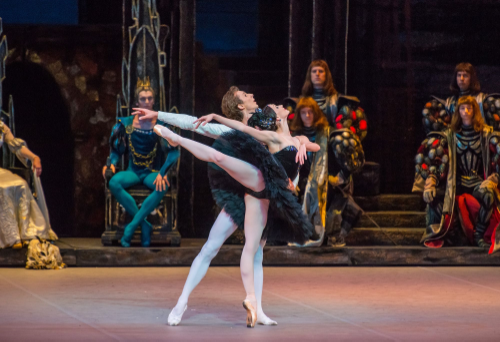
Following a dramatic entrance where she stormed the stage with the Evil Genius and an entourage of black swans, Smirnova commanded Chudin’s attention but offered very little in return – she glanced at him just often enough to maintain his interest. Her first dance on a darkened stage became more and more swan-like as it went on and as the Prince sought to recognize his ideal in her. Smirnova danced the bird-like port de bras eloquently enough to convince her Prince, but with fascination at how obviously foreign these gestures felt. You could tell Odette’s tender qualities did not inhabit her black counterpart. Most of the pretending was over with by the pas de deux, where Smirnova’s chemistry with Chudin made you think that maybe it was Odile who was Siegfried’s perfect match after all. It almost caught you by surprise when, amidst everyone’s confusion, she culminated in reserved but sinister laughter at the hapless prince after the announcement of his chosen bride backfired tragically.
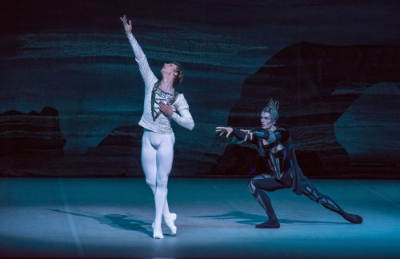
The ballet’s final scenes were reworked in 2001 to remove the happy ending and give the ballet the finale Grigorovich originally intended but wasn’t allowed to stage in the 1960s. It was the one real disappointment in the performance. After the corps’ magnificent job at creating the illusion of a storm, sweeping Odette and Siegfried into two separate halves of the stage, and the powerful clash between Chudin and Belyakov representing the Prince’s inner struggles, the ballet ended abruptly with Chudin kneeling alone on a darkened stage. Even this talented dancer’s best attempts at making the somber, thoughtful scene reflect his character’s wondering if it all had been a dream were not enough to give the work adequate closure. Instead of questioning what it all meant for the Prince, you were left dwelling on what the ballet might have been with just a few extra bars of music.
copyright © 2014 by Marianne Adams



