'Kreatur"
“Kreatur”
Sasha Waltz & Guests
Brooklyn Academy of Music
Brooklyn, New York
November 2, 20 18
Contemporary German choreographers are not known for light-hearted fare, but Sasha Waltz’s “Kreatur,” which opened Friday at the Brooklyn Academy of Music, may set a record for dystopian gloom. Not that there is much optimism on either side of the Atlantic these days.
The ninety-minute piece is set for fourteen dancers and is described as an examination of existence in a disrupted society. But “society” seems too organized a construct for this group, which consists primarily of cowering victims and violent bullies.
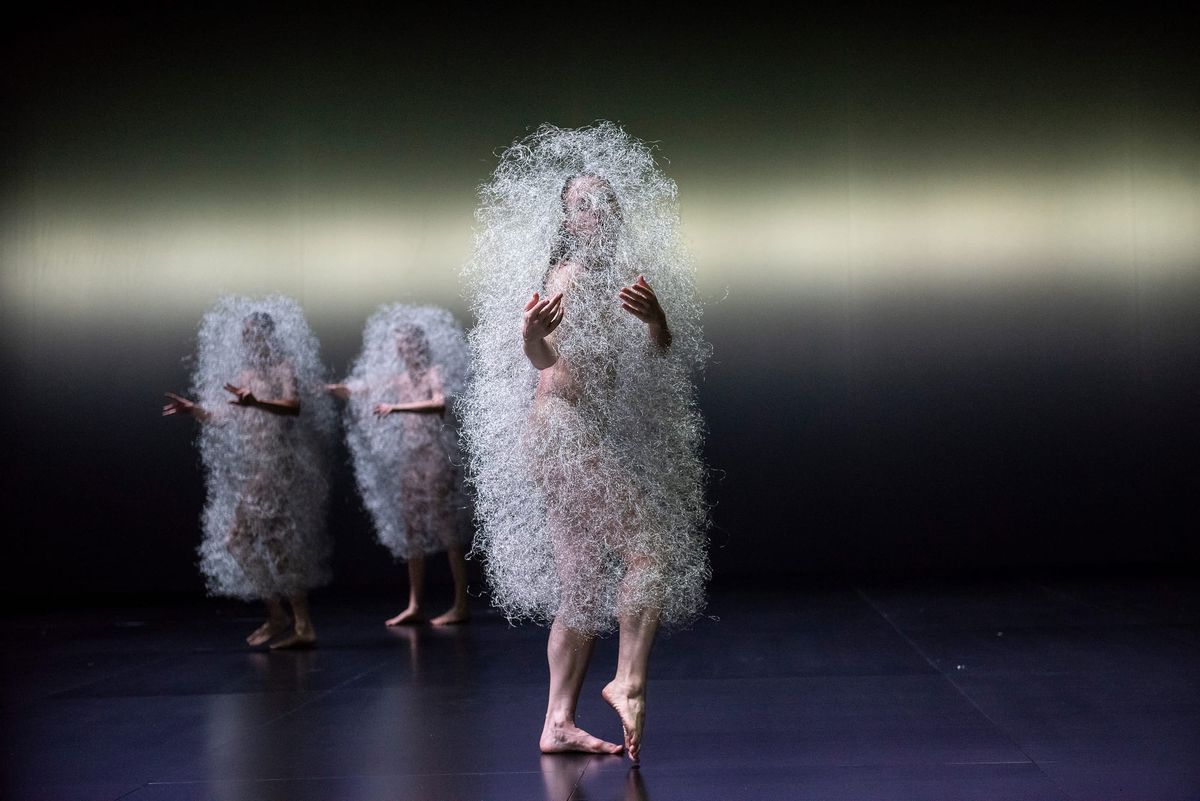
The work starts in what comes closest to a peaceable period. The dancers enter the darkened stage a little at a time in small halting steps. They wear gossamer cloud-like costumes by Iris van Herpen over semi nude bodies. They bend to look downward, as if curious about where they might be. Soon other dancers enter and crawl under the protection of the cloud costumes. This time of peace doesn’t last long, however. A couple enters with a woman wildly struggling in the embrace of a man. And so the battle for power and domination begins. Groups grapple in slow motion. The cloud costumes disappear and the dancers are left in only nude colored trunks. At one point metallic sheets that are both reflective and transparent are brought on to encircle and capture certain individuals.
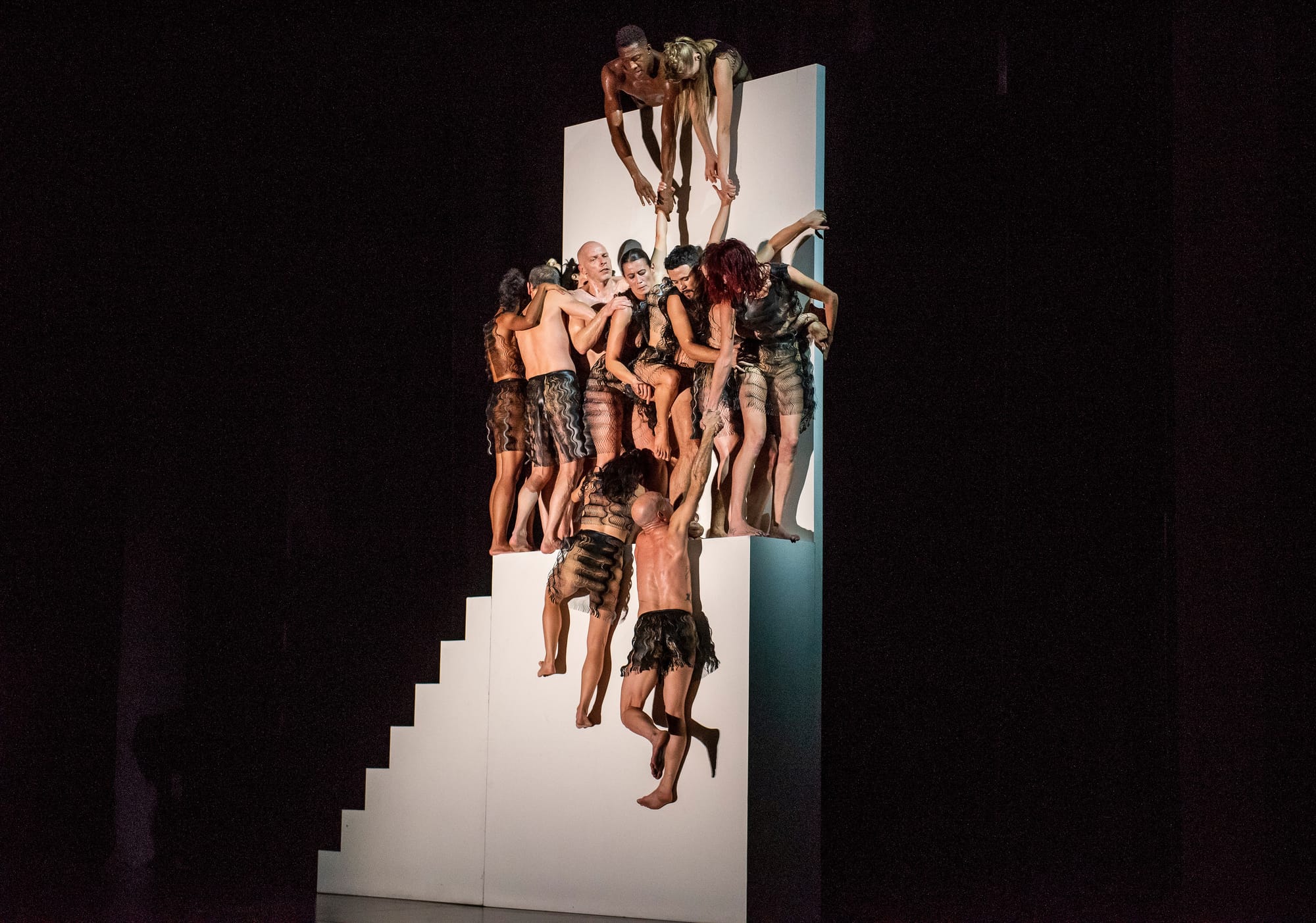
There are a series of blackouts at which time the group members reassemble in different combinations and different places on the stage. Sometimes they move rapidly, others slowly, but their actions always evolve into struggle. At one point the dancers line up before a staircase waiting to ascend to a landing. But panic sets in and they push and clamber over each other to reac h the top, where they fight for a place on the tiny platform. Some fall over the edge, while others save themselves by climbing up and over an adjacent wall. In other sections, people beat each other and drag them about by the hair.
A prop, which looked like a 2x4 board, plays a prominent role in the work, but what it symbolized escaped me. Is it a religious object? It seems to be at one moment when the group acknowledges it en masse, but at others it appears to serve no specific purpose.
From time to time in “Kreatur” the dancers vocalize in various ways. A woman repeatedly shouts at another to stop crying, or the dancers make incoherent sounds, or attempt to communicate with one another in gibberish that is not understood.
In one of the most spectacular moments, a figure covered in long glittering spikes enters to the distorted sound of the Arabian dance from Tchaikovsky’s “Nutcracker.” The figure attacks and seems to kill various people before being de-costumed, so to speak, to reveal a woman beneath. Unpleasantness of one kind and another continues, including a scene where the group members attempt to copulate but do not know how, attacking all the wrong body parts in an image that could have been inspired by Hieronymus Bosch. “Kreatur” ends with a single person imprisoned in one of the transparent sheets. She is spotlighted, with darkness all around.
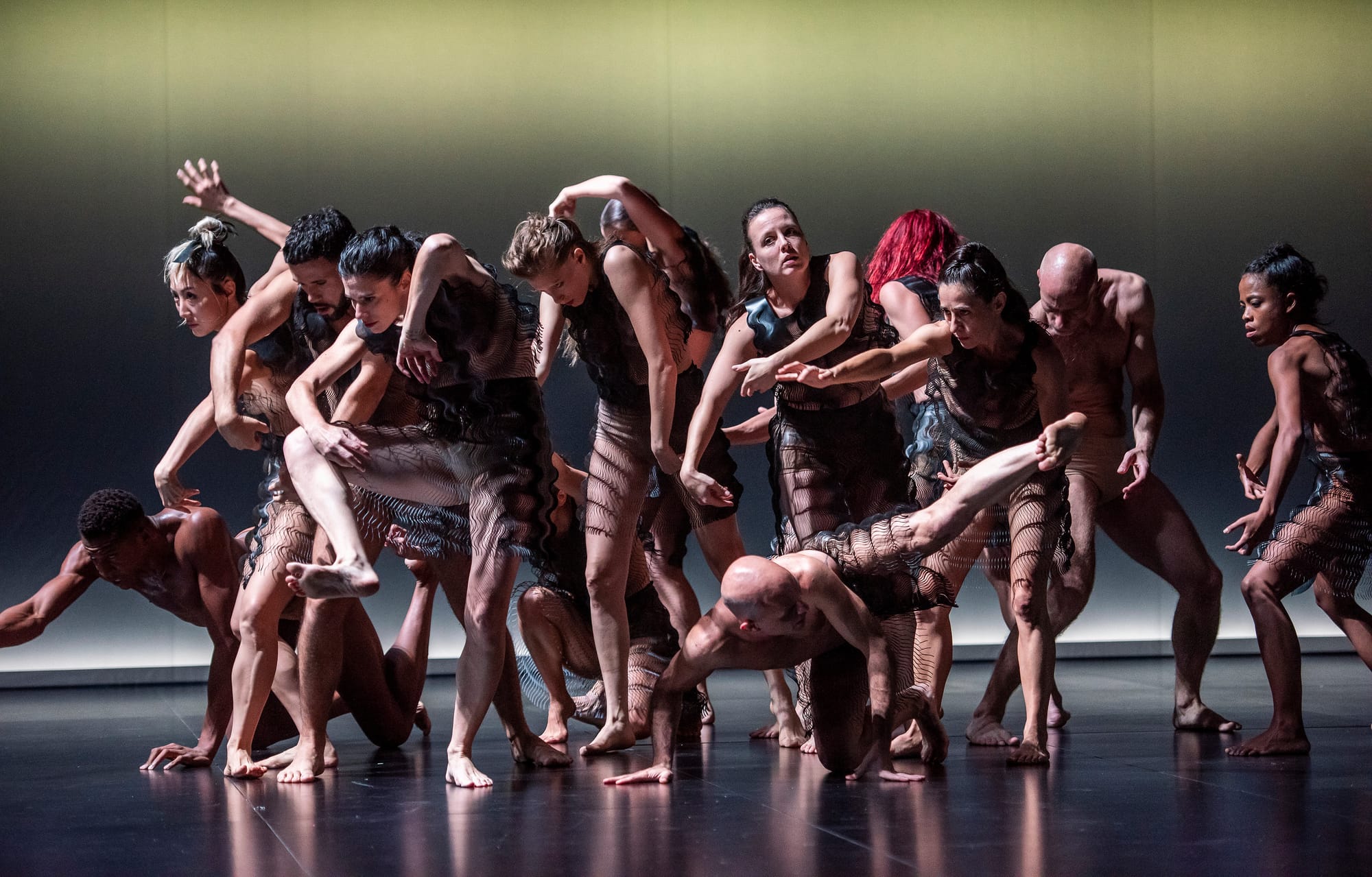
Throughout “Kreatur” the movement is one in which bodies writhe, contort, flail, kick, shudder, shake, jerk, punch, and violently push and pull. The action may suddenly freeze, but the resulting pose is nearly always agonized.
Waltz makes a point of collaboration, and certainly van Herpen’s costumes play an important part in the production, despite the fact that much of the time they consist only of the nude trunks already mentioned. In some sections, though, interesting black mesh tops and wraps are added, not to mention the arresting spiked costume.
Even more important than the costumes is the Soundwalk Collective’s sound score. According to the program, it is made up of factory sounds from sources in several industrial sites around Germany. It is extremely effective in its pounding mechanical rhythms, whistles, chugs, and metallic clangs. It also includes human voices that say things like “la vie est fantastique!” or sing a cloying song about love.
“Kreatur” is probably half and hour too long, but perhaps that’s the point: unremitting fear and violence that allows no escape.
copyright © 2018 by Gay Morris



