Knights of Old
"Don Quixote"
American Ballet Theatre
Metropolitan Opera House
New York, NY
June 29, 2026
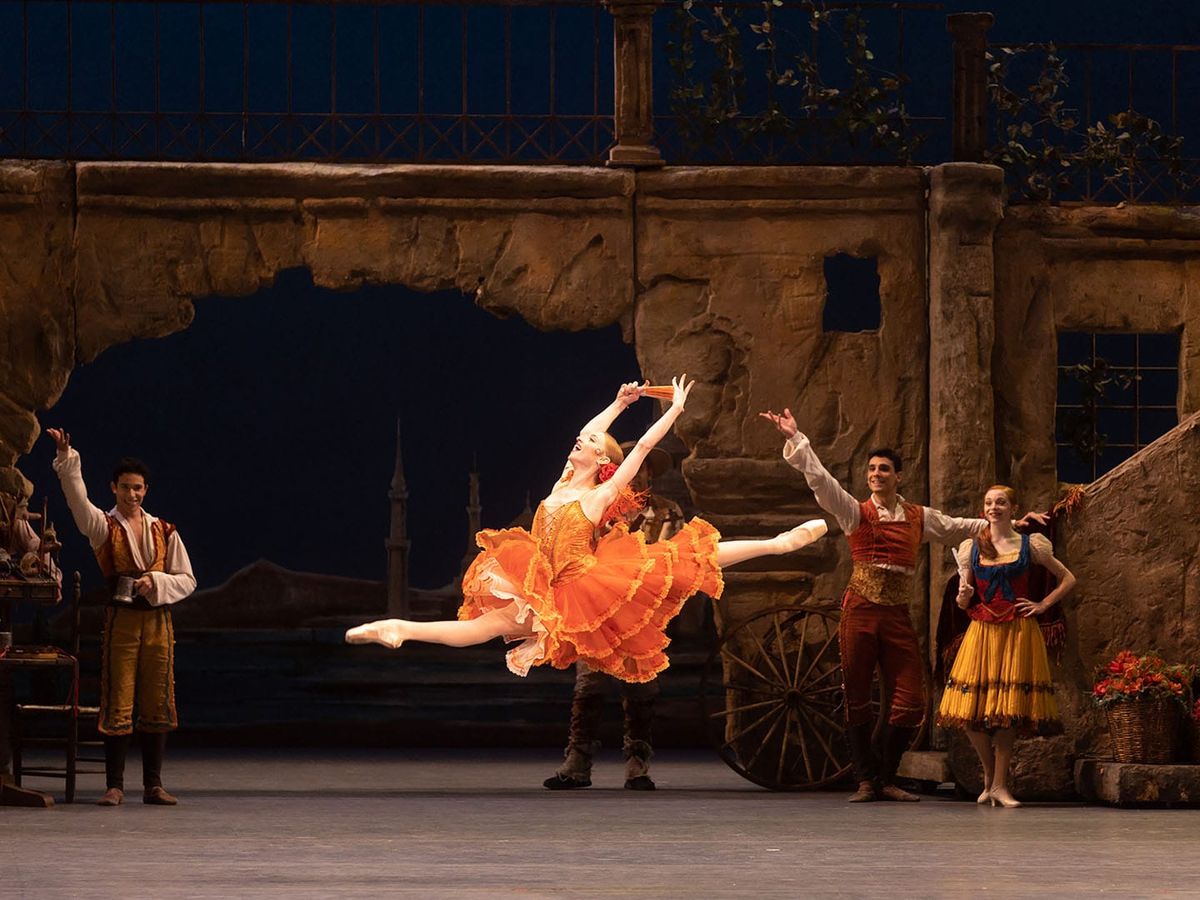
ABT’s newish version of “Don Quixote”, overseen by Director Susan Jaffe and regisseur Susan Jones, uses the lovely 1978 sets by Santo Loquasto and most of the costumes, though the corps’ charming character shoes have been replaced by point shoes which meant that the corps’ Spanish flair in Act III lost the dynamic contrast with the more formal point work. Though the men have kept their disheveled wigs, the Roma (formerly known as Gypsies) have colorful new purple and green outfits, which were apparently obtained from a second hand shop in Haight Ashbury. The major change is the conception of the eponymous Don, who, rather than being the peg on which the old comic trope of a poor young couple who defy a parent’s plan to marry the daughter to a rich man hangs, now has a more prominent role beginning and ending the ballet. As in the Russian versions, he is first seen in the prologue, reading a book and heading off to look for Dulcinea, and then showing up in Act I. Apparently he thinks that any female is his vision, and he is smitten with the flower girls, and eventually Kitri, diluting the idea that he mistook the ballet’s heroine for Dulcinea. He has a very active role in the sublime dream scene; rather than staying knocked out by the windmill, he gets up starts acting like the master of ceremonies, arranging the lovely formations and dancing along with the soloists. This disrupts the magical flow of the choreography and makes no choreographic sense—those vision scenes are little abstract ballets celebrating beauty; even the Prince in “The Sleeping Beauty” had the good manners to stand aside and just watch all those nymphs. The Don now closes the ballet, as a real live Dulcinea appears while the wedding party moved to the background. Encouraged by the little Cupid, he tottered after her; his intentions appeared to be somewhat less than chivalric.
In between the Don’s appearances, the audience saw a bravura ballet with some extraordinary dancing. Catherine Hurlin and Isaac Hernández were the happy couple. Hurlin danced with a creamy fluency and thrilling turns; her fouettés were immaculately fast singes and doubles with a great deal of fan action, and brought the house down. She was a determined Kitri, flirting with the locals get even with Basilio. She made her formal dance with the Don part of that, glancing over at Basilio standing with the flower girls as if to say “So there, I have another admirer”. I did miss the sweetness that some Kitris give to this moment, as they seem to pity the Don rather that just miming “He’s a crazy old man”. Shaking her tambourines at the top of her Act I lifts seemed a bit flashy; she is a dancer who does not need to advertise. Her solo in the vision scene had a luxurious confidence, soaring through the jumps, hopping on point across the stage, and ending with a flourish of turns.
Hernández was an engaging, lighthearted Basilio. He did take a spill coming off a difficult series of turns, but literally rolled with the punches and came up smiling. This production has added Baryshnikov’s so-called cup variation to the Act III tavern scene, where Basilio hurls himself through a menage of jumps and turns holding and pretending to drink from wine cups as he gets dizzier and dizzier, which Hernández delivered with a thrilling panache. He was a lively mime, relishing the fake suicide. It is a shame, though, that this production has kept the modern addition of Basilio grabbing Kitri’s breasts as he pretends to be dead, which shows a certain lack of decorum. The audience, it seems, is too sensitive to see the word “gypsy” in the program but is expected to laugh at a man copping a feel.
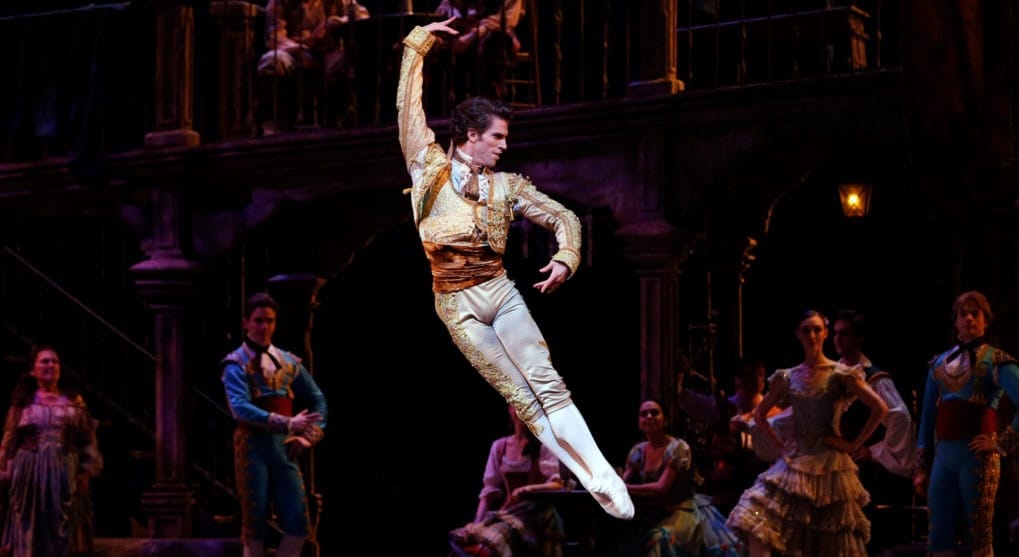
The bravura was further dialed up by a new solo for the Roma lad (Jake Roxander), with high, controlled, and magnificent jumps, showing off for his partner, the charismatic and seductive Zimmi Coker. James Whiteside as Espada added even more swaggering Spanish-inflected bravura—the ballet is a compendium of complicated jumps—and he swung a mean cape.
This production has reverted to the very sensible idea that Mercedes and the Queen of the Dryads are two different dancers; it always seemed a shame to merge them and reduce the opportunities for one of the company’s ultra-talented dancers. The tall, dark, and gorgeous Olivia Tweedy was a vibrant Mercedes, using her points like daggers. Sierra Armstrong was a majestic and warm Dryad Queen with an elegant upper body, her Italian fouettés were strong and confident, and her jumps were light and flowing.
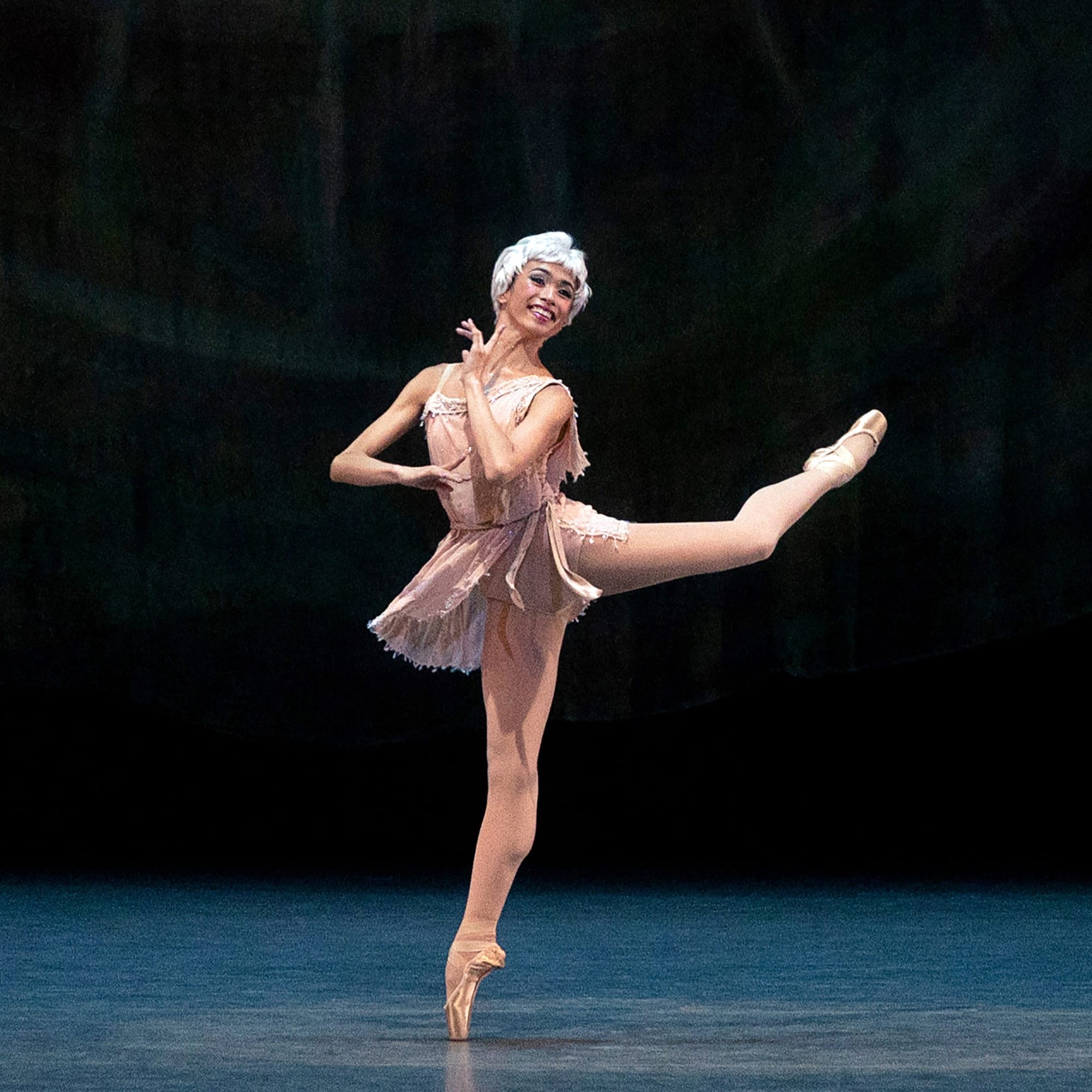
Léa Fleytoux was even more light and flowing as Amour, a perfect little Cupid with her white wig. Even with all the head nods and finger to chin movies, she had a pure and elegant style that kept her solo from Tinker-Bell cuteness; she is a gorgeous dancer. So too were the two flower girls, Fangqi Li and Sunmi Park, who danced their duets with a clear and joyful precision, mirroring each others moves. Their wedding solos were lovely, Li with her control and flying diagonal and Park with her expansive phrasing; they really looked like they were celebrating.
The mimed roles were given somewhat short shrift—much of the traditional back and forth between Gamache (Alexei Agoudine) and Don Quixote (Clinton Luckett) at the tavern has been eliminated; I did miss the politely confused Don and the extravagantly polite Gamache sharing their drinks with Kitri’s father (Roman Zhurbin). Agoudine was a broad Gamache, flouncing and mincing with exaggerated gestures; his slapstick was well-timed, though the tinge of humanity that some have given the pompous deluded fool was missing. The older mime scenes did create a setting for the more bravura elements, helping to link the dances to the narrative. This “Don Quixote” is a dance extravaganza, with the barest whiff of a story. Like the old Knight searching for his Dulcinea, I miss the lilt of the old narrative, but the wildly appreciative audience had a wonderful time.
© 2026 Mary Cargill