Kings and Peasants
"Kings of the Dance"
New York City Center
New York, NY
February 20, 2010
Men, men, and more men seems to be the mantra for ballet today, and the line-up presented by this
year's Kings--Jose Manuel Carreno, Guillaume Cote, Marcelo Gomes, David Hallberg, Joaquin De Luz, Denis Matvienko, Desmond Richardson, and Nikolay Tsiskaridze--could dance a phone book and pack in an audience. At times the choreography did take on a mind-numbing similarity; kings of choreography aren't as prevalent as kings of the dance. But the overall effect was both warm and thrilling. There seemed to be a real camaraderie and respect among the dancers, who gave every cliched step their all. The evening opened with a film showing rehearsals, with brief interviews of the dancers talking about the project. This is clearly a serious effort to create an ensemble, not a gala set of party tricks.
Christopher Wheeldon's "For 4", with Hallberg, Carreno, Gomes, and Tsiskaridze followed the film. It was a gentle exploration of Schubert music, with soft arms and an air of meditation, with no sense of virtuosity for its own sake. It was also too long, and often deliberately quirky, as if the choreographer was consciously trying for some sort of motif to give it a purpose.
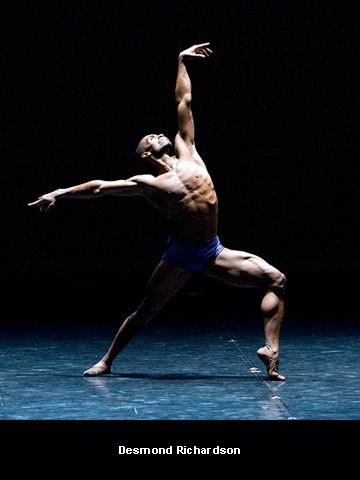
The second act was a series of solos, most, unfortunately, of the barechestedly energetic but ultimately hopeless struggle-against-fate variety. Desmond Richardson's struggle ("Lament" by Dwight Rhoden) was the most impressive, as this ageless dancer had complete control of the audience. Carreno's was impressive in its own way, as this magnificently dignified dancer managed to make Igal Perry's roll on the floor choreography to Schubert's "Ave Maria" moving, while wearing white pedal pushers. Not surprisingly, the best pieces were the older ones, Matvienko danced Leonid Jakobson's "Vestris", originally choreographed for Baryshnikov. It is a series of comic vignettes, partly mimed and partly with explosive choreography, evoking the personas Vestris might have danced. The era was old, but the choreography wasn't merely pastiche, it was an old idea reinterpreted with modern virtuosity; it was also charming and witty.
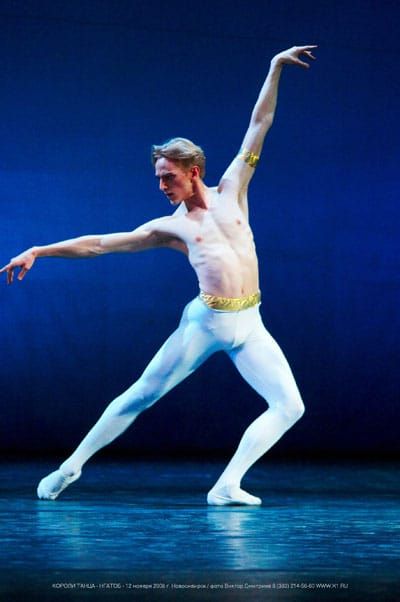
The best work on the program was Hallberg's dancing in Sir Frederick Ashton's "Dance of the Blessed Spirits" to Gluck's serene and lyrical music. Ashton choreographed it in 1978 for Antony Dowell, and Hallberg is the first person after Dowell to dance it. It is a logical succession, since Hallberg shares many of Dowell's gifts. Blond good looks, of course, but also they both have a cool precision combined with inner granite. The choreography nods to Orpheus' fateful search, giving it a hint of drama, and the elegant and subtle upper body shadings made Hallberg look like a marble statue come to life.
The final act from Nacho Duato's "Remanso" originally choreographed for ABT and featured Vladimir Malakhov wearing hot pants. It involves a wall and a rose, and three men posing; the night I saw it Tsiskaridze, Matvienko, and Gomes did the honors. It was light-hearted and harmless, but ultimately long and repetitive, but the dancers seemed to enjoy it as much as the audience. The grand finale, basically "Etudes" on steroids, featured all the dancers whipping around the stage, jumping and turning. the audience demanded, and got, an encore. The kings deserved all their cheers; it was just a shame that so many peasants contributed the choreography.
copyright © 2010 by Mary Cargill



